













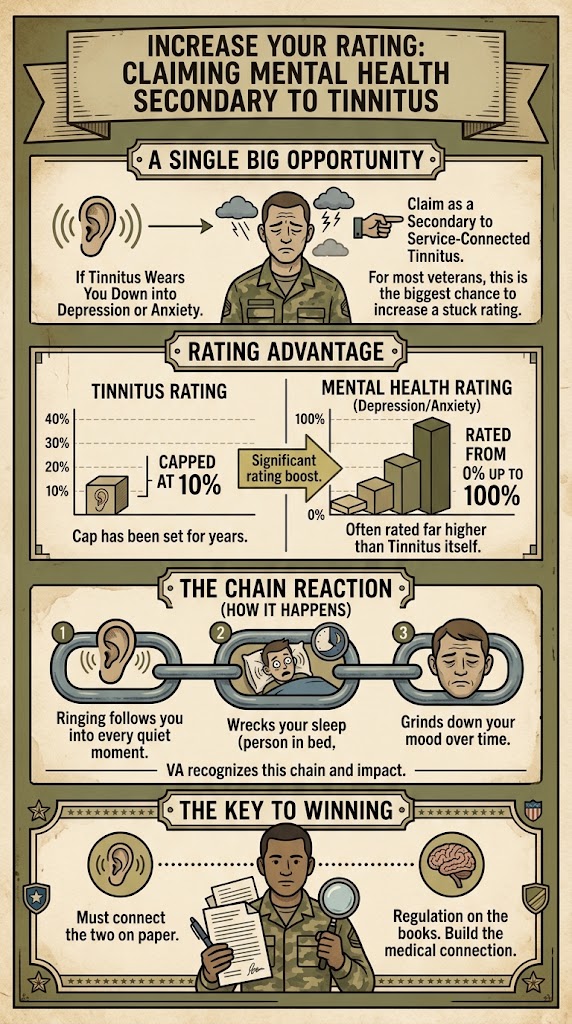
If tinnitus has worn you down into depression or anxiety, you can claim that mental health condition as a secondary to your service-connected tinnitus, and it can be rated far higher than the tinnitus itself. Tinnitus is capped at 10%. Depression and anxiety are rated from 0% up to 100%. For most veterans, this is the single biggest opportunity to increase a rating that’s been stuck for years.
The ringing doesn’t just annoy you. It follows you into every quiet moment, wrecks your sleep, and grinds down your mood over time. The VA recognizes that chain, and the regulation that lets you claim it has been on the books for years. You just have to connect the two on paper.
Here’s how the rating works, what the VA needs to grant it, and the one sentence that decides most of these claims.
Key Takeaways
- Tinnitus maxes out at 10%. It’s rated under 38 CFR § 4.87, Diagnostic Code 6260, at a flat 10% — no higher rating exists in the schedule, even if the ringing is constant.
- Depression and anxiety are rated 0% to 100% under the General Rating Formula for Mental Disorders in 38 CFR § 4.130, based on how much your symptoms impair your work and social life.
- You can claim a mental health condition as secondary to tinnitus under 38 CFR § 3.310. That’s because it’s caused or aggravated by your service-connected tinnitus.
- The claim turns on a nexus: a doctor’s opinion that your depression or anxiety is “at least as likely as not” caused or worsened by the tinnitus. That phrase signals a 50% or greater probability—the VA’s threshold to grant.
- You need tinnitus already service-connected first. If it isn’t, claim the tinnitus before or alongside the mental health condition.
Why Tinnitus Caps at 10%
Tinnitus is one of the most common service-connected disabilities in the VA system, and nearly every veteran who has it is rated at 10%. That’s not a lowball—10% is the ceiling under 38 CFR § 4.87, Diagnostic Code 6260. Whether the ringing is faint or relentless, the schedule stops at 10%.
That ceiling is exactly why secondary conditions matter so much here. If the tinnitus has real downstream effects on your life, and for many veterans it does, the way to be compensated for those effects is to claim them as their own conditions. Depression and anxiety are the most common, because the link between chronic ringing and a worn-down mood is well documented.
How the VA Rates Depression and Anxiety
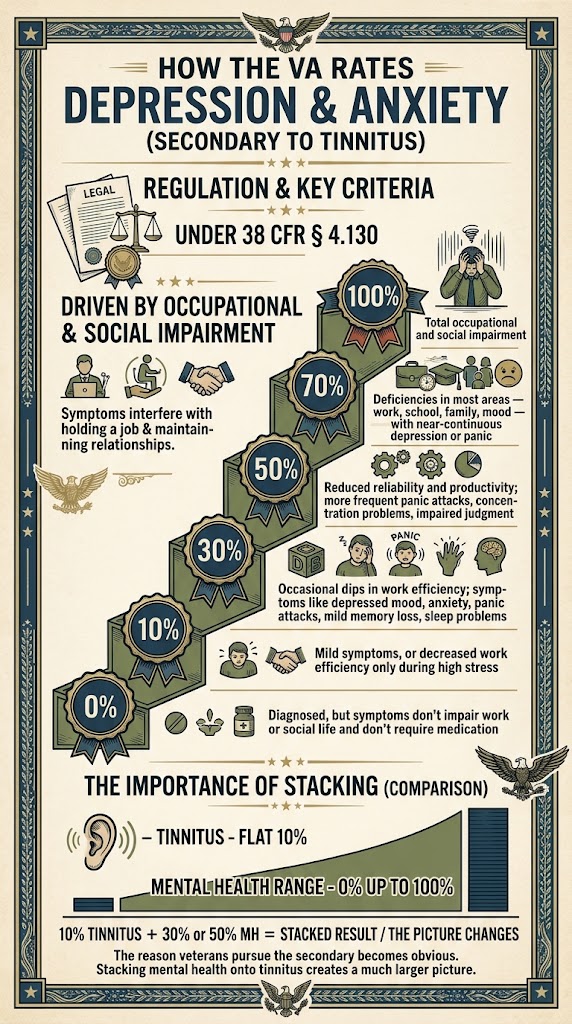
Mental health conditions are rated under one formula in 38 CFR § 4.130, and the number is driven by “occupational and social impairment,” which refers to how much your symptoms interfere with holding a job and maintaining relationships. The tiers:
| Rating | What it reflects |
| 0% | Diagnosed, but symptoms don’t impair work or social life and don’t require medication |
| 10% | Mild symptoms, or decreased work efficiency only during high stress |
| 30% | Occasional dips in work efficiency; symptoms like depressed mood, anxiety, panic attacks, mild memory loss, sleep problems |
| 50% | Reduced reliability and productivity; more frequent panic attacks, concentration problems, impaired judgment |
| 70% | Deficiencies in most areas — work, school, family, mood — with near-continuous depression or panic |
| 100% | Total occupational and social impairment |
Compare that range to tinnitus at a flat 10%, and the reason veterans pursue the secondary becomes obvious. A 30% or 50% mental health rating stacked onto a 10% tinnitus rating changes the picture.
The Rule That Makes It Possible: Secondary Service Connection
A secondary condition is any disability caused or aggravated by a condition you’re already service-connected for. It’s spelled out in 38 CFR § 3.310: if your depression is “proximately due to” your service-connected tinnitus, the depression gets service-connected too.
To win it, you need three things:
- A current diagnosis of the depression or anxiety, in your medical records.
- Tinnitus already service-connected. Without it, there’s nothing for the mental health condition to be secondary to.
- A medical nexus linking the two.
The first two are usually straightforward. The nexus is where the claim is won or lost.
The One Sentence That Decides the Claim
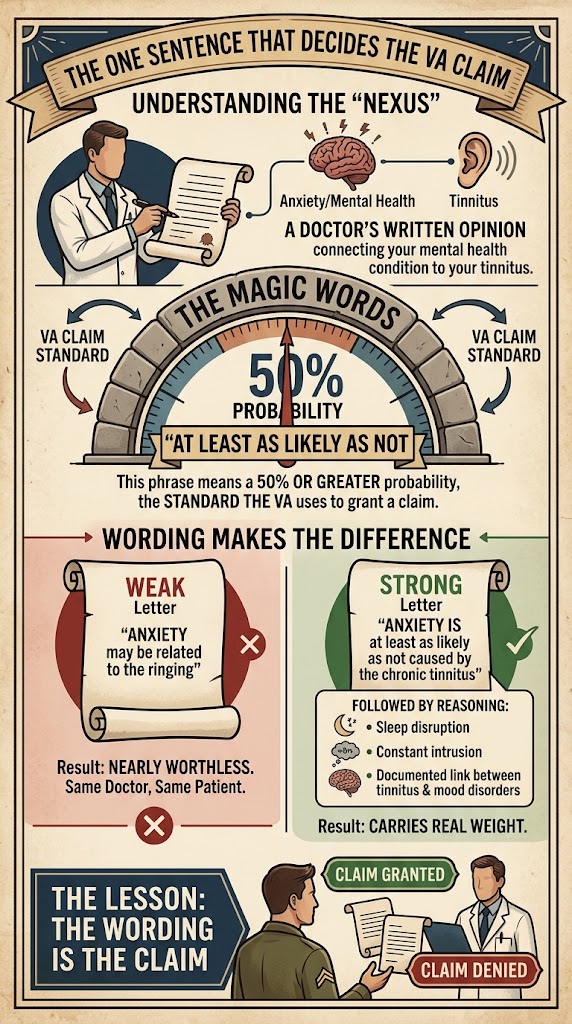
A nexus is a doctor’s written opinion connecting your mental health condition to your tinnitus. The magic words are “at least as likely as not.” That phrase means a 50% or greater probability, which is exactly the standard the VA uses to grant a claim.
A letter that says your anxiety “may be related to” the ringing is nearly worthless. A letter that says your anxiety is “at least as likely as not caused by the chronic tinnitus,” followed by a sentence or two of reasoning (the sleep disruption, the constant intrusion, the documented link between persistent tinnitus and mood disorders) carries real weight. Same doctor, same patient, completely different outcome. The wording is the claim.
A Brief Example: Turning a 10% Ceiling Into a Real Rating
The following is an anonymized composite based on common claim patterns. Names and details have been removed.
A veteran we’ll call Ray had a 10% tinnitus rating from his time on a flight line. Eight years later it was still 10%, and he assumed nothing could change that. What his file didn’t show: he’d stopped sleeping through the night years ago, had pulled away from friends, and had been quietly diagnosed with depression by his primary care doctor.
What his record showed, and what was missing:
“Tinnitus — 10% (Diagnostic Code 6260).” Translation: The VA rated the ringing at its maximum. That’s the entire entry. Nothing about the depression the ringing helped cause.
Ray asked his doctor for a nexus letter. The doctor wrote that Ray’s depression was “at least as likely as not caused and aggravated by his service-connected tinnitus,” noting the years of sleep disruption and social withdrawal tied directly to the constant noise. The VA granted the depression as a secondary under § 3.310 and rated it at 50% based on his occupational and social impairment.
His tinnitus was still 10%. But the depression that had been sitting unclaimed in his medical file for years was now on the record, and it moved his combined rating in a way the tinnitus alone never could. The lesson: the ceiling was on the tinnitus, not on the effects it caused.
What to Do This Week
- Confirm your tinnitus is service-connected. Check your rating decision. If it isn’t yet, file for the tinnitus first or at the same time.
- Get the mental health diagnosis on record. See your VA or private provider and make sure depression or anxiety is documented.
- Connect the dots for your doctor. Explain how the ringing affects your sleep, mood, and relationships — that’s the raw material for a strong nexus.
- Ask for a nexus letter using the words “at least as likely as not caused or aggravated by” your service-connected tinnitus, with a short reason why.
- File the secondary claim, or a Supplemental Claim if a prior mental health claim was denied for a weak nexus. File within a year of any prior decision to protect your effective date.
Frequently Asked Questions
Q: Can I really get a higher rating for depression than for tinnitus?
A: Yes. Tinnitus is capped at 10% under Diagnostic Code 6260. Depression and anxiety are rated from 0% to 100% under 38 CFR § 4.130, based on how much they impair your work and social life. That’s why claiming the mental health condition as a secondary is the main path to additional compensation once you have tinnitus service-connected.
Q: Do I need my tinnitus service-connected before I claim depression secondary to it?
A: Yes. A secondary claim requires an already service-connected primary condition. If your tinnitus isn’t service-connected yet, file for it first or file both together. Without the tinnitus anchor, there’s nothing for the mental health condition to attach to.
Q: What evidence do I need for depression or anxiety secondary to tinnitus?
A: Three things: a current diagnosis of the mental health condition, your service-connected tinnitus, and a medical nexus opinion stating the depression or anxiety is “at least as likely as not” caused or aggravated by the tinnitus. The nexus opinion is the piece most claims hinge on.
Q: Is claiming depression secondary to tinnitus considered pyramiding?
A: No. Pyramiding under 38 CFR § 4.14 only prohibits rating the same symptom twice. Tinnitus (an auditory condition) and depression (a mental health condition) are distinct, so each is rated on its own.
Q: What if my depression claim was already denied?
A: If it was denied for a weak or missing nexus, a Supplemental Claim with a stronger medical opinion is often the fix. File within one year of the decision to preserve your original effective date.
Q: Can anxiety and depression be rated separately from each other?
A: Generally no. The VA rates mental health conditions together under a single evaluation using the General Rating Formula, rather than assigning separate percentages for each diagnosis.
 AllVeteran.com Advisors
With expertise spanning local, state, and federal benefit programs, our team is dedicated to guiding individuals towards the perfect program tailored to their unique circumstances.