













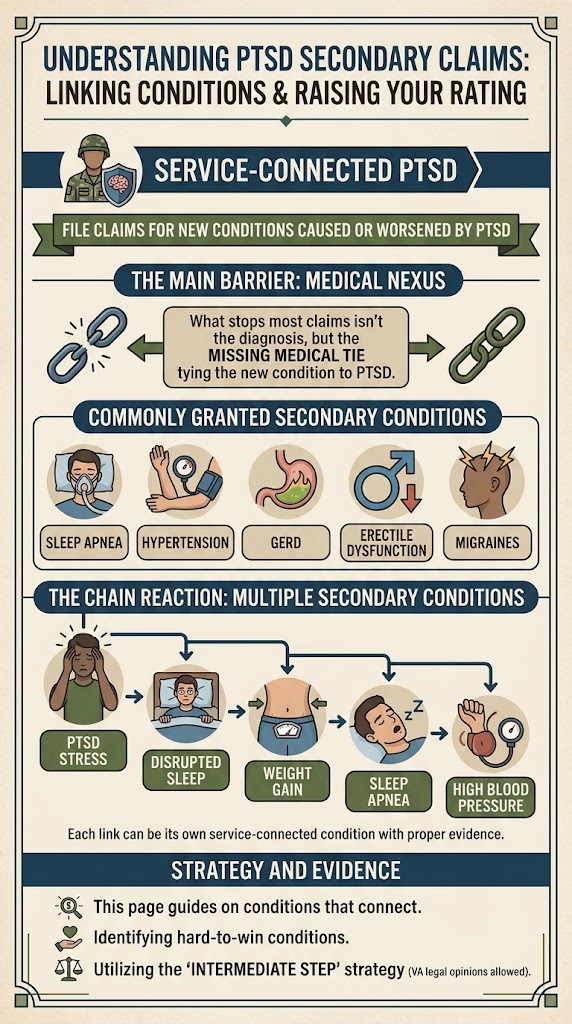
If your PTSD is already service-connected, you can file secondary claims for the physical and mental conditions it caused or made worse, and each one can raise your combined rating. The most commonly granted are sleep apnea, hypertension, GERD, erectile dysfunction, and migraines. What stops most of these claims isn’t the diagnosis; it’s the missing medical nexus tying the new condition back to your PTSD.
Here’s the part veterans leave on the table: PTSD rarely causes just one downstream problem. It tends to set off a chain. The stress disrupts your sleep and drives weight gain, the weight gain feeds sleep apnea, the sleep apnea pushes your blood pressure up. Each link in that chain can be its own service-connected condition if you build the evidence for it. This page walks through which conditions connect, which are hard to win, and the “intermediate step” strategy the VA’s own legal opinions allow.
Key Takeaways
- If PTSD is service-connected, any condition proximately caused or aggravated by it can be service-connected too, under 38 CFR § 3.310.
- The most-filed and most-granted PTSD secondary is obstructive sleep apnea, rated 0%, 30%, 50%, or 100% under 38 CFR § 4.97, DC 6847. A CPAP prescription currently rates 50%.
- Erectile dysfunction secondary to PTSD usually rates 0% under DC 7522 but qualifies you for Special Monthly Compensation (SMC-K) — extra tax-free cash on top of your other pay.
- A VA General Counsel opinion (VAOPGCPREC 1-2017) lets obesity act as an “intermediate step” between PTSD and a condition like hypertension or sleep apnea. This is the key that unlocks the harder claims.
- Every secondary claim turns on the nexus: a medical opinion that the condition is “at least as likely as not” caused or aggravated by your PTSD. No nexus, no grant.
What Counts as “Secondary” to PTSD?
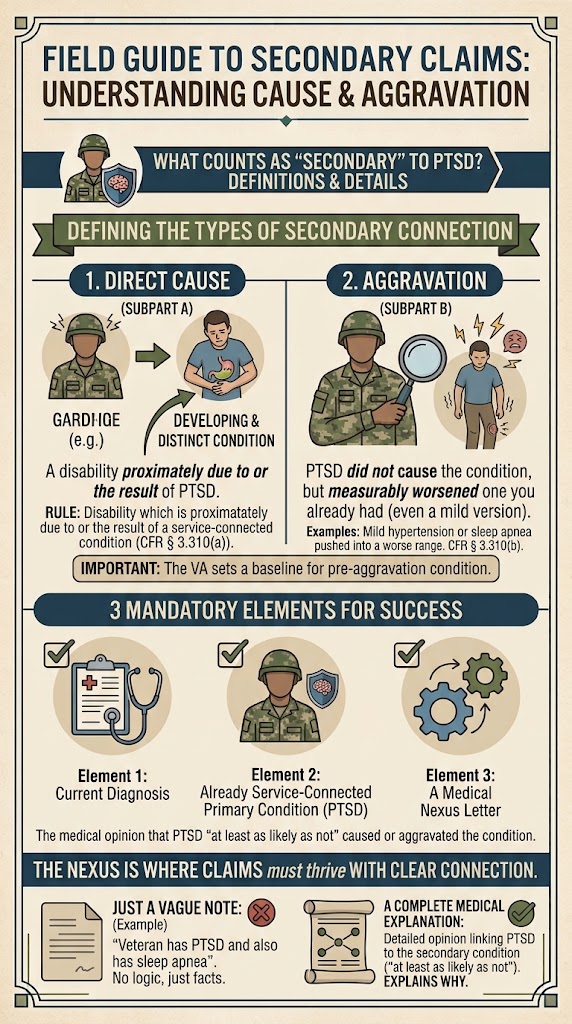
A secondary condition is a disability that wouldn’t be service-connected on its own, but gets connected because a condition that is service-connected caused or exacerbated it. The rule is short: under 38 CFR § 3.310(a), “disability which is proximately due to or the result of a service-connected disease or injury shall be service connected.”
Subsection (b) covers the other half: aggravation. If your PTSD didn’t cause a condition but measurably worsened one you already had, the amount of worsening is service-connected. The VA sets a “baseline” for how bad the condition was before the aggravation and pays you for everything above that line. This matters for hypertension and sleep apnea, where you may have had a mild version that PTSD pushed into a worse range.
Three things have to be true for any secondary claim to win:
- A current diagnosis of the secondary condition.
- An already service-connected primary condition (here, PTSD).
- A medical nexus linking the two: the opinion that PTSD “at least as likely as not” caused or aggravated the condition.
Element three is where claims die. A letter that says “the veteran has PTSD and also has sleep apnea” is not a nexus. A nexus explains why the two connect.
Most Commonly Claimed Conditions Secondary to PTSD
Not every PTSD secondary is equally winnable. The strength of each comes down to how clean the medical pathway is.
Obstructive sleep apnea. This is the big one, both the most filed and one of the most granted. PTSD fragments sleep, raises nighttime arousal, and contributes to the weight gain that drives airway collapse. The connection is supported by multiple peer-reviewed studies. Two hard requirements: you need a sleep study (polysomnography) confirming the diagnosis, and you need a nexus that names the mechanism rather than just noting you have both. Sleep apnea rates under 38 CFR § 4.97, DC 6847:
| Rating | Criteria (Diagnostic Code 6847) |
| 100% | Chronic respiratory failure with carbon dioxide retention or cor pulmonale, or requires a tracheostomy. |
| 50% | Requires use of a breathing assistance device such as a CPAP machine. |
| 30% | Persistent daytime hypersomnolence (excessive daytime sleepiness). |
| 0% | Asymptomatic but with documented sleep disorder breathing. |
Note that a prescribed CPAP rates 50%, whether or not you tolerate the machine. (The VA proposed changing these criteria in 2022 and again in 2024, but as of 2026 those remain proposals. The CPAP-equals-50% rule still applies.)
Hypertension. PTSD keeps the body’s stress system switched on. Chronic activation of the HPA axis and sympathetic nervous system raises cortisol and adrenaline, which constrict blood vessels and push blood pressure up. Research has found PTSD to be an independent predictor of hypertension. That said, this is a harder claim than sleep apnea. VA examiners often concede the association but balk at direct causation. Two ways to strengthen it: lean on the aggravation theory (PTSD worsened blood pressure you already had), or use the intermediate-step chain below.
GERD. Chronic stress increases gastric acid and weakens the valve that keeps acid down, so reflux is a recognized PTSD secondary. If you’re filing this one, we have a companion guide to GERD secondary claims that covers the 2024 rating change in detail.
Erectile dysfunction. ED connects to PTSD through three routes: the psychological effects of the condition, the strain it puts on relationships, and the SSRIs and other medications prescribed to treat it. ED rates 0% under 38 CFR § 4.115b, DC 7522, but don’t let the 0% fool you. A grant qualifies you for Special Monthly Compensation under SMC-K for loss of use of a reproductive organ, a fixed tax-free amount (roughly $140 a month for 2026) paid on top of your other compensation. It’s one of the most overlooked dollars in the system.
Migraines and headaches. PTSD and chronic headaches travel together, and migraines rate up to 50% under DC 8100 based on how often you get “prostrating” attacks. The evidence that wins here is a documented headache log, not just a diagnosis.
Gastrointestinal conditions, including IBS. The gut-brain connection makes IBS and similar conditions claimable secondary to PTSD, though the nexus has to be specific.
A quick honesty check on substance use: alcohol or drug problems that genuinely arose from self-medicating PTSD can be claimable, but this area is legally thornier because of rules around willful misconduct. Get a representative involved before you file it.
The Strategy Most Veterans Miss
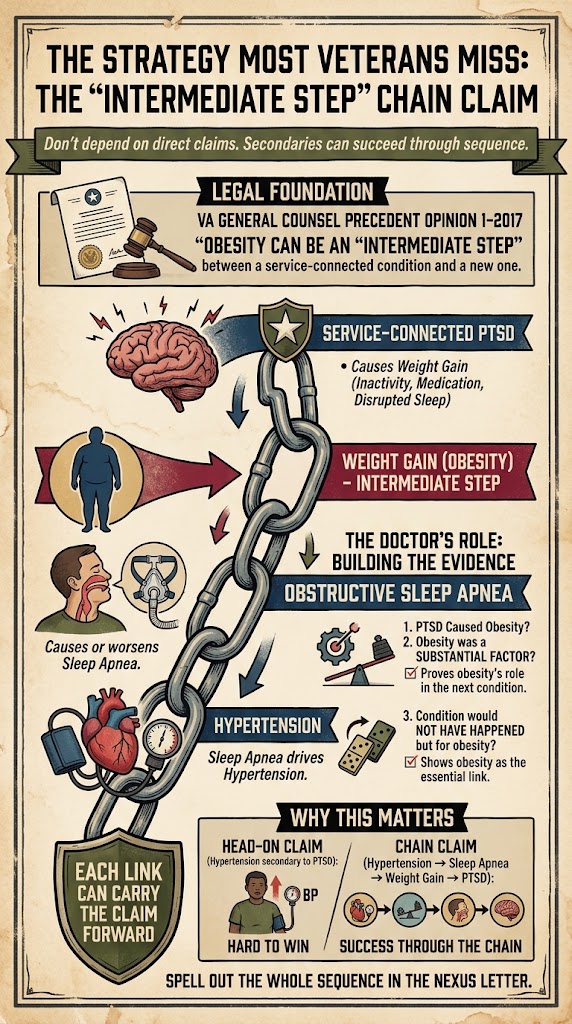
This is the part that separates a flat claim from a winning one. PTSD secondaries don’t have to be direct. The VA’s own General Counsel has held, in Precedent Opinion 1-2017, that obesity can be an “intermediate step” between a service-connected condition and a new one.
Here’s the chain in practice. PTSD causes weight gain (through inactivity, medication, and disrupted sleep). The weight gain causes or worsens obstructive sleep apnea. The sleep apnea drives hypertension. Under the 2017 opinion, each link can carry the claim forward, as long as a doctor connects every step: did the PTSD cause the obesity, was the obesity a substantial factor in the next condition, and would that condition not have happened but for the obesity.
Why this matters: hypertension secondary to PTSD is hard to win as a direct claim. But hypertension secondary to sleep apnea, with sleep apnea secondary to PTSD-driven weight gain, is a chain the VA’s own rules recognize. The nexus letter has to spell out the whole sequence, but when it does, claims that fail head-on can succeed through the chain.
A Brief Example
The following is an anonymized, representative example drawn from how these claims typically move. Names and identifying details removed.
A veteran we’ll call Matt had service-connected PTSD at 70%. He’d been on a CPAP for two years and filed sleep apnea as secondary to PTSD. His evidence was a one-line note from his primary care doctor: “Patient has PTSD and sleep apnea, likely connected.”
It came back denied. The C&P examiner wrote that the sleep apnea was “more likely due to the veteran’s obesity than to his service-connected PTSD,” and that the submitted opinion was “conclusory” with no supporting rationale.
Read that denial closely, because it’s the most common one in this whole category. The examiner didn’t dispute the sleep apnea or the CPAP. The examiner pointed at obesity as an alternative cause and dismissed the nexus for having no reasoning.
That denial is actually a roadmap. On the supplemental claim, Matt’s representative used the obesity finding for him instead of against him. A sleep physician wrote an opinion walking the full chain: Matt’s PTSD caused significant weight gain through medication and inactivity, that weight gain was a substantial factor in his obstructive sleep apnea, and the sleep apnea would not have developed as it did but for the PTSD-driven obesity. That is exactly the analysis VAOPGCPREC 1-2017 lays out. Granted at 50% for the CPAP.
He didn’t stop there. The SSRIs he took for PTSD had caused erectile dysfunction. He filed ED secondary to PTSD, documented through his medication records. It came back at 0%, and with SMC-K attached, adding tax-free money to his monthly check.
The pattern repeats across PTSD secondaries: the first denial almost never disputes that you have the condition. It disputes whether a doctor explained the connection, and it often hands you the alternative cause you then have to work through rather than around.
How To Read Your Denial Letter
PTSD secondary denials use a handful of recurring phrases. Each one tells you what to fix:
- “No nexus / link not established.” You proved the diagnosis but not the connection. Fix: a nexus letter that names the biological mechanism.
- “Opinion is speculative / conclusory.” Your nexus just asserted a link with no reasoning. Fix: a stronger opinion with medical rationale, ideally from a relevant specialist.
- “Condition is due to [alternative cause], not PTSD.” The examiner blamed obesity, age, or another factor. Fix: address that factor head-on, and where it’s obesity, use the intermediate-step chain to fold it back into the PTSD.
- “No baseline established” (on aggravation claims). The VA couldn’t tell how severe the condition was before PTSD worsened it. Fix: find the earliest records showing the pre-aggravation level, as § 3.310(b) requires.
You generally have one year from the decision to file a Supplemental Claim with new evidence, request a Higher-Level Review, or appeal to the Board. For a denial that turned on a weak or “conclusory” nexus, a Supplemental Claim with a proper medical opinion is usually the most direct path.
Frequently Asked Questions
Q: What is the most common secondary condition to PTSD?
A: Obstructive sleep apnea. It’s both the most-filed and one of the most-granted PTSD secondaries, because the medical link is well documented. You need a sleep study confirming the diagnosis and a nexus opinion connecting it to your PTSD.
Q: Can hypertension be secondary to PTSD?
A: Yes, though it’s harder to win directly. PTSD keeps the body’s stress response elevated, which raises blood pressure over time. If a direct claim is denied, an “intermediate step” chain (such a PTSD to weight gain to sleep apnea to hypertension) often succeeds because it tracks the VA’s own General Counsel opinion.
Q: Does a 0% secondary rating do anything?
A: Sometimes a lot. Erectile dysfunction secondary to PTSD usually rates 0%, but it qualifies you for Special Monthly Compensation (SMC-K), a fixed tax-free payment added on top of your other compensation. Service connection, not the percentage, is what unlocks it.
Q: Do I need a nexus letter for a PTSD secondary claim?
A: Nexus letters aren’t legally required, but these claims are denied constantly for lack of one. A medical opinion that explains why the conditions connect, not just that you have both, is the single biggest factor in winning.
Q: How does the VA rate sleep apnea secondary to PTSD in 2026?
A: Under 38 CFR § 4.97, DC 6847, at 0%, 30%, 50%, or 100%. A prescribed CPAP machine rates 50%. The VA has proposed changing these criteria, but as of 2026 the proposals are not final and the current rules still apply.
Q: Can PTSD medications cause a secondary condition?
A: Yes. Side effects of PTSD medications, most commonly erectile dysfunction and weight gain, can themselves form the basis of a secondary claim. Your pharmacy and prescribing records are key evidence.
 AllVeteran.com Advisors
With expertise spanning local, state, and federal benefit programs, our team is dedicated to guiding individuals towards the perfect program tailored to their unique circumstances.