













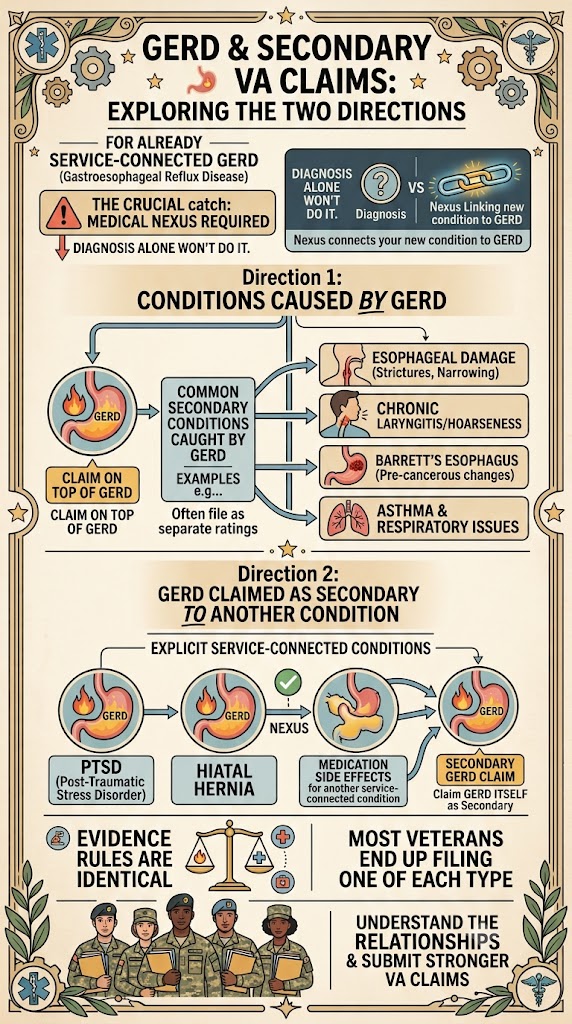
If your GERD is already service-connected, you can file secondary claims for the conditions it caused or made worse. The catch is the same one that sinks most secondary claims: you need a medical nexus tying the new condition back to your GERD. A diagnosis alone won’t do it.
This works in both directions, and that trips people up. “Secondary conditions to GERD” can mean conditions your GERD caused (you claim those on top of your GERD rating), or it can mean GERD itself claimed as secondary to something else, usually PTSD, a hiatal hernia, or a medication you take for another service-connected condition. We’ll cover both, because the evidence rules are identical and most veterans end up filing one of each.
Key Takeaways
- If GERD is service-connected, any condition proximately caused or aggravated by it can be service-connected too, under 38 CFR § 3.310.
- The strongest GERD secondaries are the ones with a clear medical pathway: dental acid erosion, chronic laryngitis/LPR, esophagitis, Barrett’s esophagus, and esophageal stricture.
- Since May 19, 2024, GERD is rated under its own code, Diagnostic Code 7206, on esophageal-stricture criteria (10%, 30%, 50%, or 80%) per the VA’s 2024 digestive system final rule. Many veterans without documented stricture now sit at 0%, which changes the secondary-claim math.
- Going the other way, GERD secondary to PTSD is one of the most-filed secondary claims because chronic stress drives acid production and weakens the lower esophageal sphincter.
- Every secondary claim lives or dies on the nexus: a medical opinion that your condition is “at least as likely as not” caused or worsened by the service-connected one. No nexus, no grant.
What “Secondary to GERD” Actually Means
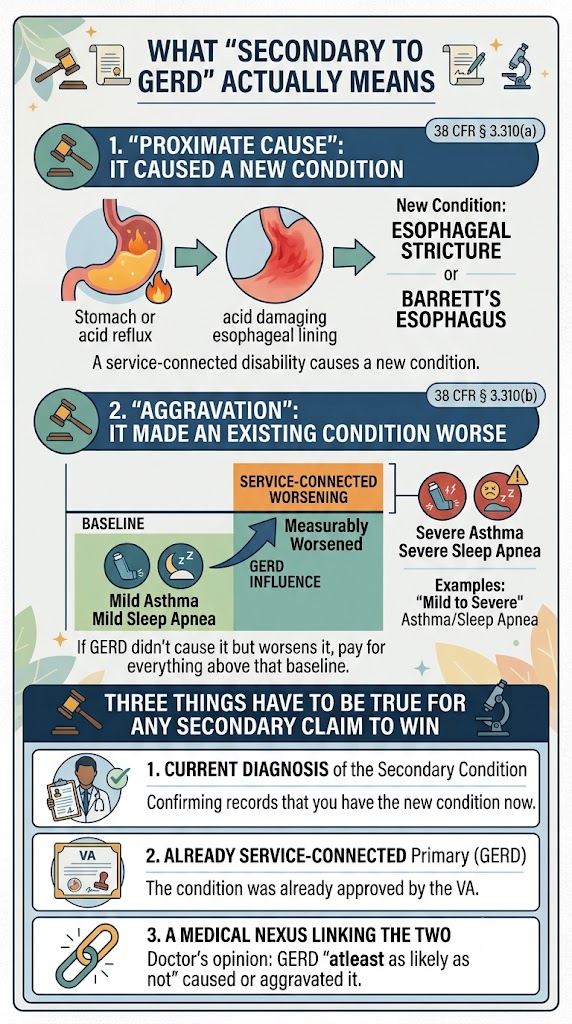
A secondary condition is a disability that wouldn’t be service-connected on its own, but gets connected because a condition that is service-connected caused it or made it worse. The regulation is short and worth reading once: under 38 CFR § 3.310(a), “disability which is proximately due to or the result of a service-connected disease or injury shall be service connected.”
Subsection (b) covers the other half: aggravation. If your GERD didn’t cause a condition but measurably worsened one you already had, the amount of worsening is service-connected. The VA establishes a “baseline” level of the condition before the aggravation and pays you for everything above that baseline. This matters for things like sleep apnea or asthma, where you might have had a mild version that GERD pushed into a more severe range.
Three things have to be true for any secondary claim to win:
- A current diagnosis of the secondary condition.
- An already service-connected primary condition (here, GERD).
- A medical nexus linking the two: the opinion that the GERD “at least as likely as not” caused or aggravated the new condition.
Strongest Conditions to Claim Secondary to GERD
Not every GERD secondary is equally winnable. The ones below have a recognized medical mechanism, which makes the nexus easier for a doctor to write and harder for the VA to dispute.
Dental conditions, erosion of tooth enamel. Chronic acid reflux bathes the back of your teeth in stomach acid, and over time it dissolves enamel. This is one of the cleaner GERD secondaries because the cause is mechanical and visible. A dentist can document the erosion pattern that acid produces.
Chronic laryngitis and laryngopharyngeal reflux (LPR). When reflux travels past the esophagus into the throat and voice box, it causes hoarseness, chronic throat clearing, and a persistent cough. The VA rates chronic laryngitis under its own diagnostic code, so a granted claim here adds a separate rating rather than folding into your GERD percentage.
Esophagitis, Barrett’s esophagus, and esophageal stricture. These are the direct downstream damage of long-term reflux. Barrett’s, where the esophageal lining changes in response to repeated acid exposure, is medically tied to GERD in the literature, which makes the nexus straightforward. Note that with the 2024 rating change, esophageal stricture is now baked into how GERD itself is rated, so talk to a representative about whether a finding is better claimed separately or used to raise your GERD evaluation.
Sleep apnea. This one is filed constantly and therefore harder to win. The medical theory is real (nighttime reflux disrupts breathing and the two conditions feed each other), but the relationship is bidirectional and the VA knows it. A bare “the veteran has both” letter loses. A nexus that explains the specific mechanism, ideally from a sleep or ENT specialist, is what moves these.
Aspiration and respiratory irritation. When reflux reaches the airway it can trigger bronchospasm, aggravate asthma, or in serious cases cause aspiration. Aggravation claims are common here: GERD didn’t give you asthma, but it made the asthma worse.
A quick honesty check: anxiety and depression are sometimes pitched as secondary to GERD. That’s a tougher sell directionally, because the VA more readily accepts GERD as secondary to a mental health condition than the reverse. If chronic GERD is genuinely fueling depression or anxiety, it’s claimable, but expect closer scrutiny and lean hard on the treatment record.
Going the Other Direction: GERD Secondary to PTSD, Hernias, and Medications
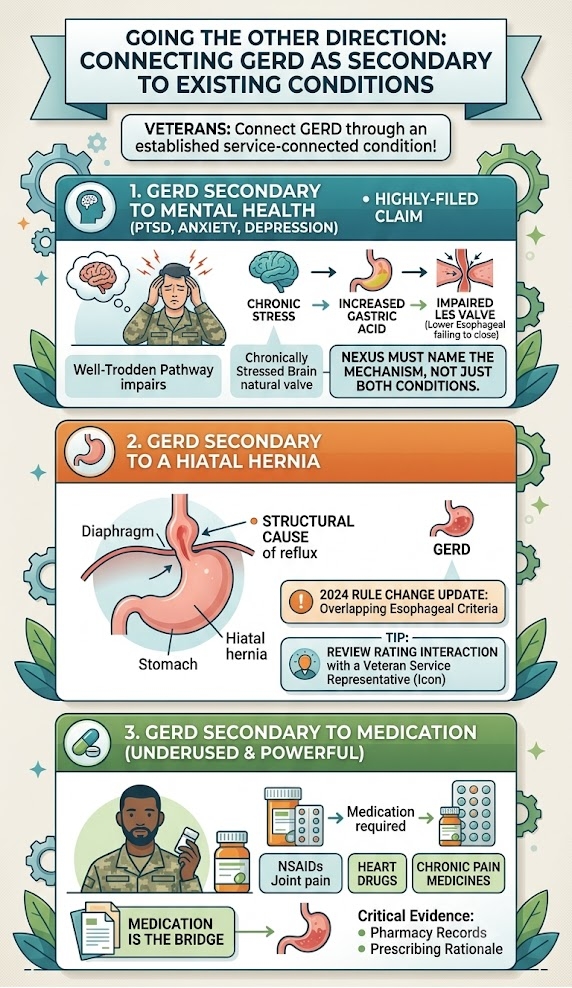
Plenty of veterans don’t have GERD service-connected yet and need to connect it through something that already is. The big three:
GERD secondary to PTSD (or anxiety/depression). Chronic stress increases gastric acid production and impairs the lower esophageal sphincter, the valve that’s supposed to keep acid down. That’s a well-trodden pathway, which is why this is one of the most-filed secondary claims in the system. The nexus has to name the mechanism, not just note that you have both conditions.
GERD secondary to a hiatal hernia. If a service-connected hiatal hernia is the structural cause of your reflux, GERD connects cleanly. Since the 2024 rule change, hiatal hernia and GERD are evaluated on overlapping esophageal criteria, so the rating interaction is worth reviewing with a representative.
GERD secondary to medication. This is underused and powerful. NSAIDs taken for a service-connected musculoskeletal condition, or certain medications for heart conditions and chronic pain, are known to cause or worsen reflux. If a service-connected disability put you on a drug that gave you GERD, the medication is the bridge. Make sure your pharmacy records and the prescribing rationale are in the file.
How GERD is Rated Now
Here’s the part most older articles get wrong. Before May 2024, GERD was rated by analogy to hiatal hernia. As of May 19, 2024, the VA gave GERD its own diagnostic code, 7206, and rates it on esophageal-stricture criteria from 38 CFR § 4.114:
| Rating | Criteria (Diagnostic Code 7206) |
| 80% | Documented history of recurrent or refractory esophageal stricture causing dysphagia, with at least one of: aspiration, undernutrition, or substantial weight loss — and treated with surgical correction or a PEG tube. |
| 50% | Recurrent or refractory stricture causing dysphagia requiring dilatation 3+ times per year, dilatation using steroids at least once per year, or esophageal stent placement. |
| 30% | Recurrent stricture causing dysphagia requiring dilatation no more than 2 times per year. |
| 10% | Stricture requiring daily medication to control dysphagia, otherwise asymptomatic. |
| 0% | GERD that doesn’t meet the stricture criteria above (noncompensable). |
Read that table and the problem jumps out: the new criteria reward stricture and dilatation, not the daily heartburn-and-PPI reality most veterans live with. A lot of people whose GERD would have rated 10% or 30% under the old hiatal-hernia analogy now land at 0% because they don’t have a documented stricture.
That’s exactly why the secondary strategy matters. If your GERD itself is stuck at 0%, the conditions it caused (dental erosion, chronic laryngitis, aspiration issues) can each carry their own compensable rating. The damage GERD does downstream may be worth more than the GERD code itself.
One more wrinkle: if your claim was pending before May 19, 2024, the VA can evaluate it under the prior criteria for the period they were in effect and assign staged ratings. Don’t assume the new code is automatically better for you. Have a representative compare.
A Brief Example
The following is an anonymized, representative example drawn from how these claims typically move—names and identifying details have been changed or removed.
A veteran we’ll call Robert had service-connected PTSD rated at 50% and had been living on daily omeprazole for reflux for years. He filed GERD as secondary to PTSD. His first submission was a single page from his primary care doctor: “Veteran has PTSD and GERD. The two are likely related.” It came back denied. The examiner wrote that the opinion was “conclusory and not supported by rationale.”
That denial language is the whole lesson. The VA didn’t dispute that he had GERD. It didn’t dispute the PTSD. It rejected the nexus because the letter asserted a link without explaining one.
On the supplemental claim, Robert got a proper nexus from a provider who walked through the mechanism: chronic PTSD-related stress elevates gastric acid secretion and impairs lower esophageal sphincter tone, which “at least as likely as not” caused his reflux. Same diagnosis, same conditions, different result: it was granted.
He didn’t stop there. Years of acid had eroded the enamel on his back teeth, documented by his dentist. He filed dental erosion secondary to the now-service-connected GERD, with the dentist’s records showing the acid-erosion pattern. That came through as a separate rating.
The pattern repeats across these claims: the first denial is almost never about whether you have the condition. It’s about whether a doctor explained why it connects.
How to Read Your Denial
When a GERD secondary claim is denied, the decision letter tends to use a few recurring phrases. Knowing what they mean tells you exactly what to fix:
- “No nexus / link not established.” The most common reason. You proved the diagnosis but not the connection. The fix: get a nexus letter that names the biological mechanism.
- “Opinion is speculative / conclusory.” Your nexus existed but just asserted a link without rationale, like Robert’s first letter. The fix: a stronger opinion with medical reasoning and, ideally, a specialist’s signature.
- “No baseline established” (on aggravation claims). The VA couldn’t tell how bad the condition was before GERD worsened it. The fix: dig up the earliest medical records showing the pre-aggravation severity, as § 3.310(b) requires.
- “Condition not currently diagnosed.” You claimed it but the file has no formal diagnosis. The fix: get the current diagnosis on record before refiling.
You generally have one year from the decision to file a Supplemental Claim with new evidence, request a Higher-Level Review, or appeal to the Board. For a denial that turned on a weak nexus, a Supplemental Claim with a proper medical opinion is usually the most direct path.
Frequently asked questions
Q: What is the most common secondary condition to GERD?
A: Dental erosion and chronic laryngitis (LPR) are among the most frequently granted because the medical pathway is direct and easy for a provider to document. Sleep apnea is filed often but is harder to win because the relationship runs both ways.
Q: Can I get GERD secondary to PTSD?
A: Yes. Chronic stress from PTSD increases gastric acid production and weakens the lower esophageal sphincter, which can cause or worsen reflux. You need a current GERD diagnosis and a nexus opinion connecting it to your service-connected PTSD under 38 CFR § 3.310.
Q: How does the VA rate GERD in 2026?
A: Under Diagnostic Code 7206, on esophageal-stricture criteria — 0%, 10%, 30%, 50%, or 80%. The criteria took effect May 19, 2024, and they reward documented stricture and dilatation, so many veterans without a stricture now rate 0%.
Q: Do I need a nexus letter for a secondary GERD claim?
A: Nexus letters aren’t legally mandatory, but secondary claims are denied constantly for lack of one. A medical opinion that explains why the conditions are connected — not just that you have both — is the single biggest factor in winning.
Q: Can a 0% GERD rating still support secondary claims?
A: Yes. Service connection is what matters, not the percentage. A 0% (service-connected) GERD rating can still serve as the primary condition for compensable secondaries like dental erosion or chronic laryngitis.
Q: Can I claim sleep apnea secondary to GERD?
A: You can, but it’s one of the tougher ones. The mechanism is real but bidirectional, so a strong, mechanism-specific nexus, ideally from a sleep or ENT specialist, is essential.
 AllVeteran.com Advisors
With expertise spanning local, state, and federal benefit programs, our team is dedicated to guiding individuals towards the perfect program tailored to their unique circumstances.