













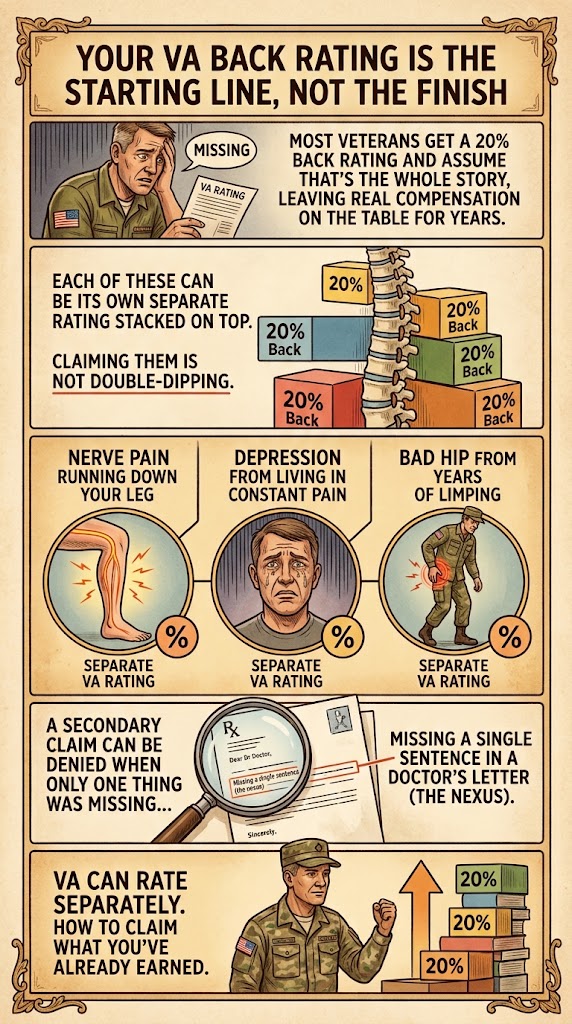
If you have a service-connected back condition, your back rating is usually the starting line, not the finish. The nerve pain running down your leg, the depression that comes with living in constant pain, the bad hip from years of limping—each of those can be its own separate rating stacked on top of your back, and claiming them is not double-dipping.
Most veterans get a 20% back rating, assume that’s the whole story, and leave real compensation on the table for years. Some get a secondary condition denied and give up, when the only thing missing was a single sentence in a doctor’s letter.
Here’s what the VA can rate separately, why it’s allowed, and how to claim what you’ve already earned.
Key Takeaways
- A back condition is rated under the General Rating Formula for the spine in 38 CFR § 4.71a, based mostly on how far you can bend forward (forward flexion), from 10% up to 100%.
- Radiculopathy (nerve pain, numbness, or weakness shooting down a leg or arm) is rated separately from your back under 38 CFR § 4.124a. Note 1 of the spine formula specifically requires this. It is not pyramiding.
- A secondary condition is any disability caused or worsened by your service-connected back, under 38 CFR § 3.310. Depression, sleep problems, and hip or knee damage from an altered gait are common examples.
- Winning a secondary claim comes down to a nexus: a doctor’s opinion that your back is “at least as likely as not” the cause. That phrase means a 50% or greater probability: the exact threshold the VA needs.
- Ratings don’t add up the way you’d expect. The VA uses combined-ratings math, so two conditions stack in a way that’s less than simple addition, but they still push your total higher.
How the VA Rates Your Back in the First Place
Nearly every back and spine condition is rated under one formula in 38 CFR § 4.71a, and the number that drives it is forward flexion — how many degrees you can bend forward at the waist before pain stops you. An examiner measures it with a goniometer, a calibrated protractor for joints.
For the lower back (the thoracolumbar spine), the breakpoints are:
| Rating | Forward flexion of the lower back |
| 10% | Greater than 60° but not more than 85° |
| 20% | Greater than 30° but not more than 60° |
| 40% | 30° or less |
| 50% | Unfavorable ankylosis of the entire thoracolumbar spine |
| 100% | Unfavorable ankylosis of the entire spine |
Here’s the part that traps people: this formula rates the orthopedic problem — the stiffness and lost motion. It does not capture the nerve damage, the mental toll, or the joints you’ve worn out compensating for it. Those are rated on their own. If your decision letter shows only a back percentage, the VA very likely never evaluated the rest.
The Conditions You Can Rate Separately
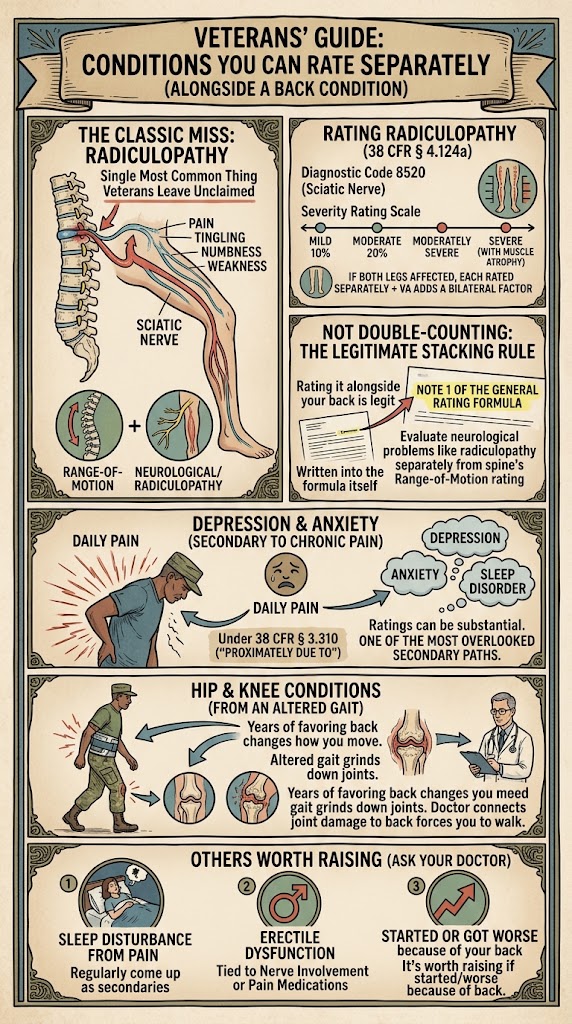
Radiculopathy (the classic one veterans miss)
When a disc in your spine presses on a nerve root, the pain, tingling, numbness, or weakness travels down a limb. In the leg, that’s usually the sciatic nerve. This is radiculopathy, and it is the single most common thing veterans leave unclaimed.
It gets its own rating under 38 CFR § 4.124a, Diagnostic Code 8520 for the sciatic nerve, scaled by severity: mild is 10%, moderate 20%, moderately severe 40%, severe with muscle atrophy 60%. If both legs are affected, each leg is rated separately and the VA adds a bilateral factor on top.
Rating it alongside your back is not double-counting. Note 1 of the General Rating Formula directs the VA to evaluate neurological problems like radiculopathy separately from the spine’s range-of-motion rating. That’s the rule that makes stacking legitimate — and it’s written into the formula itself.
Depression and anxiety (secondary to chronic pain)
Living with daily pain wears people down. When chronic back pain leads to depression, anxiety, or a sleep disorder, that mental health condition can be service-connected as a secondary under 38 CFR § 3.310 — because it’s “proximately due to” your service-connected back. Mental health ratings can be substantial, and this is one of the most overlooked secondary paths.
Hip and knee conditions (from an altered gait)
Years of favoring your back changes how you move. That altered gait quietly grinds down hips and knees. When a doctor connects the joint damage to the way your back forces you to walk, those joints can be claimed as secondaries too.
Others worth asking your doctor about
Sleep disturbance from pain, and erectile dysfunction tied to nerve involvement or pain medications, both come up regularly as secondaries to back conditions. If a condition started or got worse because of your back, it’s worth raising.
The One Thing That Wins a Secondary Claim: the Nexus
A secondary claim needs three pieces: a current diagnosis of the new condition, your existing service-connected back, and a medical nexus linking the two. The first two you usually have. The nexus is where claims are won or lost.
A nexus is a doctor’s written opinion that your back is “at least as likely as not” the cause of the new condition. That exact phrase matters — it signals a 50% or greater probability, which is the threshold the VA uses to grant. A letter that says your depression “could be” related to your back is worth almost nothing. A letter that says it is “at least as likely as not” caused by the chronic pain of your service-connected back, with a sentence of medical reasoning, is worth a great deal.
That single distinction — “could be” versus “at least as likely as not” — is the most common reason a winnable secondary gets denied.
A Real Example: How the Ratings Stack
The following is an anonymized composite built from common rating patterns. Names and details have been removed.
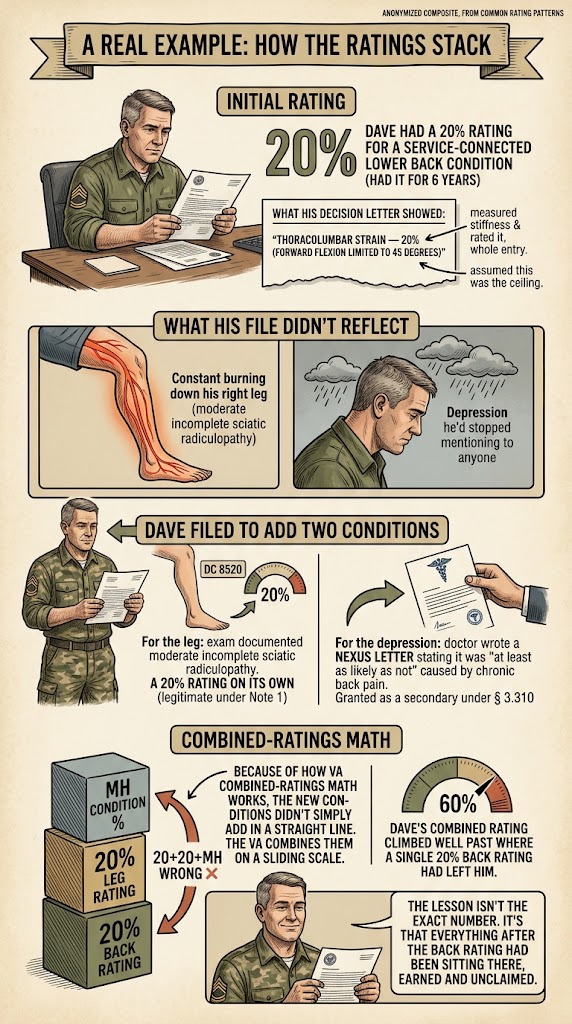
A veteran we’ll call Dave had a 20% rating for a service-connected lower back condition. He’d had it for six years and assumed that was the ceiling. What his file didn’t reflect: the constant burning down his right leg, and the depression he’d stopped mentioning to anyone.
What his decision letter showed — and what was missing:
“Thoracolumbar strain — 20% (forward flexion limited to 45 degrees).” Translation: The VA measured his stiffness and rated it. That’s the whole entry. Nothing about his leg. Nothing about his mental health.
Dave filed to add two conditions. For the leg, an exam documented moderate incomplete sciatic radiculopathy — a 20% rating on its own under DC 8520, and legitimate under Note 1, not pyramiding. For the depression, his doctor wrote a nexus letter stating it was “at least as likely as not” caused by his chronic back pain, granted as a secondary under § 3.310.
Because of how VA combined-ratings math works, the new conditions didn’t simply add to 20 + 20 + a mental health percentage in a straight line — the VA combines them on a sliding scale. But Dave’s combined rating still climbed well past where a single 20% back rating had left him for six years. The lesson isn’t the exact number. It’s that everything after the back rating had been sitting there, earned and unclaimed.
What to Do This Week
- Pull your latest rating decision and look at what’s actually rated. If it’s only a back percentage, you likely have room.
- Make two lists: the physical symptoms your back causes elsewhere (leg pain, numbness, a bad hip or knee), and the non-physical ones (poor sleep, low mood, anxiety).
- Tell your doctor the goal. You need a diagnosis for each condition and, for secondaries, an opinion using the words “at least as likely as not” with a short reason why.
- File a claim for each new condition, or a Supplemental Claim if a prior secondary was denied for a weak nexus.
- Get accredited help for the nexus if a condition is complex — the wording is the whole game, and a VA-accredited representative knows exactly what the rater needs to see.
You already earned the back rating. The conditions it caused are part of the same injury — you just have to put them on the record.
Frequently Asked Questions
Q: Can I get a separate VA rating for nerve pain from my back?
A: Yes. Radiculopathy—nerve pain, numbness, or weakness radiating from your spine—is rated separately from your back under 38 CFR § 4.124a. Note 1 of the spine rating formula specifically requires the VA to evaluate neurological conditions separately, so it is not considered double-counting.
Q: Is claiming secondary conditions to my back considered pyramiding?
A: No, as long as each condition involves different symptoms or body systems. Pyramiding under 38 CFR § 4.14 only prohibits rating the same symptom twice. Radiculopathy (nerve), depression (mental health), and a worn hip (joint) are distinct from your back’s lost range of motion, so each can be rated on its own.
Q: What is a nexus letter and do I need one for a secondary claim?
A: A nexus letter is a doctor’s written opinion linking your new condition to your service-connected back. For secondary claims it’s usually essential, because the VA needs medical reasoning showing your back caused or worsened the new condition. The strongest letters state the connection is “at least as likely as not” — a 50% or greater probability.
Q: What are the most common secondary conditions to back pain?
A: Radiculopathy or sciatica, depression and anxiety from chronic pain, sleep disturbance, and hip or knee conditions caused by an altered gait are among the most common. Erectile dysfunction related to nerve involvement or pain medication also comes up regularly.
Q: Will claiming secondaries actually raise my combined rating?
A: It can, but not by simple addition. The VA uses combined-ratings math on a sliding scale, so two 20% conditions don’t equal 40%. Even so, adding legitimate secondary conditions almost always increases your combined rating above where a single back rating leaves you.
Q: My secondary claim was denied. Is it over?
A: No. If it was denied for a weak or missing nexus, a Supplemental Claim with a stronger medical opinion—one using the “at least as likely as not” standard—is often the fix. File within one year of the decision to preserve your original effective date.
 AllVeteran.com Advisors
With expertise spanning local, state, and federal benefit programs, our team is dedicated to guiding individuals towards the perfect program tailored to their unique circumstances.