













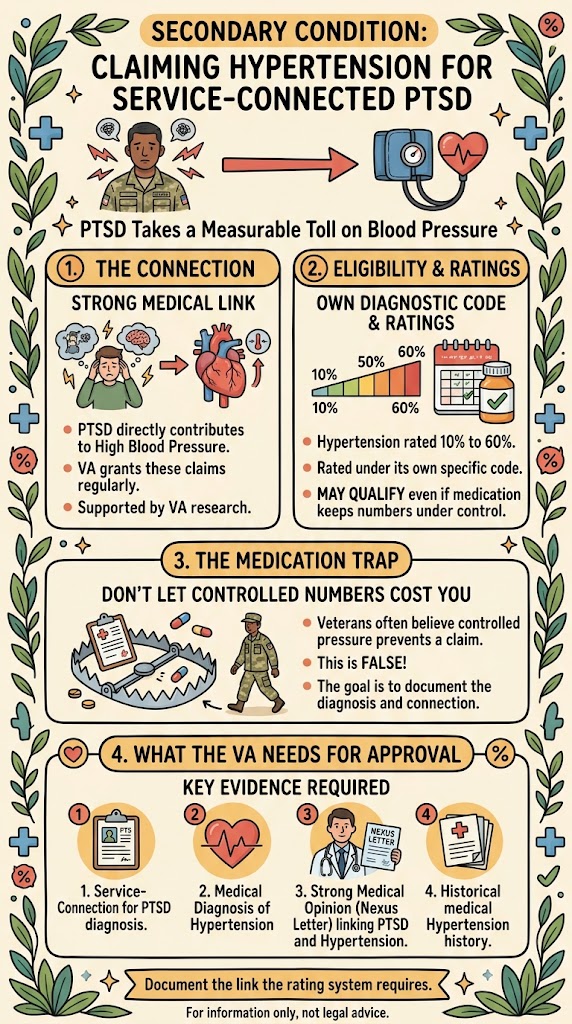
If you’re service-connected for PTSD and you’ve developed high blood pressure, you can claim the hypertension as a secondary condition. You may qualify even if medication now keeps your numbers under control. Hypertension is rated from 10% to 60% under its own diagnostic code, and the medical link between PTSD and high blood pressure is strong enough that the VA grants these claims regularly.
The connection isn’t a stretch. PTSD takes a measurable toll on blood pressure, and the VA has its own research showing it. The job is to put that link on paper in the way the rating system requires.
Here’s how the rating works, the medication trap that costs veterans a grant, and what the VA needs to approve the claim.
Key Takeaways
- Hypertension is rated 10% to 60% under 38 CFR § 4.104, Diagnostic Code 7101, based mainly on your diastolic (bottom) and systolic (top) blood pressure readings.
- You can claim it as secondary to PTSD under 38 CFR § 3.310 through either causation (PTSD caused it) or aggravation (PTSD made a pre-existing case worse).
- A 10% rating is available if you have a history of diastolic readings predominantly 100 or higher and now require continuous medication to control it, so controlled blood pressure doesn’t disqualify you.
- The VA’s own research supports the link: a study of more than 194,000 Iraq and Afghanistan veterans found those with PTSD had a substantially higher risk of developing hypertension.
- The claim turns on a nexus: a doctor’s opinion that the hypertension is “at least as likely as not” caused or aggravated by your service-connected PTSD.
How the VA Rates Hypertension
Hypertension is rated under 38 CFR § 4.104, Diagnostic Code 7101, and the numbers that drive it are your blood pressure readings:
| Rating | Blood pressure criteria |
| 10% | Diastolic predominantly 100 or more, or systolic predominantly 160 or more, or a history of diastolic predominantly 100+ that now requires continuous medication |
| 20% | Diastolic predominantly 110 or more, or systolic predominantly 200 or more |
| 40% | Diastolic predominantly 120 or more |
| 60% | Diastolic predominantly 130 or more |
One requirement to know: the VA confirms hypertension with readings taken two or more times on at least three different days. A single high reading at one appointment isn’t enough — the record needs a pattern.
The Medication Trap That Costs Veterans a Grant
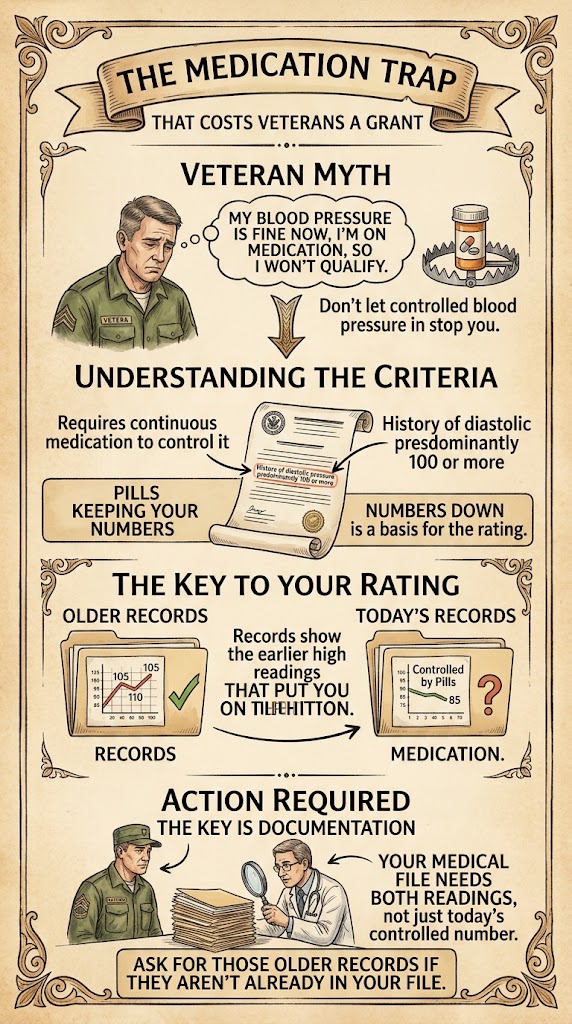
Here’s where veterans talk themselves out of a valid claim. They think: my blood pressure is fine now, I’m on medication, so I won’t qualify. That’s backwards.
Read the 10% criteria again. It specifically includes someone with a history of diastolic pressure predominantly 100 or more who requires continuous medication to control it. In other words, the fact that pills are keeping your numbers down is itself a basis for the rating, as long as your records show the earlier high readings that put you on the medication in the first place.
So don’t let controlled blood pressure stop you. The key is documentation: your medical file needs to show the history of high readings, not just today’s controlled number. Ask for those older records if they aren’t already in your file.
Two Paths for Secondary Service Connection
A secondary condition is any disability caused or aggravated by a condition you’re already service-connected for, under 38 CFR § 3.310. For hypertension and PTSD, there are two ways in:
Causation: your PTSD caused the high blood pressure. The chronic stress response drove your pressure up over time.
Aggravation: you already had some high blood pressure, and your PTSD made it worse than it would have been on its own. This path comes from § 3.310(b), and it’s the one veterans forget. Even if your hypertension started before or independent of your PTSD, you can be compensated for the additional worsening your PTSD caused.
To claim either way, you need three things: a current hypertension diagnosis, PTSD already service-connected (even at 0%), and a medical nexus.
The Science Backs the Link
This is one of the better-supported secondary connections, and that helps your claim. PTSD keeps the body’s fight-or-flight system switched on with elevated stress hormones, poor sleep, and repeated surges in heart rate and blood pressure. Over years, that pattern is a recognized driver of chronic hypertension.
The VA has studied it directly. Research on more than 194,000 Iraq and Afghanistan veterans found that those with PTSD carried a meaningfully higher risk of developing hypertension than those without. When your doctor writes the nexus, that body of research is the reasoning to lean on.
The Nexus: the One Sentence That Grants the Claim
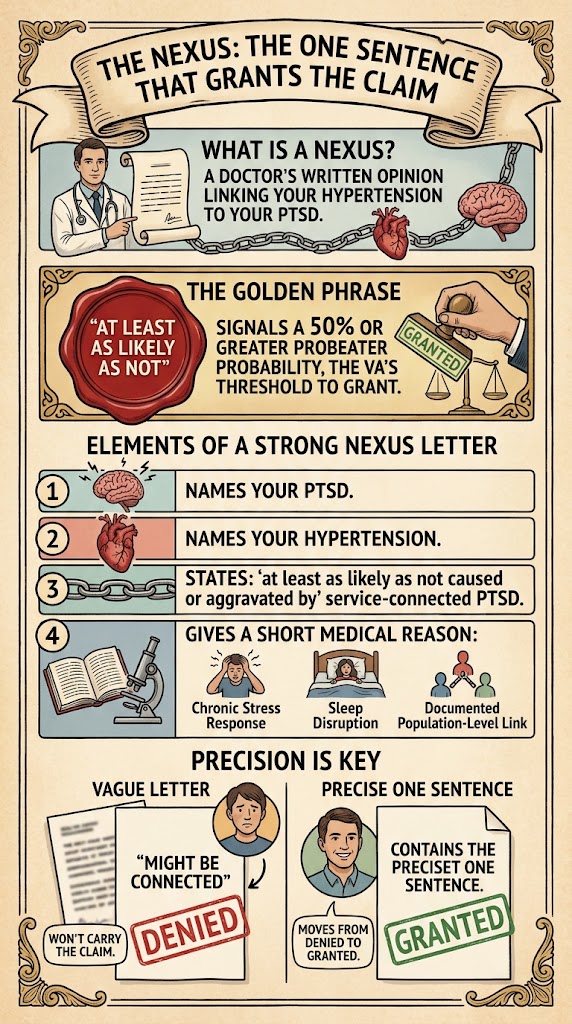
A nexus is a doctor’s written opinion linking your hypertension to your PTSD. The standard phrase is “at least as likely as not” which signals a 50% or greater probability, the VA’s threshold to grant.
A strong nexus letter names your PTSD, names your hypertension, states the hypertension is “at least as likely as not caused or aggravated by” the service-connected PTSD, and gives a short medical reason: the chronic stress response, the sleep disruption, the documented population-level link. A vague letter saying the two “might be connected” won’t carry the claim. The precision of that one sentence is what moves it from denied to granted.
A Real Example: Controlled Numbers, Valid Claim
The following is an anonymized composite based on common claim patterns. Names and details have been removed.
A veteran we’ll call Tom was service-connected for PTSD at 70%. A few years after separating, his primary care doctor put him on blood pressure medication after several readings in the 150s/100s. By the time Tom thought about a claim, his pressure was well controlled, and he assumed that meant he’d missed his chance.
What Tom got wrong — and what his records actually showed:
Tom’s assumption: “My blood pressure is normal now, so I can’t claim it.” Reality: The 10% criteria specifically covers a history of diastolic readings 100+ that now requires continuous medication. His older records showed exactly that history.
Tom pulled his earlier treatment records, which documented the pre-medication readings. His doctor wrote a nexus letter stating his hypertension was “at least as likely as not caused and aggravated by his service-connected PTSD,” pointing to the chronic stress response and his documented sleep disruption. The VA granted the hypertension as a secondary under § 3.310 and rated it at 10% under Diagnostic Code 7101—a rating that reflected the continuous medication, not his currently controlled numbers.
The takeaway: controlled blood pressure is not a closed door. The history in your file is what matters.
What to Do This Week
- Confirm your PTSD is service-connected. Check your rating decision. A 0% PTSD rating still counts as the anchor.
- Gather your blood pressure history, especially the earlier high readings that led to medication. Two or more readings on at least three different days is the standard.
- Get a current hypertension diagnosis documented if it isn’t already.
- Ask your doctor for a nexus letter using “at least as likely as not caused or aggravated by” your service-connected PTSD, with the stress-and-sleep reasoning.
- File the secondary claim, or a Supplemental Claim if a prior hypertension claim was denied. File within a year of any prior decision to protect your effective date.
Frequently Asked Questions
Q: Can I claim hypertension secondary to PTSD if my blood pressure is now controlled with medication?
A: Yes. The 10% rating under Diagnostic Code 7101 specifically covers a veteran with a history of diastolic pressure predominantly 100 or more who requires continuous medication to control it. Your records need to show that earlier history of high readings, even if your current numbers are normal.
Q: What blood pressure readings do I need for a VA hypertension rating?
A: The VA rates hypertension mainly on diastolic and systolic readings: 10% for diastolic predominantly 100+ or systolic 160+ (or the medication history above), 20% for diastolic 110+ or systolic 200+, 40% for diastolic 120+, and 60% for diastolic 130+. Readings must be documented two or more times on at least three different days.
Q: How do I prove hypertension is connected to my PTSD?
A: You need a current hypertension diagnosis, PTSD already service-connected, and a medical nexus opinion stating the hypertension is “at least as likely as not” caused or aggravated by the PTSD. The VA’s own research linking PTSD to higher hypertension risk supports the medical reasoning in that opinion.
Q: What is the aggravation path for a secondary claim?
A: Under 38 CFR § 3.310(b), if you already had high blood pressure and your PTSD made it worse than its natural progression, you can be compensated for that additional worsening. You don’t have to prove PTSD caused the hypertension, only that it aggravated it.
Q: Does a 0% PTSD rating still let me file a secondary claim?
A: Yes. As long as PTSD is service-connected, even at 0%, it can serve as the anchor for a secondary hypertension claim.
Q: My hypertension claim was denied. What now?
A: If it was denied for a weak or missing nexus, a Supplemental Claim with a stronger medical opinion—using the “at least as likely as not” standard and citing the PTSD-hypertension research—is often the fix. File within one year of the decision to preserve your original effective date.
 AllVeteran.com Advisors
With expertise spanning local, state, and federal benefit programs, our team is dedicated to guiding individuals towards the perfect program tailored to their unique circumstances.