












Much of the time, veterans with an other than honorable discharge (OTH) assume they won’t qualify for benefits, but that isn’t necessarily true. The Department of Veterans Affairs (VA) does not automatically deny benefits based solely on an OTH discharge. There are several other factors at play that determine whether or not you’ll receive benefits from the VA. They perform a character of discharge VA review to determine eligibility. Depending on the circumstances of service and separation, veterans may still receive health care, disability compensation, and other support. In some cases, a discharge upgrade can restore access to additional benefits.
So, there are options available to you. Here is what you need to know about OTH benefits and how you may still be able to get help from the VA.
Can You Get VA Benefits With an Other Than Honorable Discharge?
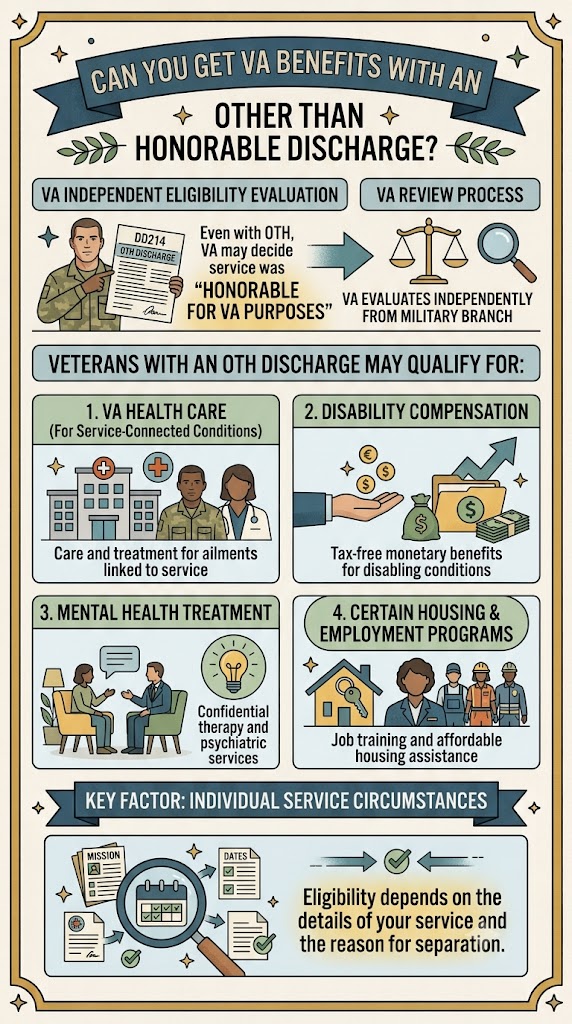
In certain situations, you can still receive other than honorable discharge benefits. The VA evaluates eligibility independently from the military branch that issued the discharge. Even if your DD214 shows an OTH discharge, the VA may decide your service was “honorable for VA purposes.”
Veterans with an OTH discharge may qualify for:
- VA health care for service-connected conditions
- Disability compensation
- Mental health treatment
- Certain housing or employment programs
Eligibility depends on the details of your service and the reason for separation.
How the VA Determines Eligibility (Character of Discharge Review)
When a veteran applies for benefits with an OTH discharge, the VA performs a VA administrative decision discharge review called a Character of Discharge determination. The VA examines factors such as length and quality of service, nature of misconduct, combat service or deployments, and mental health conditions affecting behavior.
Additionally, the VA looks at whether misconduct was minor and isolated OR serious and persistent. A positive character of discharge VA decision can open access to benefits even without a discharge upgrade.
Types of Discharges and Their Impact on Benefits
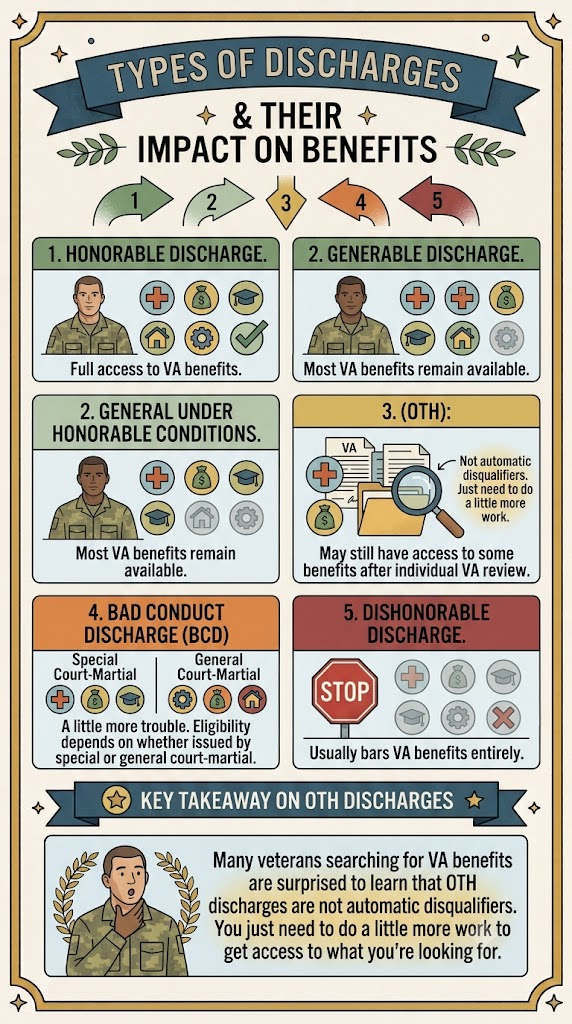
There are five different types of discharges from the military, and each one can have an impact on the benefits that are accessible to you. First is an Honorable Discharge, which provides full access to VA benefits.
General Under Honorable Conditions is the next level of discharge, and most VA benefits remain available. OTH, which we are covering here, may still have access to some benefits after the VA has reviewed your individual case.
Someone with a Bad Conduct Discharge (BCD) will have a little more trouble. Eligibility depends on whether issued by a special or general court-martial. Dishonorable Discharge, on the other hand, usually bars VA benefits entirely.
Many veterans searching for VA benefits are surprised to learn that OTH discharges are not automatic disqualifiers. You just need to do a little more work to get access to what you’re looking for.
How to Apply for a Discharge Upgrade
Some veterans pursue a discharge upgrade VA benefits strategy to restore eligibility. You can request an upgrade through the Discharge Review Board (DRB) or the Board for Correction of Military Records (BCMR).
Common reasons for upgrades include:
- PTSD or mental health conditions
- MST-related behavioral issues
- Substance abuse connected to service trauma
- Administrative errors or unfair punishment
You will need to submit supporting evidence, which often includes medical records, personal statements, service records, and nexus opinions from mental health providers. It may sound like a lot, but an upgraded discharge can dramatically improve access to benefits.
Steps to Apply for VA Benefits With an OTH Discharge
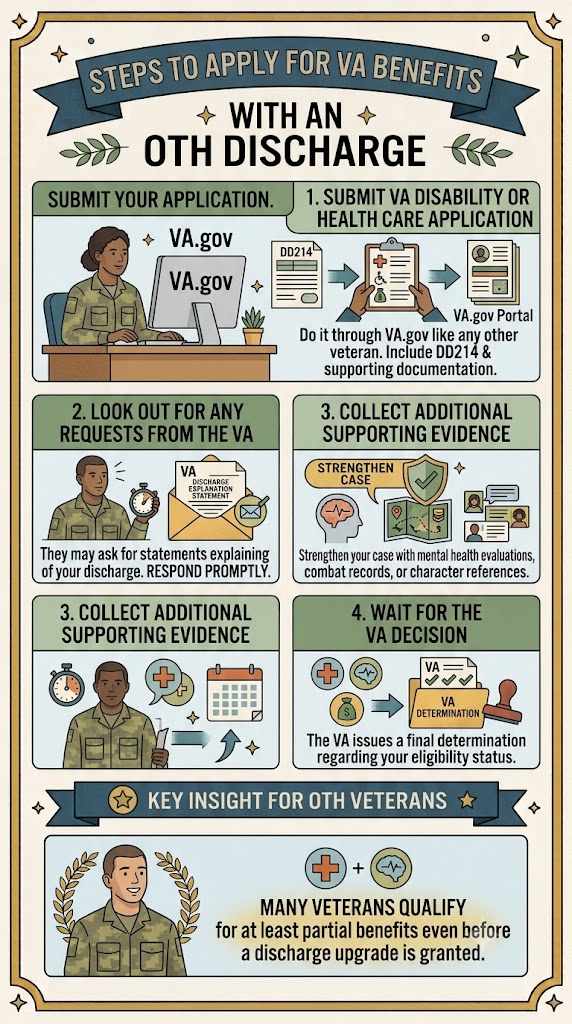
If you’re wondering whether or not you can get VA benefits with OTH, the process starts by applying like any other veteran. First, you’ll submit a VA disability or health care application through VA.gov. Be sure to include your DD214 and any supporting documentation.
Once you’ve submitted your application, look out for any requests from the VA. The VA may ask for statements explaining the circumstances of your discharge. It’s important to respond promptly.
Oftentimes, they will ask for additional supporting evidence. Mental health evaluations, combat records, or character references can strengthen your case.
Then, you wait for the decision to come down from the VA. Ultimately, they will issue a determination regarding your eligibility status. Many veterans qualify for at least partial benefits even before a discharge upgrade is granted.
An OTH Doesn’t Mean You Don’t Qualify
Sometimes, it helps to have an example scenario to think about. Carlos, a former Marine, received an OTH discharge after repeated misconduct linked to untreated PTSD following deployment. Years later, he applied for VA benefits and submitted medical evidence showing his PTSD contributed to his behavior. The VA conducted a character of discharge review and determined his service was honorable for VA purposes. Carlos was approved for health care and disability compensation despite his discharge status. This story is more common than you’d think, and getting access to benefits can be extremely helpful for some veterans.
FAQs About OTH Benefits
When it comes to OTH benefits, there are a lot of questions that come up. Here are some of the key points to take away.
- Can you get VA benefits with an OTH discharge? Yes. The VA may still grant benefits after reviewing your service history.
- What is a character of discharge review? It is a VA review process that determines whether your service qualifies for benefits despite your discharge status.
- Does an OTH discharge automatically disqualify me? No. OTH discharges are reviewed case by case.
- Can I receive health care with an OTH discharge? Possibly. Many veterans qualify for treatment related to service-connected conditions.
- How do I apply for a discharge upgrade? You can apply through the Discharge Review Board or Board for Correction of Military Records.
- Can PTSD help support a discharge upgrade? Yes. PTSD, MST, and other mental health conditions are common factors in successful upgrades.
- What discharge completely bars VA benefits? A dishonorable discharge generally blocks access to VA benefits.
Tamila’s Take
It’s sad when veterans assume they don’t qualify for help just because of an OTH discharge. Many never even tried applying for VA benefits because they assumed an OTH discharge meant the door was completely closed forever. The reality is that many veterans were dealing with untreated PTSD, trauma, MST, substance abuse, or serious mental health struggles during service, and those issues sometimes played a major role in the behavior that led to their discharge. Veterans carry shame and guilt for years without realizing the VA may still consider their service honorable for VA purposes after reviewing the full circumstances. What many people outside the military don’t understand is that combat stress and trauma can deeply affect judgment, behavior, and emotional stability long before someone ever receives proper treatment or support. Veterans with an OTH discharge deserve to know they may still have options for healthcare, compensation, and help rebuilding their lives, and they should never assume they are automatically beyond support or recognition.
An OTH Discharge May Not Be the End of the Road
An other than honorable discharge does not automatically mean a veteran is permanently barred from receiving VA benefits. Many veterans still qualify for healthcare, disability compensation, and other forms of support after the VA completes a character of discharge review and examines the full circumstances surrounding their service and separation. In many cases, untreated PTSD, MST, combat stress, or other mental health conditions may have contributed to the behavior that led to the discharge itself. Veterans should understand that discharge upgrades and favorable VA determinations happen more often than many people realize, especially when strong supporting evidence is provided. If you have an OTH discharge and believe your service-connected conditions deserve recognition, visit AllVeteran.com today to begin a free medical evidence screening and learn what benefits and options may still be available to you.
 AllVeteran.com Advisors
With expertise spanning local, state, and federal benefit programs, our team is dedicated to guiding individuals towards the perfect program tailored to their unique circumstances.