












Quick Answer
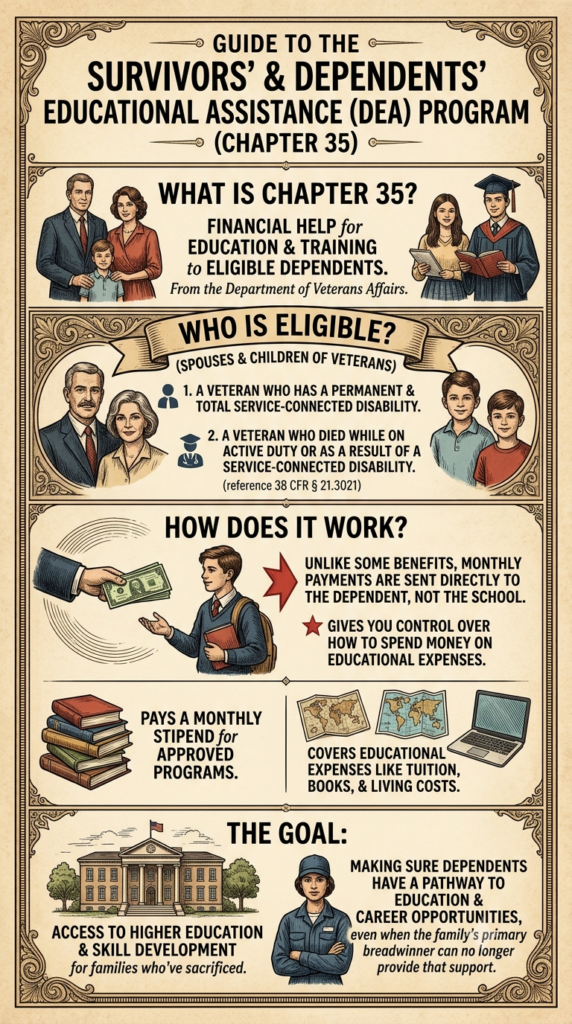
Chapter 35 benefits, officially known as the Survivors’ and Dependents’ Educational Assistance (DEA) program, provide educational and training opportunities to eligible dependents of veterans who are permanently and totally disabled due to a service-connected disability, or who died while on active duty or as a result of a service-connected disability. This program helps cover tuition, fees, books, and supplies for approved education and training, including college, vocational training, and apprenticeships. Eligibility typically extends to spouses and children, with specific age limits for children. The benefit amount varies based on the type of training and enrollment status, aiming to support educational pursuits for those whose families have made significant sacrifices.
Why This Update
Chapter 35 is a life-changing benefit that too many military families overlook. We created this guide so eligible spouses and children know exactly who qualifies, how much it pays, and how to apply before the window closes.
Author’s Take
Chapter 35 is one of those benefits that families don’t even know exists until someone mentions it in passing — and by then, they’ve sometimes missed years they could have used it. I’ve worked with spouses who assumed education benefits died with the veteran, and children who didn’t realize they were eligible until they were almost 26. The biggest mistake I see is waiting too long to apply or choosing the wrong benefit when both Chapter 35 and transferred Post-9/11 GI Bill are on the table. My advice: if your family qualifies, sit down and map out the timeline now. Know the age limits, know the enrollment deadlines, and talk to your school’s VA certifying official before your first semester — not after.
What Are VA Chapter 35 Benefits (DEA) and Who Do They Support?
Chapter 35, formally known as the Survivors’ and Dependents’ Educational Assistance (DEA) program, gives financial help for education and training to eligible dependents, according to the Department of Veterans Affairs. The program supports the spouses and children of veterans who have a permanent and total service-connected disability, or who died while on active duty or as a result of a service-connected disability, as defined in 38 CFR § 21.3021.
The program pays a monthly stipend to help cover educational expenses like tuition, books, and living costs for approved programs. The goal is straightforward: give access to higher education and skill development for families who’ve sacrificed alongside their veteran, making these essential benefits. Unlike some education benefits that pay schools directly, Chapter 35 puts the monthly payment in the dependent’s hands, giving you control over how to spend the money on your educational expenses. While Chapter 35 focuses on education, other financial support avenues exist, such as exploring different types of VA loans.
When a veteran becomes permanently disabled or dies in service, the entire family feels the impact. Chapter 35 is the VA’s way of making sure dependents still have a pathway to education and career opportunities, even when the family’s primary breadwinner can no longer provide that support.
Who Qualifies for Chapter 35 Benefits in 2026?
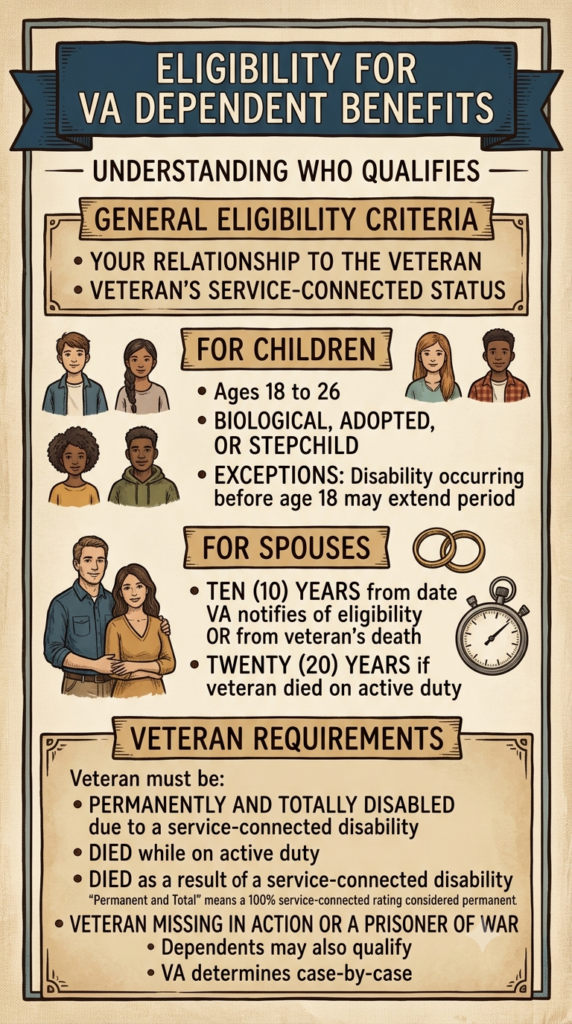
Eligibility depends on two things: your relationship to the veteran and the veteran’s service-connected status. Let’s break down who qualifies.
For children, you must be between ages 18 and 26, according to the VA. Some exceptions apply. If you have an intellectual or physical disability that occurred before age 18, your eligibility period may be extended. You must be the biological, adopted, or stepchild of the qualifying veteran. The age window is firm for most dependents. Know about this benefit early.
For spouses, the timeline works differently. You typically have 10 years from the date the VA tells you you’re eligible or from the veteran’s death to use VA disability benefits for spouses. However, if the veteran died on active duty, you may have up to 20 years to use the benefit. These timelines matter. Miss the window, and the benefit disappears.
The veteran must meet specific criteria for you to qualify. As defined by the VA, the veteran must be permanently and totally disabled due to a service-connected disability, or have died while on active duty, or died as a result of a service-connected disability (38 CFR § 21.3021). That “permanently and totally disabled” status means a 100% service-connected disability rating the VA considers permanent. This rating is often a key component discussed in a guide to VA disability benefits. Not all 100% ratings qualify. It has to be designated as “permanent and total.”
One thing that confuses families: if the veteran is missing in action or a prisoner of war, dependents may also qualify under certain conditions. The VA determines eligibility case-by-case for these situations.
How Much Does Chapter 35 Pay in 2026?
Chapter 35 benefits are paid as a monthly stipend directly to the eligible dependent, not to the educational institution. This matters: you receive the money and decide how to spend it on your education-related expenses.
The exact monthly payment amount depends on your enrollment status and the type of training you’re doing. Full-time students receive the highest monthly rate, while those enrolled three-quarter time, half-time, or less than half-time receive proportionally reduced amounts. The type of training also matters. Institutional training (like college courses) has different rates than on-the-job training or apprenticeships.
The VA adjusts these rates periodically, though not always annually. As of this writing, the most recent published rates are from October 1, 2023, through September 30, 2024. Here’s what matters for your planning. The rates vary significantly based on your enrollment status, so if you’re considering part-time enrollment to work while studying, factor in that your monthly payment will be substantially lower than the full-time rate.
For on-the-job training and apprenticeships, the payment structure is different. You’ll typically start at a higher rate during your first six months of training, with the rate decreasing as you progress and gain more skills. This assumes that as you become more skilled, you’re also earning more from your employer.
What Educational and Training Programs Does DEA Cover?
Chapter 35 benefits can be used for a wide range of educational programs, so you have flexibility in how you pursue your education or training.
College and university programs are the most common use. You can apply Chapter 35 toward associate, bachelor’s, and graduate degrees at accredited colleges and universities. This includes professional courses and graduate training, so whether you’re working on a master’s degree or a professional certification, the benefit applies.
Vocational and technical training programs are fully covered. If you’re interested in gaining marketable skills for a specific trade or profession (like welding, HVAC, medical assisting, or automotive technology), Chapter 35 can help you get there. These programs often lead to careers faster than traditional four-year degrees, which makes them a good choice for some beneficiaries.
Approved training extends beyond the classroom. You can use Chapter 35 for on-the-job training (OJT), apprenticeships, correspondence courses, preparatory courses, and even some high school diploma or GED programs. Whether you’re 18 and just starting out or a spouse returning to education after years away, there’s likely a program that fits.
Here’s the catch. All programs must be approved by the VA for Chapter 35 benefits. Not every school or training program qualifies. Before you enroll, verify approval with your school’s VA certifying official. This person is your key contact at the institution. They handle all the VA paperwork and can confirm whether your specific program is approved. Enroll in a non-approved program and you won’t receive benefits. You can’t get retroactive approval.
Step-by-Step Guide to Applying for Chapter 35 Benefits
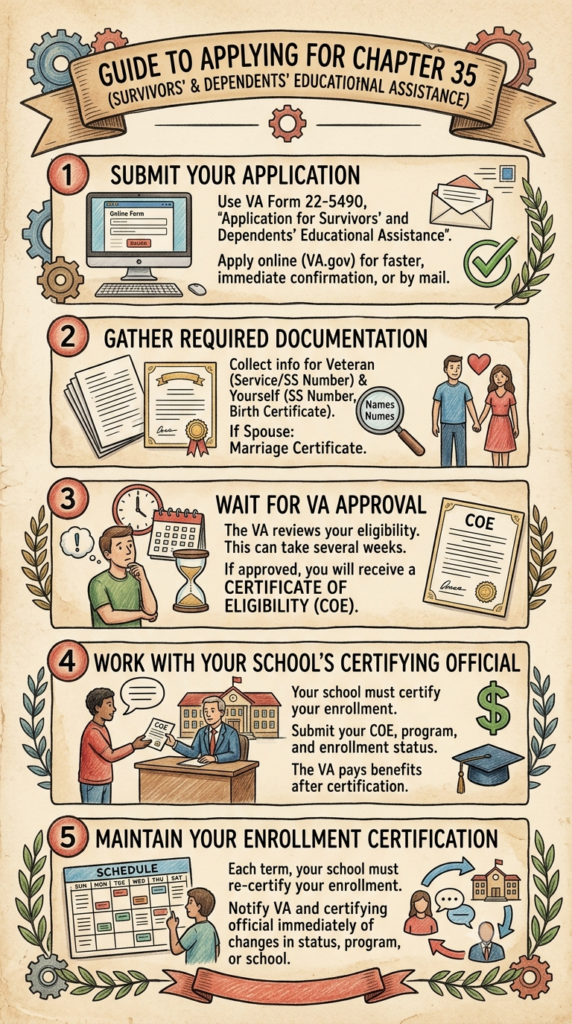
Applying for Chapter 35 isn’t complicated, but follow the process in the right order.
Step 1: Submit your application. The primary application form for new beneficiaries is VA Form 22-5490, “Application for Survivors’ and Dependents’ Educational Assistance.” You can submit this online through VA.gov or by mail. The online process is faster and you’ll get immediate confirmation the VA received your application.
Step 2: Gather required documentation. You’ll need information about the qualifying veteran, including their service number or Social Security number. You’ll also need your own personal information, like your Social Security number and birth certificate. If you’re a spouse, have your marriage certificate ready. The VA uses this documentation to verify your relationship to the veteran and the veteran’s service-connected status.
Step 3: Wait for VA approval. After you submit your application, the VA reviews your eligibility. This can take several weeks. You’ll receive a Certificate of Eligibility (COE) if you’re approved, which confirms your entitlement to benefits and how long your eligibility period lasts.
Step 4: Work with your school’s certifying official. Once the VA approves your eligibility, you must work with your chosen school’s VA certifying official to have your enrollment certified to the VA. This step matters. The VA won’t start paying benefits until your school submits enrollment verification. The certifying official will need your COE and information about your program and enrollment status.
Step 5: Maintain your enrollment certification. Each term, your school must certify your continued enrollment to the VA. If you change your enrollment status, program, or school, you’ll need to notify both the VA and your certifying official immediately.
Important Considerations and Limitations for DEA Beneficiaries
Chapter 35 has rules you need to understand before you start using it.
You can’t use multiple VA education benefits at once. Beneficiaries typically can’t use Chapter 35 benefits at the same time as other VA education benefits, like the Post-9/11 GI Bill or transferred benefits, according to 38 CFR § 21.3023. If you’re eligible for both Chapter 35 and transferred Post-9/11 GI Bill benefits, you must choose which one to use for a given period. This is where many families get tripped up. The Post-9/11 GI Bill is often more generous, but Chapter 35 has different eligibility windows. You need to compare both and choose strategically, especially when understanding VA dependent education benefits.
Satisfactory academic progress is required. You must maintain satisfactory academic progress, as defined by your educational institution, to continue receiving Chapter 35 benefits. If you’re failing classes or not meeting your school’s academic standards, the VA can stop your payments. This is outlined in 38 CFR § 21.3131. Each school defines “satisfactory progress” differently. Know your school’s policy.
Report all changes immediately. You must notify the VA and your school of any changes in enrollment status (like dropping courses or changing programs), marital status, or dependency status. Drop a course mid-semester and it can affect your enrollment status, which may reduce your monthly benefit or create an overpayment you’ll need to repay. These overpayments aren’t forgiven. The VA will collect them, sometimes by withholding future benefit payments.
The 36-month limit is firm. Eligible individuals can receive up to 36 months of full-time equivalent benefits under Chapter 35. If you’re enrolled part-time, those 36 months stretch over a longer calendar period, but the total entitlement doesn’t increase. Plan your educational path carefully within your eligibility period. Once you’ve used your 36 months, the benefit is gone.
Example Scenario
If you’re a dependent child of a veteran rated 100% permanently and totally disabled due to service, you could use Chapter 35 benefits to work on a bachelor’s degree at a state university. If you enroll full-time, the monthly stipend helps cover living expenses and some educational costs, so you can focus on your studies. This benefit gives a pathway to higher education for families who’ve sacrificed, so you can reach your academic and career goals.
Frequently Asked Questions
Can I use Chapter 35 if I’m already using the Post-9/11 GI Bill?
No, dependents generally can’t use Chapter 35 at the same time as other VA education benefits like the Post-9/11 GI Bill, including transferred benefits. You must choose which benefit to use for a specific period. Dual entitlement typically isn’t allowed.
Is there an age limit for Chapter 35 benefits?
Yes, for children, benefits generally end at age 26, though specific circumstances like intellectual or physical disabilities may allow for extensions. Spouses have a 10-year or 20-year window, depending on the veteran’s date of death or VA rating.
Do Chapter 35 benefits pay for tuition directly?
No, Chapter 35 benefits are paid directly to the eligible dependent as a monthly stipend. This payment covers educational expenses like tuition, fees, books, and living costs, but isn’t paid directly to the school.
What is the maximum duration for Chapter 35 benefits?
Eligible individuals can receive up to 36 months of full-time equivalent benefits under Chapter 35. This applies across all approved programs.
Can Chapter 35 benefits be transferred to another dependent?
No, Chapter 35 benefits (DEA) belong to the specific eligible dependent and can’t be transferred to another family member. Eligibility is based on each dependent’s relationship to the qualifying veteran.
What happens if I drop a course while receiving Chapter 35?
Dropping courses can affect your enrollment status and may reduce your monthly benefit or create an overpayment you’ll need to repay. Tell both the VA and your school’s certifying official immediately about any enrollment changes.
 AllVeteran.com Advisors
With expertise spanning local, state, and federal benefit programs, our team is dedicated to guiding individuals towards the perfect program tailored to their unique circumstances.