













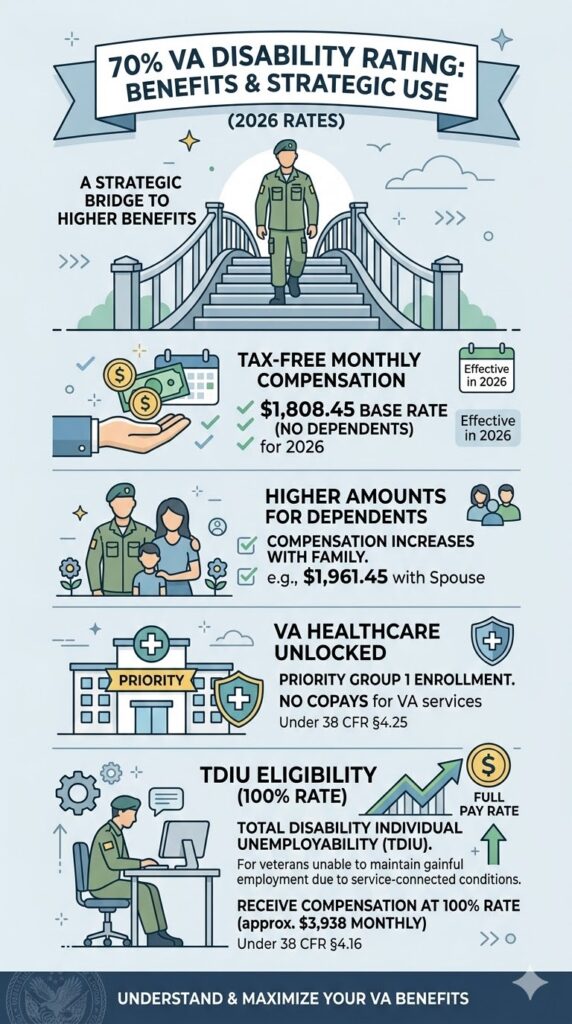
A 70% VA disability rating provides $1,808.45 per month in tax-free compensation for 2026, with higher amounts for dependents—for example, $1,961.45 with a spouse. Under 38 CFR §4.25, this combined rating also unlocks Priority Group 1 VA healthcare with no copays and eligibility for Total Disability Individual Unemployability (TDIU).
TDIU is significant because under 38 CFR §4.16, veterans at 70% who cannot maintain substantially gainful employment due to service-connected conditions can receive compensation at the 100% rate (approximately $3,938 monthly). Many veterans use 70% as a strategic bridge to higher benefits.
Tamila’s Take
As an Army veteran who has spent years helping other veterans transition into civilian life, I can tell you this: the 70% rating is where a lot of people get stuck, and often, underpaid. I’ve worked with veterans who were struggling financially, not because they didn’t qualify for more, but because they didn’t realize how close they were to benefits like TDIU.
That extra $2,000+ per month isn’t just a number. It’s the difference between constant financial stress and real stability. The biggest mistake I see is veterans assuming the VA will automatically “get it right” without fully updating dependents, submitting evidence, or advocating for themselves. If your conditions are impacting your ability to work, you owe it to yourself to explore every option available, because these benefits exist for a reason. You earned them.
Why This Update
As of December 1, 2025, the VA implemented a 2.8% cost-of-living adjustment (COLA), bringing the base monthly payment for a single veteran at 70% to $1,808.45. This amount is completely tax-free.
2026 Compensation Rates: What You Actually Take Home
Your actual payment depends on your family situation. A veteran with a spouse receives $1,961.45 monthly, while a veteran with a spouse and one child gets $2,074.70. Each additional child under 18 adds $76.07 to your monthly check. These numbers represent increases of roughly $49 to $57 compared to 2025 rates.
One critical detail many veterans miss: the VA does not automatically add dependents to your award. If you recently married, had a child, or your child turned 18 but is still in school, you must file VA Form 21-686c to receive the higher payment. Failing to update your dependents means leaving money on the table every single month.
The Hidden Value: Benefits Beyond the Monthly Check
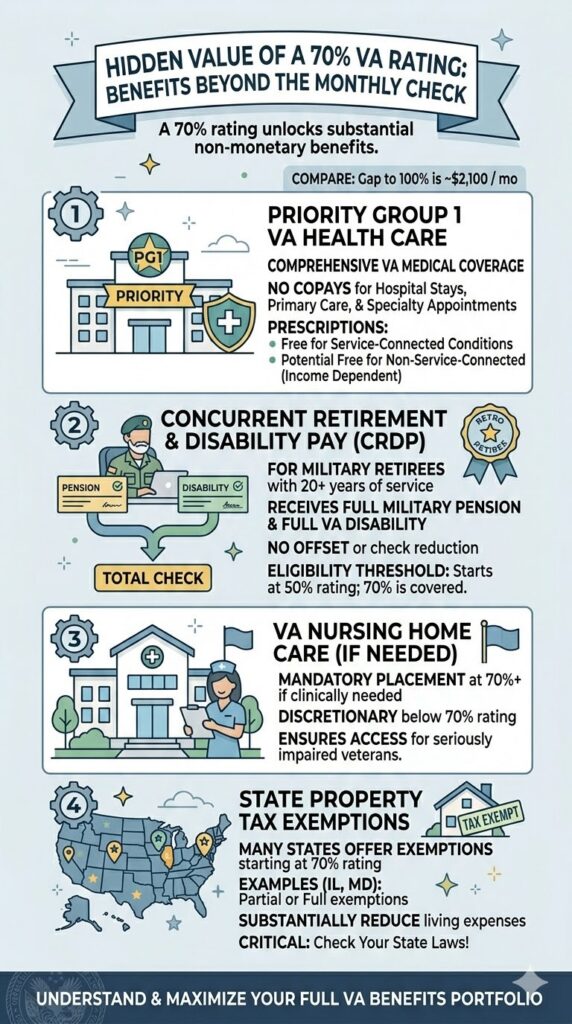
The gap between 70% and 100% disability compensation is approximately $2,100 per month. However, a 70% rating unlocks substantial non-monetary benefits that can significantly reduce your living expenses. Priority Group 1 Health Care is perhaps the most valuable. At 70%, you qualify for comprehensive VA medical coverage with no copays for hospital stays, primary care visits, or specialty appointments. Prescriptions for service-connected conditions are free, and depending on your income, non-service-connected prescriptions may also be covered.
This benefit alone can save thousands annually compared to private insurance. Military retirees with 20 or more years of service gain access to Concurrent Retirement and Disability Pay (CRDP). This allows you to receive both your full military pension and your VA disability check simultaneously, rather than having one offset the other.
CRDP eligibility begins at 50%, so 70% veterans are well within this threshold. The 70% rating is also the point where VA nursing home care becomes mandatory if clinically needed. Below this threshold, nursing home placement is discretionary.
TDIU: The Bridge to 100% Compensation
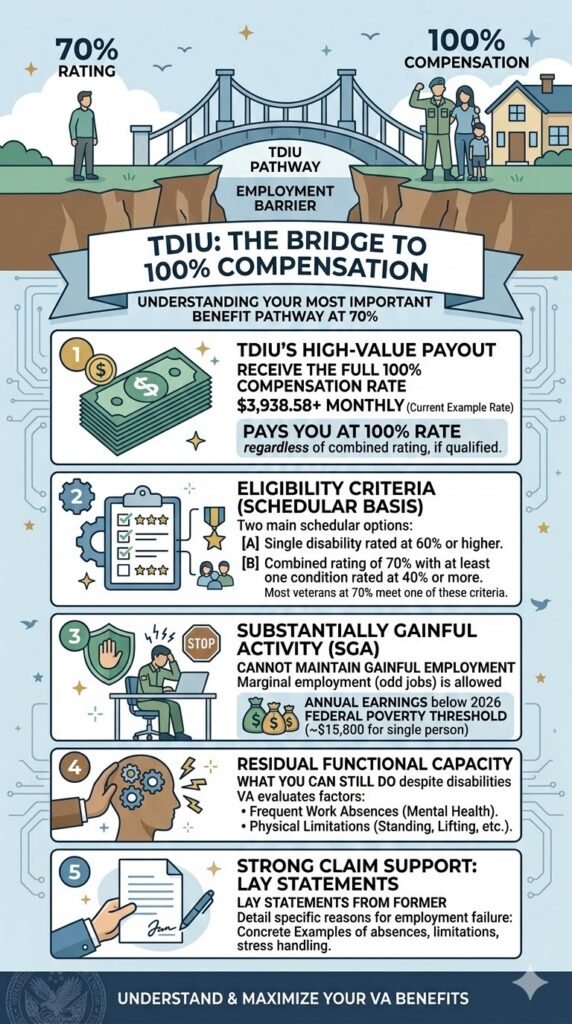
Total Disability based on Individual Unemployability (TDIU) is arguably the most important benefit pathway for veterans rated at 70%. TDIU pays you at the 100% compensation rate—currently $3,938.58 or more per month—even if your combined rating is only 70%, provided your service-connected conditions prevent you from maintaining gainful employment.
To qualify for TDIU on a schedular basis, you need either a single disability rated at 60% or higher, or a combined rating of 70% with at least one condition rated at 40% or more. Most veterans at 70% meet one of these criteria.
The key term here is Substantially Gainful Activity (SGA). The VA borrows concepts from Social Security disability determinations. You cannot maintain substantially gainful employment to qualify for TDIU. Marginal employment, such as occasional odd jobs, is permitted as long as your annual earnings stay below the federal poverty threshold, approximately $15,800 for a single person in 2026.
Residual Functional Capacity (RFC) is another relevant concept. This refers to what you can still do despite your disabilities. The VA considers your RFC when evaluating whether you can work. If your mental health conditions cause you to miss work frequently, or your physical limitations prevent standing or lifting, these factors support a TDIU claim.
Veteran advocates report higher TDIU approval rates when claims include lay statements from former employers or supervisors. These statements should detail specific reasons employment could not be sustained—frequent absences, inability to handle stress, physical limitations that prevented job duties, or other concrete examples.
Navigating the 70% Purgatory: Real Veteran Experiences
In veteran communities online, the 70% rating is often described as purgatory. The compensation is meaningful but rarely sufficient to live on independently in most areas of the country.
Many veterans at this level feel trapped between needing to work despite their conditions and wanting the financial security that 100% or TDIU would provide. A common theme is the fear of ‘poking the bear’—applying for an increase or TDIU and potentially triggering a review that results in a reduction.
This anxiety keeps many veterans from filing claims they likely deserve. Veteran advocates consistently push back on this fear. If your condition has genuinely worsened and you have current medical evidence documenting that decline, the risk of reduction is lower than many assume.
The potential reward of TDIU approval—an additional $2,100 monthly—often outweighs the perceived risk, especially for veterans struggling to maintain employment. The lifestyle reality at 70% is that the monthly payment covers some basics like utilities or a car payment, but it does not replace a working salary.
Action Steps for 70% Veterans
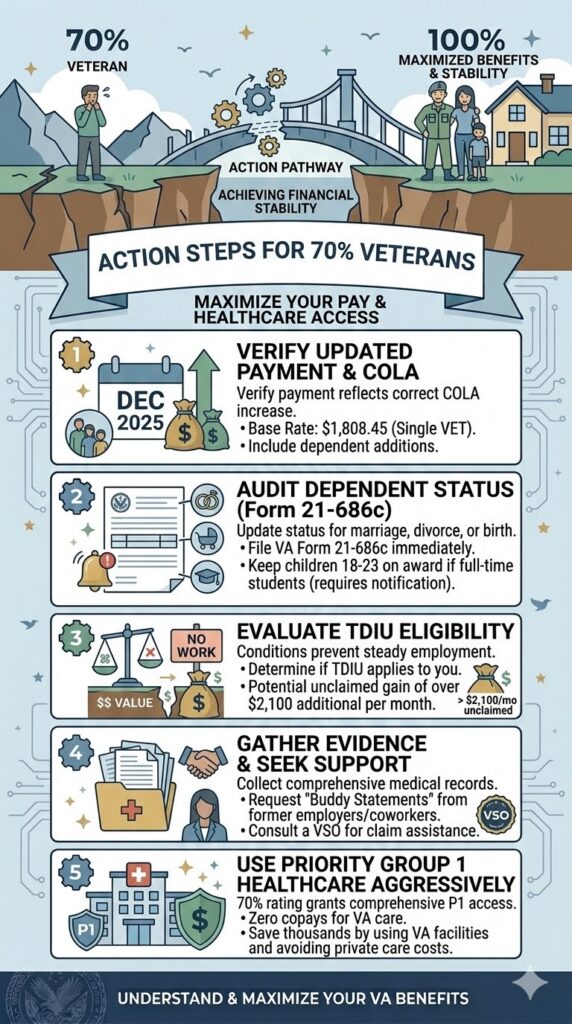
There are some steps you can take to make sure you are getting the benefits you deserve.
- Verify that your December 2025 payment reflects the updated $1,808.45 base rate plus any dependent additions. If it does not, contact the VA to ensure the COLA increase was applied correctly.
- Audit your dependent status. Life changes like marriage, divorce, birth of a child, or a child turning 18 require VA Form 21-686c filings. Children between 18 and 23 who are in school full-time can remain on your award, but you must notify the VA.
- Evaluate whether TDIU applies to your situation. If your service-connected conditions prevent you from holding steady employment, you may be leaving over $2,100 per month unclaimed.
- Gather medical evidence, request buddy statements from former employers or coworkers, and consider consulting a Veterans Service Organization (VSO) for assistance with your claim.
- Use your Priority Group 1 healthcare status aggressively. Every dollar you spend on private urgent care copays or out-of-pocket prescriptions is money you could save by using VA facilities.
Your 70% rating grants you access to comprehensive care at no cost—take full advantage of it.
What a 70% Rating Really Looks Like
Imagining this in a real-life scenario helps many people think about what it could do for them. So, picture this: Marcus, a 42-year-old Army veteran, has a 70% combined disability rating due to PTSD (50%) and a chronic back injury (40%).
Based on the 2026 VA compensation rates, he receives $1,961.45 per month with his spouse listed as a dependent. On paper, that sounds like solid support, but in reality, Marcus struggles to hold steady work as a warehouse supervisor because his conditions cause frequent absences and physical limitations.
Over time, he began missing three to four days of work each month, eventually leading to his resignation. His former employer even provided a statement confirming that Marcus couldn’t maintain consistent attendance due to his service-connected conditions.
Now, Marcus earns about $12,400 annually doing occasional freelance work, which falls below the federal poverty threshold. This puts him in a strong position to qualify for Total Disability based on Individual Unemployability (TDIU), allowing him to be paid at the 100% rate—around $3,938 per month. That’s an increase of over $2,000 monthly, which could completely change his financial stability and reduce the pressure to work beyond his physical and mental limits.
Frequently Asked Questions
How much does a 70% VA disability rating pay per month in 2026?
A single veteran with a 70% VA disability rating receives $1,808.45 per month in 2026, tax-free. Veterans with dependents receive more: $1,961.45 with a spouse, or $2,074.70 with a spouse and one child. These rates reflect the 2.8% COLA increase effective December 1, 2025.
What benefits do you get at 70% VA disability?
At 70% VA disability, you receive Priority Group 1 Health Care with no copays for hospital visits, primary care, specialty care, and prescriptions for service-connected conditions. You also become eligible for TDIU, mandatory VA nursing home care if clinically needed, and Concurrent Receipt (CRDP) if you’re a military retiree. Many states offer property tax exemptions at this rating level.
Can you get 100% VA pay with a 70% disability rating?
Yes, through Total Disability based on Individual Unemployability (TDIU). If your service-connected disabilities prevent you from maintaining substantially gainful employment, you can receive the full 100% compensation rate ($3,938.58+ per month) even with a 70% combined rating. You must have at least one disability rated at 40% or higher to qualify.
What is the income limit for TDIU in 2026?
To qualify for TDIU, your earnings must stay below the federal poverty threshold, which is approximately $15,800 for a single person in 2026. Marginal employment like odd jobs is allowed as long as you remain under this limit. Substantially gainful employment disqualifies you from TDIU benefits.
Do you have to add dependents to your VA disability claim?
Yes, the VA does not automatically add dependents to your award. You must formally add them by filing VA Form 21-686c to receive higher compensation rates. You also need to update this form when dependents are added, removed, or when a child turns 18 but remains in school.
What is the difference between 70% and 100% VA disability pay?
The financial gap between 70% and 100% VA disability is roughly $2,100 per month. A single veteran at 70% receives $1,808.45 monthly, while 100% pays $3,938.58 or more. However, 70% unlocks critical non-monetary benefits like free healthcare and TDIU eligibility that can help bridge this gap.
Can applying for a VA disability increase cause a rating reduction?
While veterans often fear “poking the bear,” veteran advocates consistently advise that if your condition has worsened and you have supporting medical evidence, the risk is worth pursuing. Submit lay statements from former employers detailing why you couldn’t sustain employment to strengthen your claim for increases or TDIU.
Make Sure Your Benefits Work for You
Navigating VA benefits can feel overwhelming, especially when your health and finances are already under pressure. But you don’t have to figure it out alone, and you shouldn’t settle for less than what you’re entitled to. Even small updates to your claim or additional documentation can make a meaningful difference in your monthly compensation. Taking that next step can bring both financial relief and peace of mind.
 AllVeteran.com Advisors
With expertise spanning local, state, and federal benefit programs, our team is dedicated to guiding individuals towards the perfect program tailored to their unique circumstances.