













Quick Answer
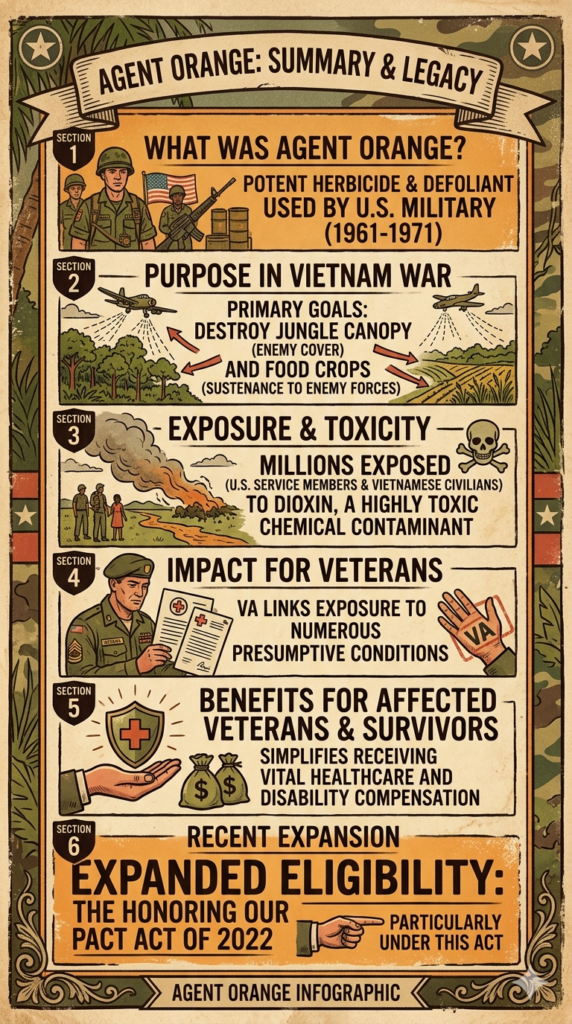
Agent Orange was a potent herbicide and defoliant used by the U.S. military during the Vietnam War (1961-1971), primarily to destroy jungle canopy and food crops that provided cover and sustenance to enemy forces. Its use exposed millions of U.S. service members and Vietnamese civilians to dioxin, a highly toxic chemical contaminant. For Vietnam veterans, this exposure is now linked by the Department of Veterans Affairs (VA) to numerous presumptive conditions, simplifying the process for affected veterans and their survivors to receive vital healthcare and disability compensation, particularly under the expanded eligibility of the Honoring our PACT Act of 2022.
Why This Update
The PACT Act opened the door for thousands of Vietnam veterans who were previously shut out. We wrote this guide so you can see the full list of presumptive conditions, know if you qualify, and file with confidence.
Author’s Take
This one is personal for me. I’ve worked with Vietnam-era veterans who spent decades thinking they couldn’t get benefits, men and women who were sick for years and never connected it to their service. The PACT Act changed the game, but too many veterans still don’t know they’re eligible, especially Blue Water Navy vets and those stationed in Thailand. My advice: if you served anywhere near Vietnam between 1962 and 1975 and you have a health condition you’ve been living with, check the presumptive list. Don’t assume you don’t qualify.
What Was Agent Orange and Where Was it Used in Vietnam?
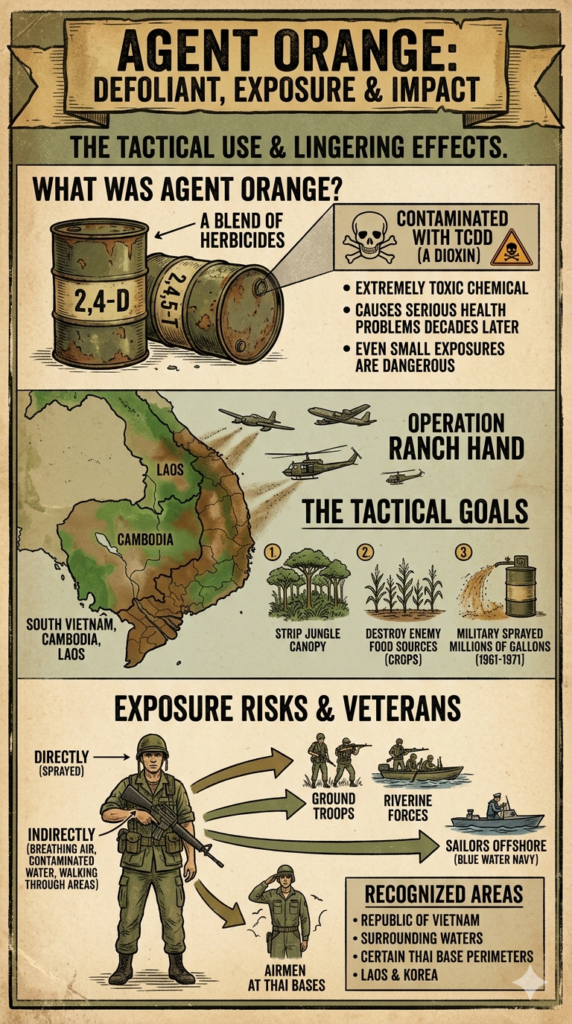
Agent Orange was a blend of two herbicides, 2,4-D and 2,4,5-T, contaminated with 2,3,7,8-tetrachlorodibenzo-p-dioxin (TCDD), an extremely toxic dioxin. That contamination makes Agent Orange dangerous. TCDD is one of the most toxic chemicals ever studied. Even small exposures can cause serious health problems decades later.
It was one of several “Rainbow Herbicides” used in Operation Ranch Hand to defoliate forests and destroy enemy food sources across large areas of South Vietnam, Cambodia, and Laos. The military sprayed millions of gallons from aircraft, helicopters, trucks, and boats between 1961 and 1971. The goal was tactical: strip away the jungle canopy so enemy forces couldn’t hide, and destroy crops to cut off their food supply.
U.S. military personnel, including ground troops, riverine forces, and those on ships operating in the inland waterways, were exposed directly or indirectly through contaminated environments. You didn’t have to be sprayed directly to be exposed. Walking through treated areas, drinking contaminated water, or even breathing the air near sprayed zones could lead to dioxin entering your body.
Specific areas of concern for exposure include the Republic of Vietnam, surrounding waters (Blue Water Navy), and certain base perimeters in Thailand. The VA now recognizes that exposure wasn’t limited to boots-on-the-ground combat troops. Sailors offshore, airmen stationed at Thai bases, and personnel in Laos and Korea also faced exposure risks.
Understanding VA Presumptive Conditions for Agent Orange Exposure
The VA maintains a list of diseases presumed to be caused by Agent Orange exposure, so veterans don’t need to prove a direct link to their military service. Instead of spending years gathering medical evidence to show your cancer or heart disease came from Agent Orange, you only need to show you served in a qualifying location and have a diagnosis.
Conditions like various cancers (prostate cancer, lung cancer, Hodgkin’s disease), Parkinsonism, ischemic heart disease, and Type 2 diabetes are among the established presumptive conditions. The full list covers 15 conditions, including AL amyloidosis, chloracne, multiple myeloma, non-Hodgkin’s lymphoma, peripheral neuropathy (early onset), porphyria cutanea tarda, and soft tissue sarcomas.
The Honoring our PACT Act of 2022 added new presumptive conditions for Agent Orange, including high blood pressure (hypertension) and monoclonal gammopathy of undetermined significance (MGUS). Hypertension alone affects millions of Vietnam veterans, and adding it to the presumptive list opened benefits to thousands who previously couldn’t get service connection.
Presumptive status applies to veterans who served in specific locations during defined periods, especially those who served in Vietnam between January 9, 1962, and May 7, 1975, or in other designated areas. If you were in-country during those dates, even for a single day, and you develop a presumptive condition, you’re covered. The VA automatically assumes your exposure happened, and you don’t have to prove it.
How to File a VA Claim for Agent Orange-Related Conditions
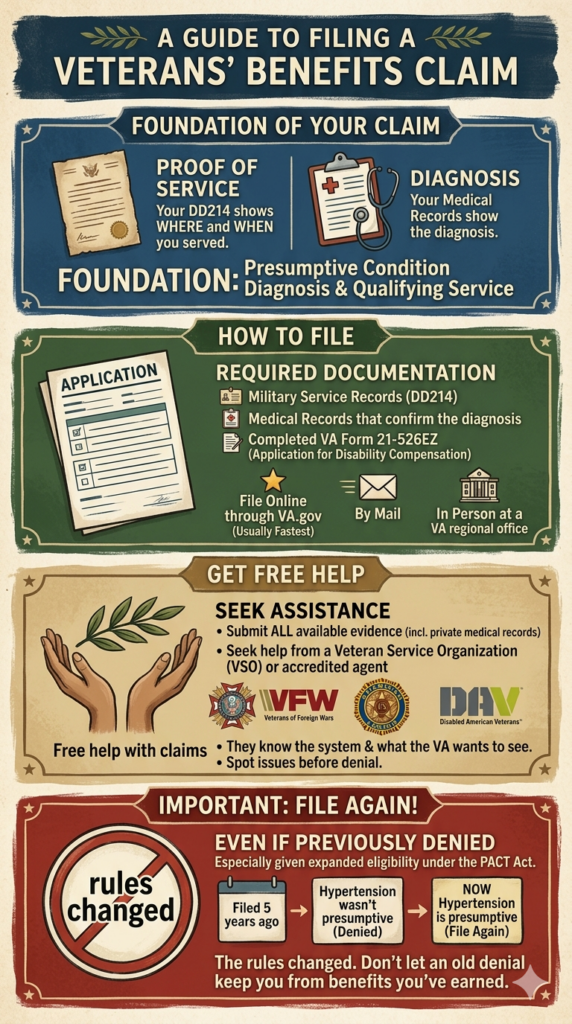
To file a claim, veterans must have a diagnosis of a presumptive condition and proof of service in a qualifying location and timeframe. Your DD214 shows where and when you served. Your medical records show the diagnosis. That’s the foundation of your claim.
Required documentation typically includes military service records (DD214), medical records that confirm the diagnosis, and a completed VA Form 21-526EZ, “Application for Disability Compensation and Related Compensation Benefits.” You can file online through VA.gov, by mail, or in person at a VA regional office. Online filing is usually fastest.
Veterans should submit all available evidence, including private medical records, and can seek help from a Veteran Service Organization (VSO) or accredited agent. VSOs like the Veterans of Foreign Wars (VFW), American Legion, and Disabled American Veterans (DAV) offer free help with claims. They know the system, they know what the VA wants to see, and they can spot issues before your claim gets denied.
The VA encourages veterans to apply even if they were previously denied, especially given the expanded eligibility under the PACT Act. If you filed five years ago and got denied because hypertension wasn’t presumptive yet, file again. The rules changed. Don’t let an old denial keep you from benefits you’ve earned.
Current VA Benefits and Support for Agent Orange-Exposed Veterans in 2026
Approved claims result in monthly tax-free disability compensation. The amount varies based on the disability rating and dependent status. A 10% rating gets you a few hundred dollars a month. A 100% rating can mean over $3,000 monthly, tax-free, for life. The rating depends on how severe your condition is and how much it affects your ability to work and function.
Veterans with Agent Orange-related conditions are often eligible for VA healthcare and disability benefits, including specialized care and prescription medications. Once you’re service-connected for an Agent Orange condition, you get Priority Group 1 enrollment, the highest priority for VA healthcare. That means better access to appointments, specialists, and treatments.
Additional benefits may include vocational rehabilitation, home loan guarantees, and survivor benefits for eligible dependents if the veteran’s death was service-connected due to Agent Orange. If your condition prevents you from working, vocational rehab can help you retrain for a new career. If you die from a service-connected condition, your spouse and dependents can receive monthly Dependency and Indemnity Compensation (DIC) payments.
The VA offers specific registries like the Agent Orange Registry health exam to help veterans understand potential health issues and monitor their health over time. The registry exam is free, even if you’re not enrolled in VA healthcare. It’s a health screening to document potential exposure effects and catch problems early, not a claim exam.
The PACT Act’s Expansive Impact on Agent Orange Claims
The Sergeant First Class Heath Robinson Honoring our Promise to Address Comprehensive Toxics (PACT) Act of 2022 expanded the scope of VA benefits for toxic exposure, including Agent Orange. It added multiple conditions and changed how the VA approaches toxic exposure claims.
It added new presumptive conditions, making it easier for veterans with hypertension, MGUS, and other newly listed conditions to receive benefits without proving a direct service connection. Before the PACT Act, getting service connection for high blood pressure was nearly impossible unless you could show it started in service or was directly caused by another service-connected condition. Now it’s automatic for Vietnam veterans.
The Act also expanded the list of covered locations for Agent Orange exposure, notably including “Blue Water Navy” veterans who served offshore of Vietnam and veterans exposed at certain bases in Thailand. Blue Water Navy veterans fought for decades to get recognition. They served on ships in the waters off Vietnam, not on land, and the VA argued they weren’t exposed. The PACT Act settled that fight. If you served on a ship operating in the offshore waters during the war, you’re covered.
The PACT Act has provided a new opportunity for veterans whose claims were previously denied to refile, with some benefits being retroactive to the date of original claim submission or to August 10, 2022, depending on the condition. If you filed before August 10, 2024 (two years after the PACT Act’s enactment), and your claim is approved, you may be eligible for retroactive benefits back to August 10, 2022. That can mean tens of thousands of dollars in back pay.
Example Scenario
If you served as a “Blue Water Navy” veteran off the coast of Vietnam in 1968 and were later diagnosed with ischemic heart disease, you may now be eligible for VA disability benefits. Prior to the PACT Act, proving direct exposure was often challenging, leading to denials. However, with the expanded presumptive conditions and covered service locations, your claim could now be approved, granting you access to monthly compensation and comprehensive VA healthcare.
Frequently Asked Questions
Q1: What is the key chemical in Agent Orange that causes health issues?
A: The key chemical contaminant in Agent Orange responsible for severe health issues is 2,3,7,8-tetrachlorodibenzo-p-dioxin (TCDD), an extremely toxic form of dioxin.
Q2: Which specific locations and service periods qualify for Agent Orange presumptive conditions?
A: Service in the Republic of Vietnam between January 9, 1962, and May 7, 1975, or in the waters offshore (Blue Water Navy), is commonly accepted. Other locations include certain bases in Thailand, and specific areas in Korea and Laos during defined periods.
Q3: Can survivors of Vietnam veterans claim benefits related to Agent Orange?
A: Yes, survivors may be eligible for Dependency and Indemnity Compensation (DIC) if the veteran’s death was due to a service-connected Agent Orange-related condition, or if the veteran was totally disabled from a service-connected condition for a specific period before death.
Q4: Does the PACT Act cover all types of toxic exposure, or just Agent Orange?
A: The PACT Act is comprehensive, addressing various forms of toxic exposure, including Agent Orange, burn pit exposure, and other contaminants, by expanding presumptive conditions and covered locations for multiple toxic agents.
Q5: Is there a deadline to file an Agent Orange claim under the PACT Act?
A: While there isn’t a specific deadline to file an initial claim, veterans who file before August 10, 2024 (two years after the PACT Act’s enactment) may be eligible for retroactive benefits back to August 10, 2022, if their claim is approved.
Q6: How can I find out if my specific condition is recognized as presumptive for Agent Orange?
A: You can review the official VA website, consult with a VA-accredited representative, or contact a Veteran Service Organization (VSO) to get the most current list of presumptive conditions and eligibility criteria.
 AllVeteran.com Advisors
With expertise spanning local, state, and federal benefit programs, our team is dedicated to guiding individuals towards the perfect program tailored to their unique circumstances.