












Refinancing a home loan can be one of the smartest financial moves a veteran makes, but not all refinance options are created equal. For those who already have a VA-backed mortgage, there’s a special program designed to simplify the process, lower monthly payments, and create long-term financial stability. It’s called the VA IRRRL, often referred to as the VA Streamline Refinance, and it’s one of the easiest ways for veterans to take advantage of today’s interest rates without the hassle of a full loan application.
Let’s take a look at exactly what a VA IRRRL is, how it works, and why so many veterans are using it to save money, gain peace of mind, and make their VA benefits work harder for them.
Why This Update
Home loans are not to be taken lightly, and we want to make sure you have the most updated information to base your decisions on.
Tamila’s Take
This program isn’t just a refinance. It’s a lifeline for veterans trying to stretch every dollar. With the IRRRL, you won’t need a new appraisal. You won’t have to jump through hoops to prove your income again. And you won’t have to worry about my credit score holding me back. It can be fast, simple, and save you hundreds of dollars a month.
But here’s what many veterans don’t realize: the IRRRL only works if you already have a VA loan. And it’s not for cash-out refinancing. It’s strictly to lower your rate or switch from an adjustable to a fixed mortgage. Still, for those of us living on a fixed income or trying to stabilize our finances, that monthly savings can be a game-changer.
Guidelines for IRRL
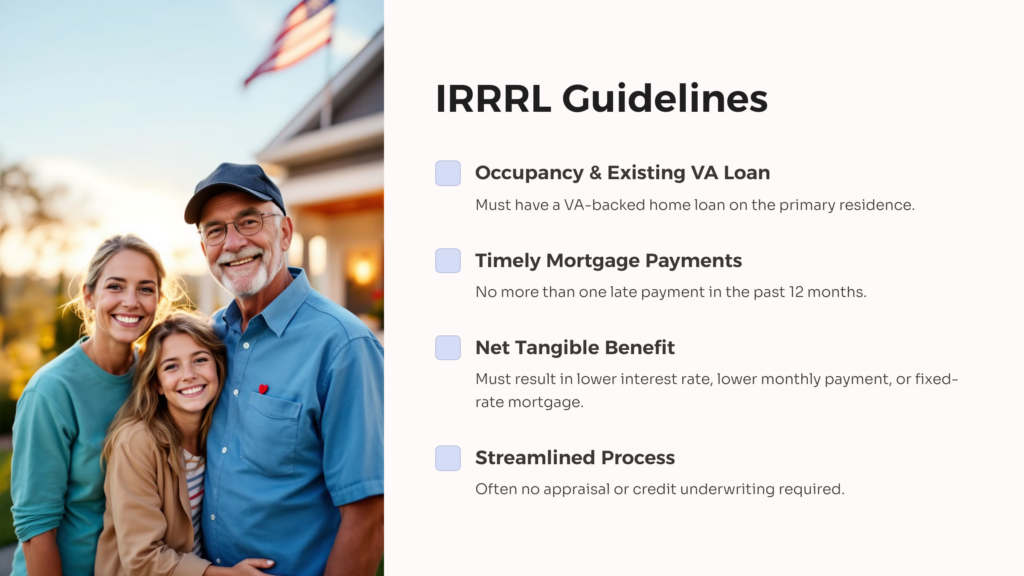
There are some guidelines you need to meet to be approved for VA IRRRL. Here are some criteria that you need to meet.
Occupancy & Existing VA Loan: The borrower must currently have a VA-backed home loan on the property being refinanced and ensure that is their primary residence.
Timely Mortgage Payments: A good payment history on the existing VA loan is important, as with any refinance. Ensure that there is no more than one late payment in the past 12 months to achieve desired results.
Net Tangible Benefit: The refinance must result in a tangible benefit to the borrower, meaning either a lower interest rate, a lower monthly payment, or a move from an adjustable-rate mortgage to a fixed-rate mortgage.
No Appraisal or Credit Underwriting: In many cases, an appraisal or credit underwriting may not be required, making the process more streamlined.
How Does VA IRRRL Work?
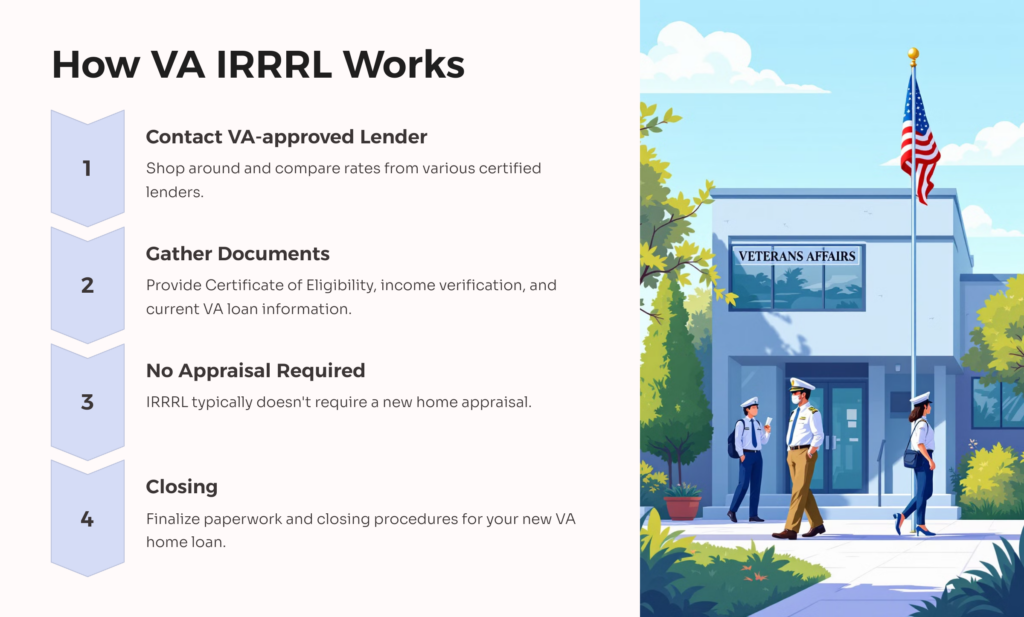
When you are trying to get approval for a VA IRRL, you need to know the ins and outs of how the process works. It can be broken down into four simple steps.
- Contact a VA-approved lender: Shop around and compare rates from various lenders such as a private bank, mortgage company, or credit union certified to offer VA loans. Terms and fees may vary by customer, so ensure to contact multiple lenders to review your options.
- Gather required documents: Provide paperwork like your Certificate of Eligibility (COE), income verification, and current VA loan information. If you don’t have your original COE, ask your VA lender to get your COE electronically through the VA Home Loan program portal.
- No appraisal: Unlike typical refinances, an IRRRL typically doesn’t require a new home appraisal.
- Closing: Once approved, finalize the paperwork and closing procedures for your new VA home loan.
Benefits of VA IRRRL for Veterans:
There are numerous benefits to VA IRRRL for veterans. First, if interest rates have fallen since you took out your original loan, you could lower your monthly payment significantly by refinancing to a new, lower rate.
On top of that, small interest rate drops can result in substantial savings over the life of your loan, freeing up money for other expenses. Additionally, closing costs may be minimal or nonexistent.
If you have an adjustable rate mortgage (ARM), an IRRRL is essential in converting your payments to a predictable fixed rate mortgage, protecting you from future interest rate hikes through the duration of your existing loan.
Compared to traditional refinances, IRRRLs involve less paperwork and require no new appraisal, leading to a significantly quicker closing time.
Unlike typical refinances, credit checks are often waived or less stringent with IRRRLs, making them an option for Veterans with less-than-perfect credit. In other words, a low credit score doesn’t exactly disqualify you from achieving this type of refinance.
Disadvantages of VA IRRRL for Veterans:
That said, there are some disadvantages of VA IRRRL for veterans. It is important to note that IRRRLs are designed for refinance rate and term refinancing ONLY. Cash-out refinancing is not applicable to this instrument. This can be a major downside, particularly considering recent steep increases in equity for many, as home values have risen. With an IRRRL, you won’t be able to tap into this equity to pay down debt, pay for home improvements, or reach another financial goal.
You will also be ineligible for a streamline refinance if your new VA refinance rates are higher than your original rate. Additionally, the VA IRRRL has a 0.5 percent funding fee, but it can be included in the loan amount so as to avoid upfront expenses.
And, depending on the lender, your credit, income, and employment may be reviewed lightly or not at all.
Comparison with Traditional Refinance:
When you look at how a traditional refinance compares with a VA IRRRL, there are some key differences.
- VA Funding Fee: A one-time fee based on the loan amount helps offset the program’s cost to taxpayers.
- Closing Costs: You may be responsible for various closing costs such as origination fees, title insurance, and recording fees.
- Interest Rate: Remember, while you’re aiming for a lower loan estimate, compare different lenders and offers to ensure the overall package is beneficial.
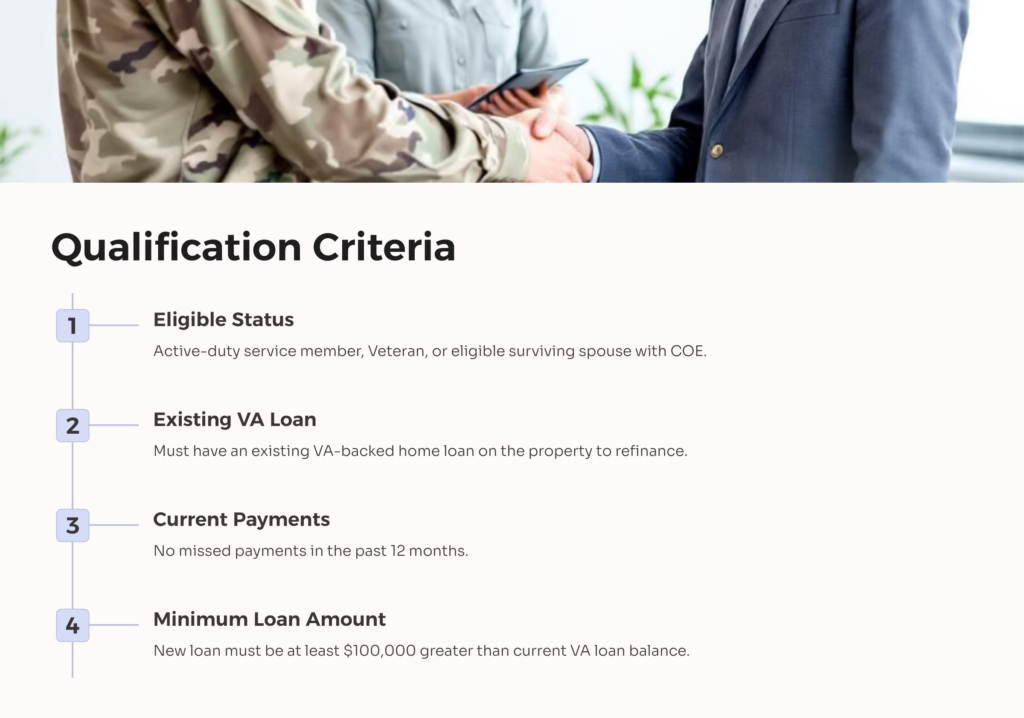
To qualify for a VA IRRRL, you must meet specific criteria:
- Active Duty, Veteran, or Eligible Surviving Spouse: You must be an active-duty service member, Veteran, or eligible surviving spouse with a Certificate of Eligibility (COE).
- Existing VA Loan: You must have an existing VA-backed home loan on the property you want to refinance. If there is a second mortgage on your home, it is necessary to have your mortgage lender agree to position your newly refinanced VA loan as the first mortgage.
- Current on Payments: You must be current on your mortgage payments with no missed payments in the past 12 months.
- Minimum Loan Amount: The new loan amount must be at least $100,000 greater than your current VA loan balance.
Documentation Requirements:
You will need some documentation to make your VA IRRRL process to go as smoothly as possible. Here is what you will need.
- VA Form 26-0285, VA Transmittal List.
- VA Form 26-0286, VA Loan Summary Sheet.
- VA Form 26-8320, Certificate of Eligibility.
- VA Form 26-8998, Acknowledgment of Receipt of Funding Fee from Mortgagee, or (if applicable)
- VA Form 26-0500, Notification to Mortgagee of Funding Fee Shortage to Mortgagee, or evidence borrower is exempt.
- Written Statement: signed veteran acknowledgment of the effect of the refinancing loan on the veteran’s existing loan payments and interest rate.
- Must Contain: the interest rate and monthly payments for the new loan versus that for the old loan.
- VA Form 26-8923, Interest Rate Reduction Refinancing Loan Worksheet.
- VA Form 26-1820, Report and Certification of Loan Disbursement.
- VA Form 26-8937, Verification of VA Benefit Related Indebtedness (if applicable).
- HUD-1 Settlement Statement (if applicable).
- VA Form 26-0503, Federal Collection Policy Notice.
- Any other necessary documents required by your VA lender.
Example
Jack, a veteran living in Texas, secured a VA home loan five years ago with a 4.5% adjustable-rate mortgage. With current interest rates significantly lower, he decided to explore a VA IRRRL. He quickly found a lender who offered a 3.0% fixed-rate, reducing his monthly payment by $150. The process was swift, requiring no new appraisal, and he rolled the minimal funding fee into his new loan, creating long-term financial predictability.
Frequently Asked Questions
What is the main purpose of a VA IRRRL?
The main purpose of a VA IRRRL is to help veterans with existing VA loans reduce their interest rate, lower monthly payments, or convert from an adjustable-rate to a fixed-rate mortgage, thereby achieving a ‘net tangible benefit’.
Can I get cash out with a VA IRRRL?
No, a VA IRRRL is strictly for rate and term refinancing and does not allow for cash-out options. If you need to access home equity, you would need to explore other VA refinance programs or conventional options.
Do I need a new appraisal for a VA IRRRL?
In most cases, a new appraisal is not required for a VA IRRRL, which helps streamline the process, reduces paperwork, and often lowers closing costs compared to traditional refinances.
What is the ‘net tangible benefit’ requirement for an IRRRL?
The ‘net tangible benefit’ means the refinance must provide a clear financial advantage to the veteran, such as a lower interest rate, lower monthly payment, or a beneficial change from an adjustable to a fixed-rate mortgage.
Is there a VA funding fee for an IRRRL?
Yes, typically a 0.5% VA funding fee is required for an IRRRL, but it can be rolled into the loan amount. Veterans receiving VA disability compensation may be exempt from this fee.
Can I get an IRRRL if I’ve had late payments on my current VA loan?
While lenders prefer a strong payment history, many lenders may allow for no more than one late payment in the past 12 months. Consistent late payments may make it challenging to qualify for the streamlined process.
How long does the VA IRRRL process typically take?
Due to its streamlined nature, an IRRRL can often close much faster than a traditional refinance, sometimes within 30 days, depending on the lender and the borrower’s responsiveness
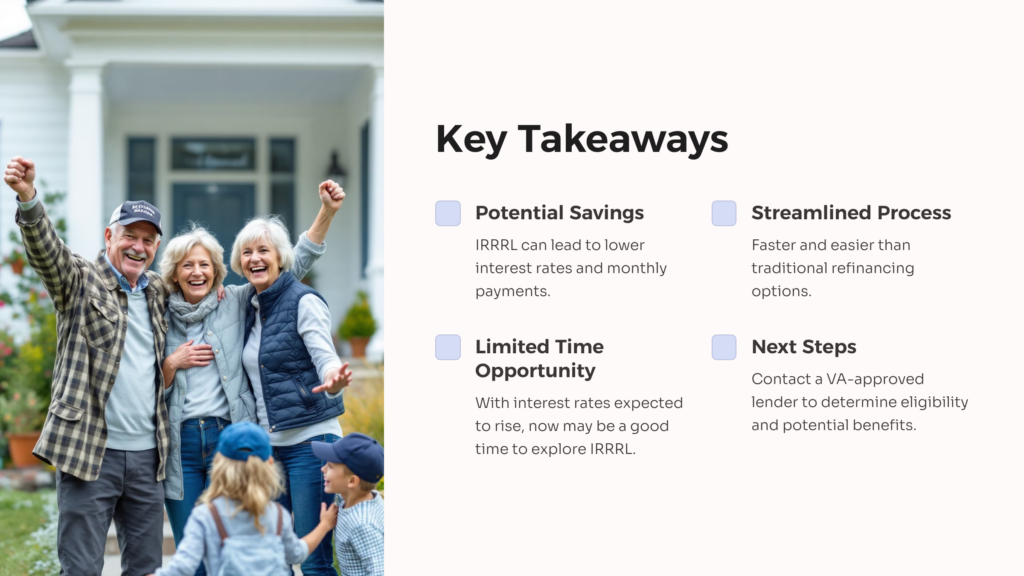
Secure Your Financial Future with a VA IRRRL
The VA Interest Rate Reduction Refinance Loan (IRRRL) offers veterans a simple and effective way to lower monthly payments, lock in stable interest rates, and achieve long-term financial security. By converting from an adjustable-rate to a fixed-rate mortgage, veterans can protect themselves from future rate hikes and enjoy greater peace of mind.
With interest rates fluctuating, there’s never been a better time to explore whether refinancing through the IRRRL program makes sense for you. If you have more questions about VA home loans or other benefits, visit us at AllVeteran.com!
 AllVeteran.com Advisors
With expertise spanning local, state, and federal benefit programs, our team is dedicated to guiding individuals towards the perfect program tailored to their unique circumstances.