













Have you ever wondered what happens to your documentation after you have sent it in? The Department of Veterans Affairs (VA) has an Evidence Intake Center (EIC) that receives, processes, and stores all of the supporting documents for disability benefit claims.
The EIC plays a crucial role in determining how fast (or slow) your claim is processed. It also has a large impact on the accuracy of your claim. If you receive a letter from the VA Evidence Intake Center, make sure to read it carefully and follow any instructions provided as soon as possible to avoid delays.
Tamila’s Take:
Many veterans get frustrated not because they lack strong claims, but because their evidence isn’t submitted properly. Knowing the ins and outs of where to send your documents, what medical evidence is acceptable, and how to send them correctly can make a world of difference between a delayed denial and fast approval.
What Is the VA Evidence Intake Center?
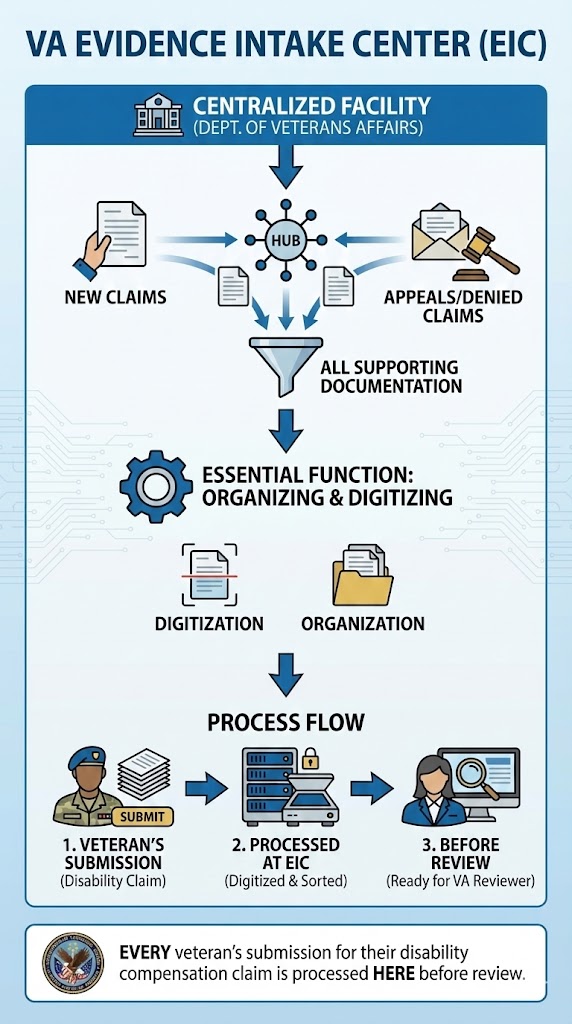
The VA Evidence Intake Center (EIC) is a centralized facility managed by the Department of Veterans Affairs, designed to handle all supporting documentation related to disability claims. Whether you’re appealing a denied claim or submitting a new one, any evidence you want the VA to consider needs to go here.
The EIC is essential for organizing and digitizing all incoming documents. Every veteran’s submission for their disability compensation claim is processed here before review.
What Documents Should You Send to the VA Evidence Intake Center
You should only send documents that support or clarify your disability claim. This documentation can include:
- Medical records (from VA or private doctors)
- Service treatment records
- Statements from family, friends, or fellow service members (also called “buddy letters”)
- Nexus letters from doctors linking your condition to service
- Marriage, birth, or dependent documentation (for increased benefits)
- Any additional evidence that supports your claim
Do not send original documents unless requested. Send copies and keep the original documentation for your own files. It’s a good idea to keep extra copies of what you sent in as well for your own records.
How to Submit Evidence
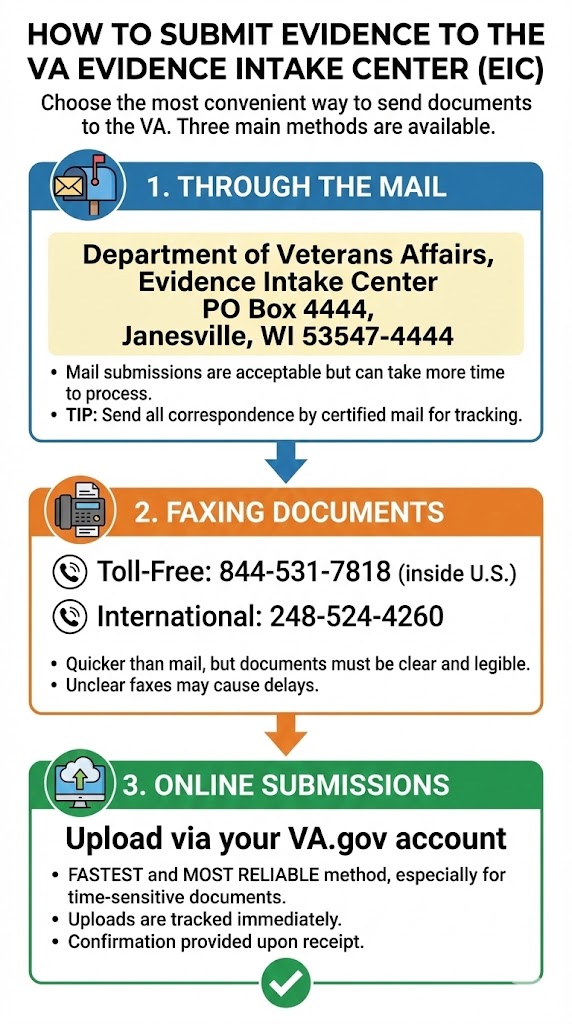
You have several ways to submit documents to the VA Evidence Intake Center, depending on what’s most convenient for you. The three main ways people submit evidence are through the mail, via fax, or online. Here is what you need to know about each submission type.
Through the Mail
Veterans can submit information to the EIC through the mail. The mailing address is as follows:
Department of Veterans Affairs
Evidence Intake Center
PO Box 4444
Janesville, WI 53547-4444
However, you should keep in mind that while mail submissions are acceptable, they can take more time to process. Make sure to send all correspondence to the Evidence Intake Center by certified mail to ensure tracking.
Faxing Documents to the EIC
The next way veterans can submit their documentation to the EIC is via fax. There are two tax numbers you can use.
Toll-Free: 844-531-7818 (inside U.S.)
International: 248-524-4260
While fax is quicker than sending documentation through snail mail, you have to make sure everything you send is clear and legible. If it isn’t, it could cause delays in the process.
Online Submissions
You can upload documents via your VA.gov account. This is the fastest and most reliable method, especially when time-sensitive. Uploads are tracked immediately, and you are provided with a confirmation that your documents have been received.
How the Evidence Intake Center Affects Your VA Claim Timeline
Once your documents reach the EIC, they are scanned into the VA’s database and added to your file for a processor to review with your disability claim.
Most evidence is reviewed within 7 to 14 days after receipt. Delays can happen if forms are incomplete, hard to read, or misdirected. So ensure that everything you submit is clear, complete, and supports your claim. Any additional evidence received after a decision has been made will be used for an appeal or a supplemental claim.
You can track your submissions using your VA.gov claims portal to monitor the process in real time.
An Example Of How Understanding the EIC Helps in Real Life
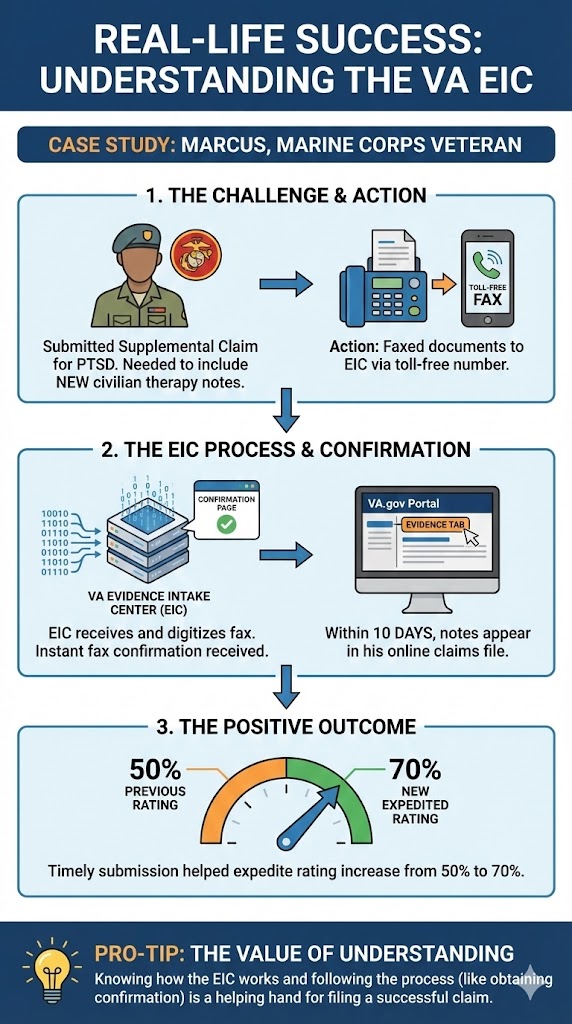
Marcus, a Marine Corps veteran, submitted a supplemental claim for PTSD and included new therapy notes from a civilian doctor. He faxed the documents using the VA’s toll-free number and received a confirmation page. Within 10 days, the notes appeared in his claims file under the Evidence tab in his VA.gov portal. This timely submission helped expedite his rating increase from 50% to 70%.
In my experience, having a full understanding of how things work with the EIC and the VA process documentation can lend a helping hand in filing a successful claim.
FAQs About the VA’s Evidence Intake Center
All of that being said, here is a look at several of the most frequently asked questions about the Evidence Intake Center. Reviewing these will give you a big-picture view of the entire process.
- What is the VA Evidence Intake Center? It’s the centralized location where the VA collects and digitizes evidence submitted for disability and benefit claims.
- What’s the best way to submit my claim evidence? Online via VA.gov is the fastest and most reliable method.
- What’s the fax number for the VA Evidence Intake Center? Fax toll-free to 844-531-7818. Make sure your documents are clear and include your name and VA file number on each page.
- Can I send in photos or non-standard documents? Yes, but ensure they are clear, labeled, and relevant to your claim.
- How long does it take for my evidence to be reviewed? Typically, 7 to 14 days. You can track this progress online.
- What happens if I send my documents to the wrong address? It could significantly delay your claim. Always double-check you’re using the official address or upload platform.
- Can I walk into a VA office and submit evidence there? Yes, but those documents will often be sent to the EIC anyway. For speed and accuracy, online is preferred.
Don’t Let Paperwork Derail Your Claim for Disability Compensation
Submitting the right evidence to the VA Evidence Intake Center is more than just a bureaucratic step. It’s the foundation of your entire claim. A single missing document, an unreadable fax, or a misrouted form can delay your disability benefits for weeks or even months. But you don’t have to navigate this process alone.
Whether you need help gathering medical records, writing a nexus letter, or making sure your documentation is complete and properly submitted, AllVeteran.com is here to support you. Their team specializes in helping veterans like you prepare strong, well-documented claims that get noticed and processed faster. From medical reviews to evidence checklists, they’ll walk you through every step.
Your service deserves a fair and timely response. Let AllVeteran.com help you make sure your paperwork tells the full story!
 AllVeteran.com Advisors
With expertise spanning local, state, and federal benefit programs, our team is dedicated to guiding individuals towards the perfect program tailored to their unique circumstances.