













Navigating the Department of Veterans Affairs (VA) disability process can feel overwhelming, especially if you are dealing with the mental and emotional aftermath of trauma. Unfortunately, many veterans leave the service with post-traumatic stress disorder (PTSD). DBQ forms are standardized medical assessment tools used to document and support disability claims for conditions like PTSD. That said, the VA Disability Benefits Questionnaire (DBQ) for post-traumatic stress disorder can be an extremely useful tool for veterans trying to establish or increase a service-connected PTSD rating.
When the VA DBQ for PTSD is completed properly, it can influence the outcome of your claim and even reduce the processing time. To qualify for VA disability benefits, a veteran must be formally diagnosed with PTSD by a qualified provider. That said, many veterans don’t quite understand what it is, how to fill it out, or who can complete it on their behalf. Here’s what you need to know about filling out the VA DBQ for PTSD.
The DBQ for PTSD is specifically designed to document and support a veteran’s PTSD in the VA disability process.
What Is a VA DBQ for PTSD?
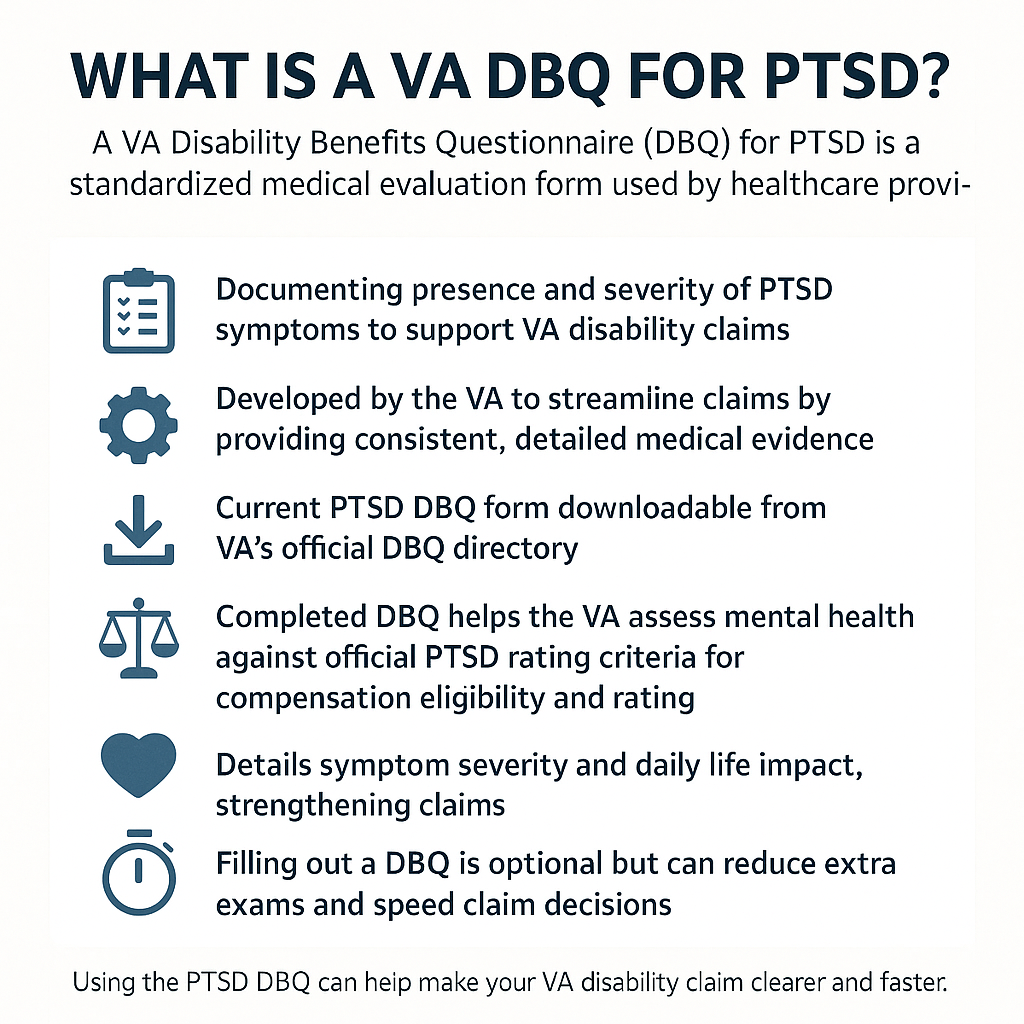
It is a standardized medical evaluation form used by healthcare providers to document the presence and severity of symptoms related to PTSD. DBQ forms are standardized tools that help healthcare providers document medical evidence for VA disability claims. The form was developed by the VA to assist in streamlining the claims process. It ensures that the VA receives consistent, detailed medical evidence.
You can download the current version of the PTSD DBQ form through the VA’s official DBQ directory. When completed, the form helps the VA assess your mental health condition against the official VA PTSD rating criteria, which are based on recognized diagnostic criteria, and determine your eligibility for VA disability compensation and the appropriate disability rating. The DBQ provides detailed information that supports your claim by documenting the severity of your symptoms and their impact on daily functioning.
One important thing to note is that filling out a DBQ is optional. However, including one with your VA PTSD disability claim can strengthen your application. It can also reduce the need for additional exams and potentially even get you a quicker decision.
Why the PTSD DBQ Matters in VA Disability Claims
When the VA evaluates your PTSD claim, it must decide two things:
- Whether your PTSD is connected to your military service
- How severely it affects your daily functioning
The DBQ is a key piece of evidence in a VA disability claim for PTSD, as it provides the medical documentation needed to support your application for benefits.
The DBQ addresses these issues in a medically structured format and ensures that your provider’s input covers all the necessary bases the VA uses to determine your PTSD rating. When reviewing PTSD claims, the VA considers whether a traumatic event occurred during your service and if there is a clear link between that event and your current symptoms. The DBQ uses language and formatting that directly align with the VA’s mental health diagnostic framework. Overall, it can help reduce confusion or misinterpretation of your symptoms, preventing unnecessary delays in your case. A well-prepared DBQ can make all the difference in the world by clearly documenting how PTSD impacts your occupational and social functioning, which are key factors in the VA’s assessment.
Who Can Fill Out the PTSD DBQ Form?
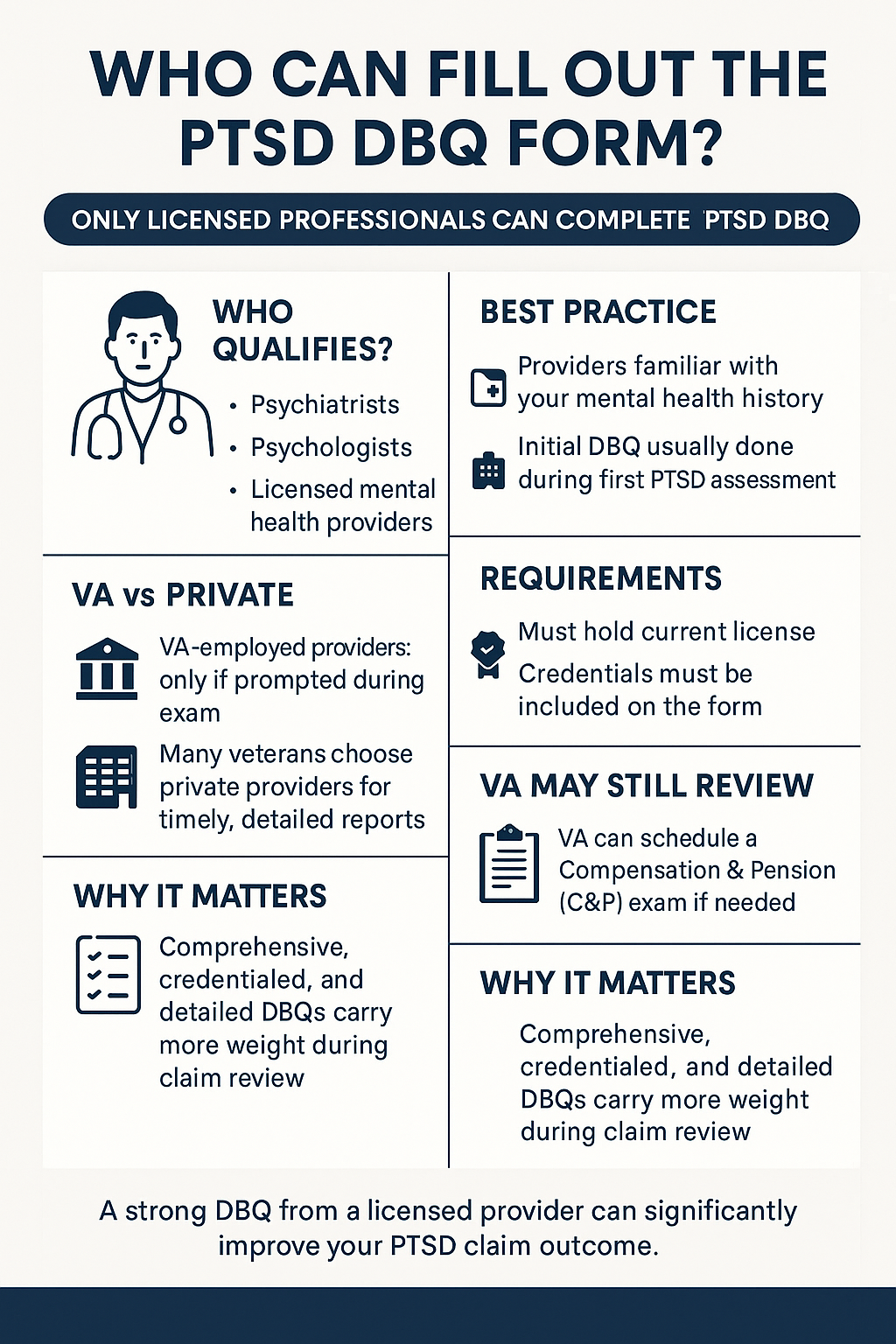
One thing many veterans wonder about is who can fill out the PTSD DBQ form. Most may assume that they can answer the questionnaire themselves, but that isn’t true. Veterans Affairs states that only licensed healthcare professionals can complete the VA DBQ for PTSD. This could be a psychiatrist, psychologist, or other licensed mental health provider. It is also helpful if the provider is already familiar with your mental health history. The initial PTSD DBQ is typically completed during a veteran’s first assessment for PTSD.
It’s also important to note that while VA-employed providers can fill out a DBQ, they usually won’t unless they are prompted to do so during a scheduled exam. For this reason, many veterans applying for disability benefits choose to work with private providers to complete the appropriate DBQ. All evaluators are required to have current licenses and they must include their credentials on the form.
The VA still reserves the right to schedule a Compensation and Pension (C&P) exam if additional information is needed to carry out the claim. Ultimately, the more comprehensive and credentialed the report is, and the more detailed information it provides to support the claim, the more likely it is to carry weight when your claim is being reviewed.
Key Sections of the VA PTSD DBQ Explained
The PTSD DBQ form includes several critical areas that directly influence how the VA evaluates your condition. Understanding these sections can help you ensure nothing is overlooked during your appointment with the provider.
First is the diagnosis section, where your provider must confirm that you have been formally diagnosed with PTSD in line with the Diagnostic and Statistical Manual of Mental Disorders (DSM-5), meeting the official diagnostic criteria for PTSD. This is a foundational requirement for any PTSD claim.
Next is the symptoms checklist. This part of the form covers a wide range of PTSD symptoms—from nightmares and anxiety to memory problems, irritability, and social withdrawal. Your provider rates each symptom based on its frequency and severity, and details how these PTSD symptoms impact your daily life.
Another essential section assesses occupational and social impairment. This is where the evaluator describes how PTSD impacts your occupational and social functioning, including your ability to work and maintain relationships. The VA weighs this section heavily when determining your disability rating percentage.
The final sections include remarks, test results, and an overall summary of your mental health condition. Together, these entries form the basis of your VA PTSD rating decision.
How the DBQ Supports Your PTSD Claim
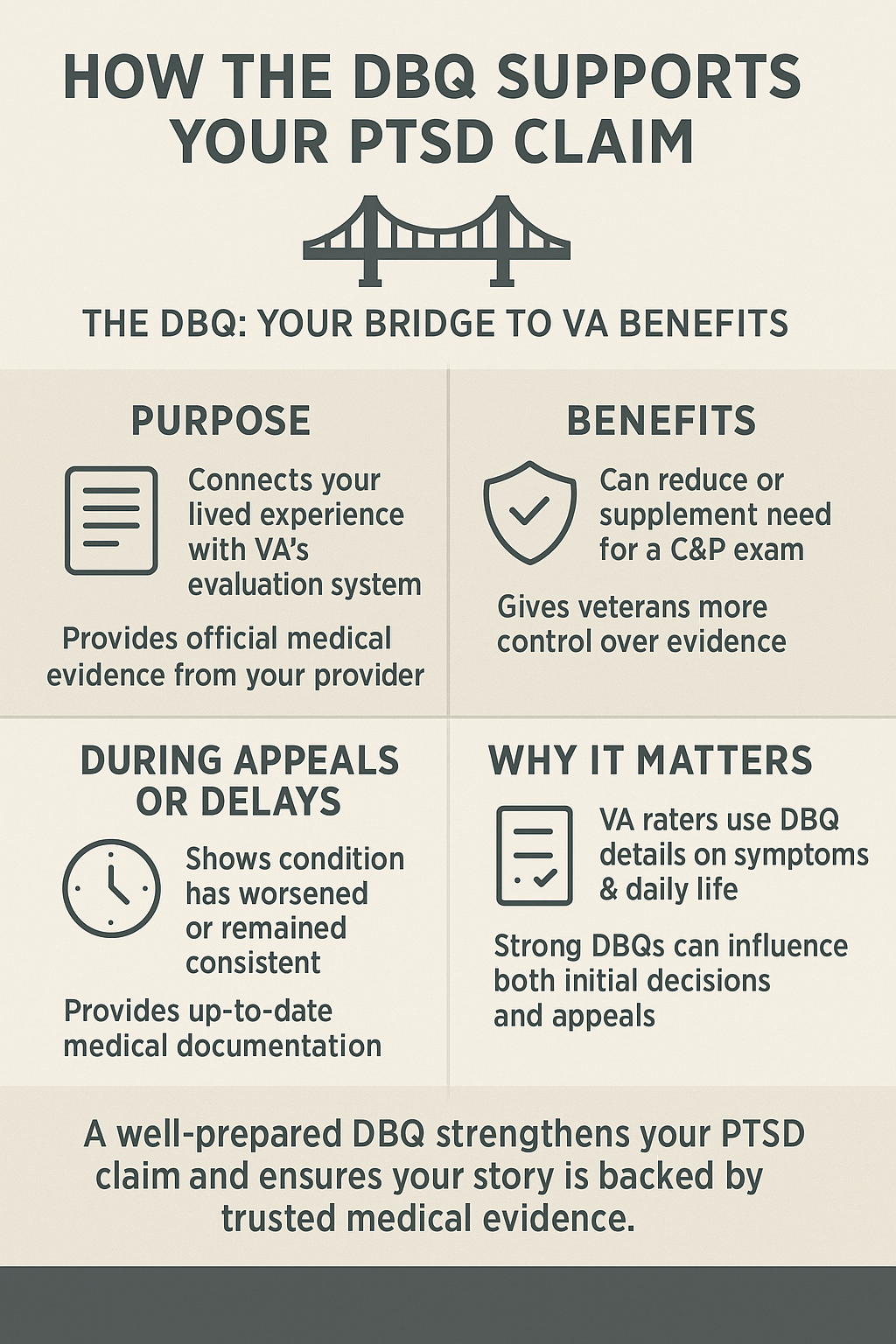
The DBQ form serves as a bridge between your lived experience and the VA’s formal evaluation system. If you’re already being treated for PTSD, this form allows your trusted provider to present an official snapshot of your condition that’s both clinical and contextual, supporting your VA disability claim and benefits claim by providing essential medical evidence.
By submitting a completed PTSD DBQ with your VA claim, you may be able to avoid—or at least supplement—the PTSD C&P exam. Since some veterans find the C&P experience impersonal or frustrating, a DBQ lets you take control of the evidence presented in your case.
In claims involving long wait times or appeals, the DBQ can also serve as up-to-date medical evidence showing that your condition has worsened or remained consistent. The VA rater will review the detailed information provided in the DBQ, including comprehensive data about your PTSD symptoms and daily functioning, to make a decision on your benefits claim. This can make a crucial difference in both initial decisions and review outcomes.
Tips for Veterans: Getting the Most Out of Your DBQ
If you’re preparing to submit a DBQ for PTSD, there are a few steps you can take to make the process more effective.
- Ensure the provider completing the form is experienced with VA disability claims or is willing to review the PTSD rating criteria before your appointment.
- Bring documentation to the appointment, including your military service records, previous diagnoses, and current treatment notes.
- Don’t minimize your experiences. Veterans often understate their symptoms, which can result in a lower rating than deserved.
- Submit the DBQ along with your VA Form 21-0781, the statement in support of a claim for service connection for PTSD.
- Make sure your provider documents any limitations in functioning that you experience due to PTSD symptoms.
- Clearly report how PTSD symptoms affect your ability to perform routine activities and activities of daily living, such as personal hygiene, managing daily tasks, and self-care.
- Describe any difficulties you have in your ability to function independently, including challenges in managing stressful situations or maintaining relationships.
- Explain how your PTSD symptoms impact your ability to perform your own occupation, including any work-related impairments or inability to fulfill job duties.
DBQ vs. C&P Exam: What’s the Difference?
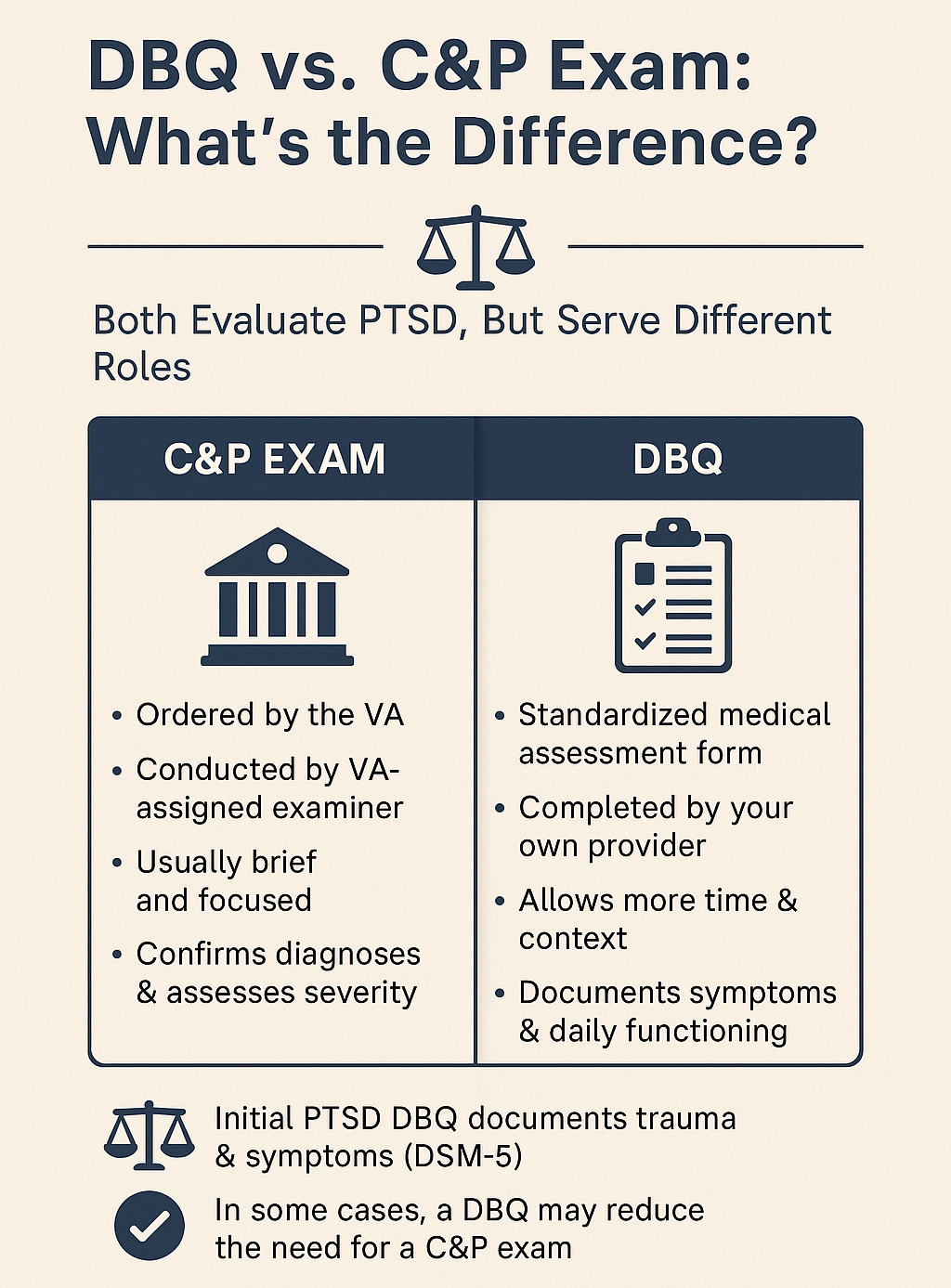
A lot of veterans tend to think that the PTSD DBQ will replace the C&P exam. Both of these are tools used to evaluate PTSD claims. However, they each serve slightly different roles in doing so. A C&P exam is ordered by the VA and conducted by a VA-assigned examiner. Typically, it is a brief exam and focused on confirmed diagnoses as well as assessing the severity of symptoms.
On the other hand, DBQ forms are standardized medical assessment tools that can be carried out by your own provider. This allows more time for discussion and context than a C&P may provide. A DBQ also offers a structured, standardized assessment that aligns with how the VA rates PTSD claims and enables your provider to include detailed information about your symptoms and daily functioning. For your first PTSD assessment, the initial PTSD DBQ is essential for documenting traumatic stressors and symptoms according to DSM-5 criteria. There are some cases where a DBQ might reduce the need for a C&P exam altogether.
FAQs About the VA DBQ for PTSD
Still have questions? Here are some commonly asked questions about filling out the DBQ for PTSD.
- Can I fill out the PTSD DBQ myself? No. The DBQ must be completed and signed by a licensed medical professional who is qualified to evaluate mental health conditions.
- Is submitting a DBQ required for a VA PTSD disability claim? No. It’s not required, but it can greatly strengthen your case and potentially reduce wait times.
- Will the VA still schedule a C&P exam if I submit a DBQ? Possibly. If the VA believes more information is needed, they may still schedule an exam. However, a well-completed DBQ may reduce this likelihood. The DBQ covers a wide range of symptoms such as panic attacks, impaired judgment, memory loss, long term memory issues, disorganized thought processes, impaired impulse control, near continuous panic, inability to recall the names of close relatives or one’s own name, and difficulties in performing activities.
- Can a civilian doctor complete my PTSD DBQ? Yes. As long as the provider is licensed and qualified to assess mental health, the VA will accept a DBQ from a civilian doctor. The DBQ considers exposure to traumatic events, including combat, hostile military actions, and terrorist activity, as well as the impact of depression affecting daily functioning and the ability to adapt to stressful circumstances.
- Does a DBQ guarantee a higher PTSD rating? Not necessarily. The VA still reviews all evidence, but a detailed DBQ can help ensure your symptoms are accurately and fully represented. PTSD includes a wide range of symptoms and functional impairments.
Why the Right Documentation Makes All the Difference
Filing a VA PTSD disability claim can be one of the most emotional and complex steps a veteran takes after leaving service. The DBQ gives you a chance to be seen clearly, not just through the lens of a brief VA exam, but through the eyes of a provider who understands your journey. It’s a chance to bring medical precision to deeply personal pain—and to make your claim stronger in the process.
If you believe your PTSD is service-connected, don’t let paperwork stand in the way of the support you deserve. See how AllVeteran.com can help you get what you need.
 AllVeteran.com Advisors
With expertise spanning local, state, and federal benefit programs, our team is dedicated to guiding individuals towards the perfect program tailored to their unique circumstances.