













Most veterans do not leave the military with a clear moment they can point to and say, “That’s when my back went bad.” For many, the damage happens quietly in the background. It builds during ruck marches, long hours in vehicles, repetitive training, and injuries that were never fully treated. Years later, the pain becomes constant, imaging is ordered, and unfamiliar terms appear in the report.
One of those terms is disc osteophyte complex.
When veterans see it for the first time, they are often told it is a normal finding or a routine sign of aging. That explanation does not sit right for many people who were physically active, relatively young, and had no back problems before service. For veterans, this condition is often tied directly to the physical demands and cumulative stress of military life.
Here is everything you need to know about this condition and how it fits into VA disability claims and long-term care.
Why This Update
Disc osteophyte complex is no joke, and we want to make sure you have the most updated information on ratings and service connections.
Tamila’s Take
I don’t have disc osteophyte complex, but I’ve served with plenty of folks who do, and most of them didn’t even know it until years after they got out. What hits me hardest is how many of us were trained to ignore pain, to push through. That mindset doesn’t just disappear when the uniform comes off.
If your back’s been giving you trouble, don’t wait for it to get worse. Get it checked, get it documented, and don’t let anyone tell you it’s “just age.” You earned better than that.
What Disc Osteophyte Complex Really Means
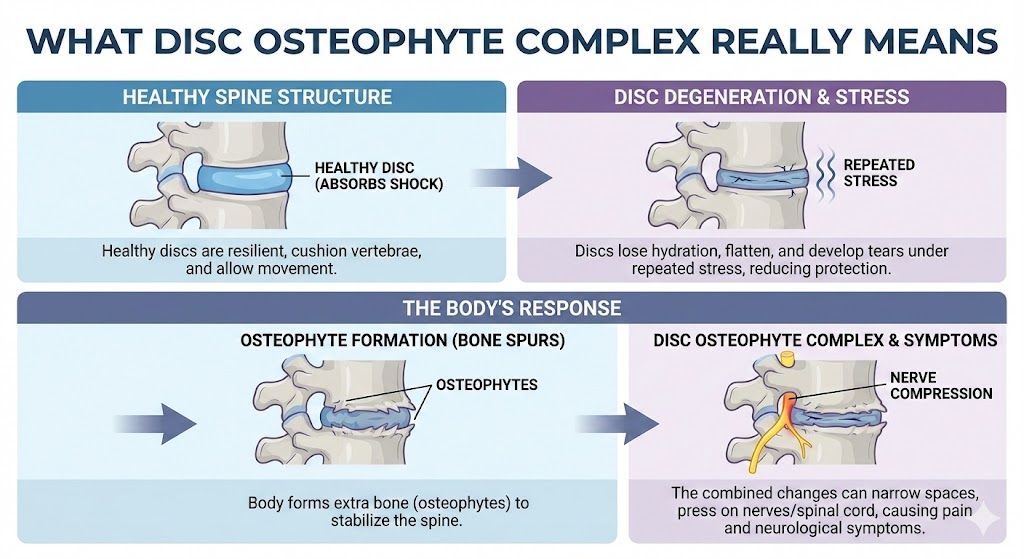
Disc osteophyte complex is not a single injury and it is not something that suddenly appears. It is a description of structural changes in the spine that develop over time.
Between each vertebra sits a disc. These discs absorb shock and allow the spine to move. When discs are healthy, they are flexible and resilient. Under repeated stress, discs can lose hydration, flatten, or develop small tears. This reduces their ability to protect the spine.
When that happens, the spine becomes less stable. The body reacts by forming extra bone along the edges of the vertebrae. These bony projections are called osteophytes, or bone spurs. When disc degeneration and bone spur formation are seen together, the term disc osteophyte complex is used.
This process is not the body failing. It is the body trying to protect itself. The problem is that this extra bone can narrow spaces in the spine and press on nearby nerves or the spinal cord, which leads to pain and neurological symptoms.
Why Veterans Are at Higher Risk Than Civilians
While spinal degeneration happens to many people eventually, veterans often develop it earlier and with greater severity. The difference comes down to exposure.
Military service places the spine under repeated stress that most civilians never experience. That stress does not happen once or twice. It happens daily.
Load Bearing as a Way of Life
Carrying heavy gear is routine in the military. Rucksacks, body armor, weapons, radios, and mission equipment quickly add up. Carrying this weight compresses the spine with every step.
Long marches, standing for extended periods, and uneven terrain magnify that stress. Over time, the outer layers of spinal discs weaken. Small injuries accumulate. Disc height decreases. The spine responds by forming bone spurs to regain stability.
This process can begin early in a service member’s career and continue silently for years.
Repetitive Training Without Adequate Recovery
Physical training in the military is constant. Running, jumping, lifting, crawling, and climbing place repeated stress on the spine. Fatigue changes posture and movement patterns, increasing wear on discs and joints.
Unlike recreational exercise, military training often continues despite pain. Minor injuries are expected to be pushed through. Recovery time is limited. This environment allows degeneration to progress without interruption.
Vehicle Use and Constant Vibration
Many veterans spent years operating or riding in military vehicles. Armored trucks, tactical vehicles, heavy equipment, and aircraft expose the body to constant vibration.
This type of vibration damages spinal discs at a microscopic level. It does not always cause immediate pain, which is why it is often ignored. Years later, imaging reveals advanced disc degeneration and bone spur formation.
Airborne Operations and Impact Forces
Airborne service places unique stress on the spine. Even proper parachute landings transmit force through the legs, pelvis, and spine. Repeated jumps increase compression and impact stress.
Over time, these forces can destabilize spinal segments and accelerate degeneration. Many airborne veterans later show disc osteophyte complex in the cervical bone or lumbar spine.
Injuries That Were Minimized or Ignored
Falls, vehicle accidents, training mishaps, and blast exposure are common in service. Some injuries are documented. Many are not.
Pain that did not stop a mission was often brushed aside. Temporary treatment replaced proper healing. Those injuries frequently become the starting point for long-term degeneration.
Delayed Care as the Norm
For many veterans, seeking care during service was discouraged. Reporting pain could affect assignments or deployments. Symptoms were normalized.
As a result, early disc damage often went untreated. By the time veterans seek care after separation, degeneration has already progressed.
How Symptoms Usually Develop
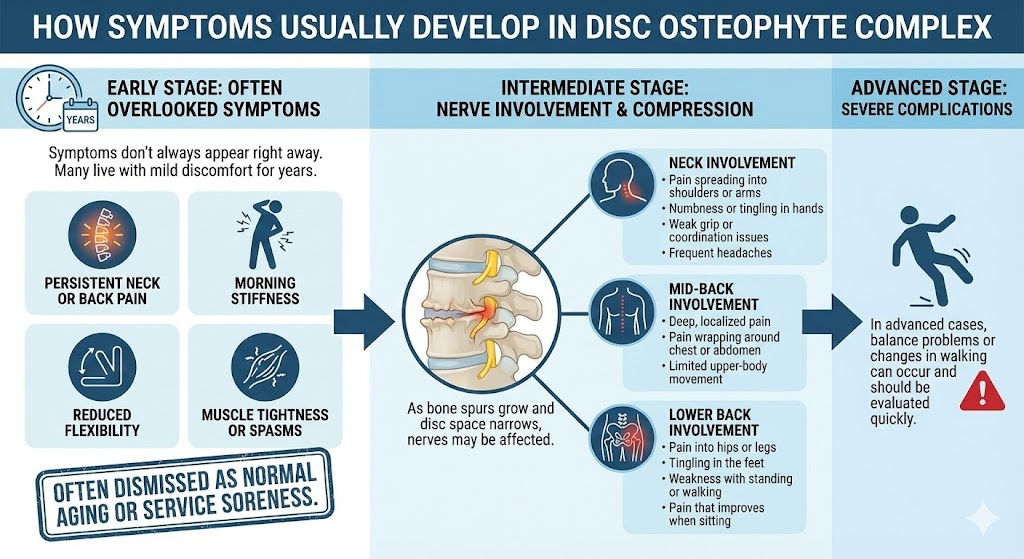
Symptoms do not always appear right away. Many veterans live with mild discomfort for years before it becomes severe.
Early Symptoms Often Overlooked
- Persistent neck or back pain
- Morning stiffness
- Reduced flexibility
- Muscle tightness or spasms
These symptoms are often dismissed as normal aging or leftover soreness from service.
When Nerves Become Involved
As bone spurs grow and disc space narrows, nerves may be affected.
Neck involvement may cause:
- Pain spreading into shoulders or arms
- Numbness or tingling in hands
- Weak grip or coordination issues
- Frequent headaches
Mid-back involvement may cause:
- Deep, localized pain
- Pain wrapping around the chest or abdomen
- Limited upper-body movement
Lower back involvement may cause:
- Pain into hips or legs
- Tingling in the feet
- Weakness with standing or walking
- Pain that improves when sitting
In advanced cases, balance problems or changes in walking can occur and should be evaluated quickly.
How the VA Evaluates This Condition
The VA does recognize disc osteophyte complex as a degenerative spinal condition. Veterans do not need to show a diagnosis during service to establish service connection.
What matters is whether military service likely contributed to or accelerated the condition.
Helpful evidence may include:
- Physically demanding roles
- Load-bearing duties
- Vehicle or airborne service
- Documented injuries
- Credible personal statements
Medical opinions that explain how service-related stress led to degeneration are often critical.
VA ratings are based on:
- Range of motion
- Functional loss
- Pain with movement
- Nerve involvement
Veterans with nerve symptoms may receive separate ratings for those conditions.
Treatment Options Veterans Commonly Use
Treatment focuses on reducing pain, maintaining function, and slowing progression.
Conservative Care
Many veterans begin with anti-inflammatory medications, physical therapy focused on stability, targeted injections, and activity modification.
These approaches aim to manage symptoms rather than reverse structural changes.
Surgical Care
Surgery may be considered when conservative treatment fails or nerve symptoms worsen.
Common procedures include:
- Removal of bone spurs
- Nerve decompression
- Spinal fusion for instability
- Disc replacement in select cases
Surgical decisions depend on severity, location, and overall health.
Long-Term Management and Quality of Life
While the structural changes cannot be undone, many veterans successfully manage symptoms long term.
Helpful strategies include:
- Regular low-impact movement
- Core strengthening
- Weight management
- Avoiding tobacco
- Addressing new symptoms early
Consistency matters more than intensity.
You Carried The Weight, Now Get The Support You Deserve
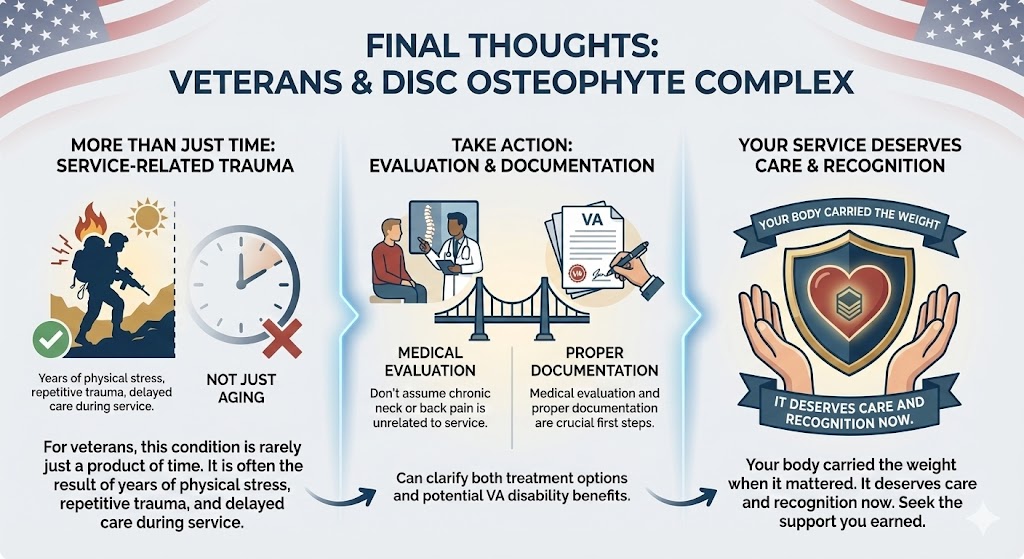
For veterans, disc osteophyte complex is rarely just a product of time. It is often the result of years of physical stress, repetitive trauma, and delayed care during service.
If you are dealing with chronic neck or back pain, do not assume it is unrelated to your military experience. Medical evaluation and proper documentation can clarify both treatment options and potential VA disability benefits.
Your body carried the weight when it mattered. It deserves care and recognition now.
At Allveteran.com, we seek to help veterans connect with resources that may make all the difference. To find out your disability rating, take our free medical evidence screening today!
 AllVeteran.com Advisors
With expertise spanning local, state, and federal benefit programs, our team is dedicated to guiding individuals towards the perfect program tailored to their unique circumstances.