













Quick Answer
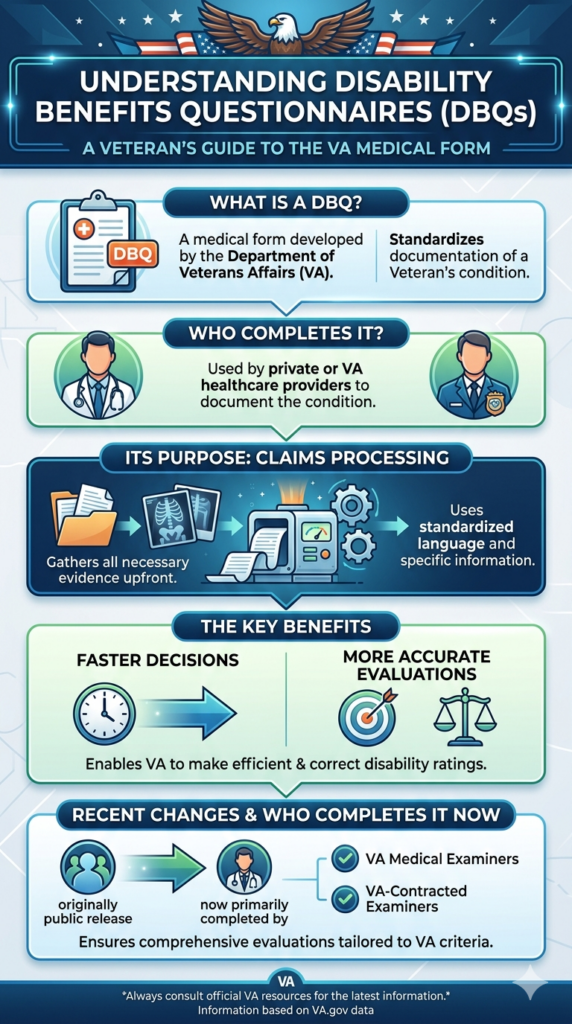
A Disability Benefits Questionnaire (DBQ) is a medical form developed by the Department of Veterans Affairs (VA) that allows a private or VA healthcare provider to document a veteran’s medical condition using standardized language and specific information required for claims processing. These forms aim to gather all necessary evidence upfront, enabling the VA to make faster, more accurate disability decisions. Originally released to the public, DBQs are now primarily completed by VA-contracted or VA medical examiners to ensure comprehensive evaluations tailored to VA criteria.
Why This Update
I’ve lost count of how many veterans tell me they didn’t know they could have their own doctor fill out a DBQ. That one piece of information changes everything — it puts you in the driver’s seat instead of relying entirely on a single C&P exam with a stranger. The mistake I see most often is submitting a DBQ that’s incomplete or doesn’t clearly connect your condition to your service. My advice: sit down with your doctor before they fill it out, walk them through your history, and make sure every section is answered. A strong DBQ is one of the best tools you have.
Author’s Take
I’ve lost count of how many veterans tell me they didn’t know they could have their own doctor fill out a DBQ. That one piece of information changes everything — it puts you in the driver’s seat instead of relying entirely on a single C&P exam with a stranger. The mistake I see most often is submitting a DBQ that’s incomplete or doesn’t clearly connect your condition to your service. My advice: sit down with your doctor before they fill it out, walk them through your history, and make sure every section is answered. A strong DBQ is one of the best tools you have.
What Exactly is a Disability Benefits Questionnaire (DBQ)?
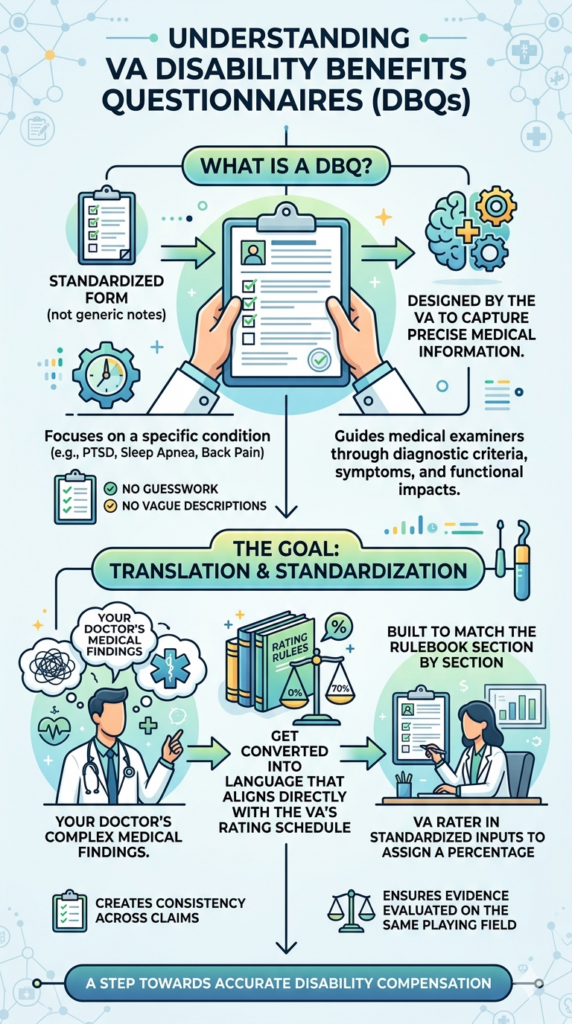
A DBQ is the VA’s way of speaking the same language as your medical records. These aren’t generic doctor’s notes. They’re standardized forms designed by the VA to capture precise medical information required for evaluating overall VA disability benefits compensation claims.
Each DBQ focuses on a specific condition, whether that’s PTSD, sleep apnea, or back pain. You can review the top 20 most common VA disability claims to understand frequently filed conditions. The form guides the medical examiner through relevant diagnostic criteria, symptoms, and functional impacts in a structured way. No guesswork, no vague descriptions.
The goal is translation. Your doctor’s complex medical findings get converted into language that aligns directly with the VA’s Schedule for Rating Disabilities. That’s the rulebook VA raters use to assign your percentage, and DBQs are built to match it section by section.
This standardization matters. When every examiner is answering the same questions in the same format, it creates consistency across thousands of claims. Your evidence gets evaluated on the same playing field as everyone else’s.
Who Completes DBQs and What is Their Role?
DBQs are primarily completed by medical professionals, typically VA-contracted examiners or VA healthcare providers, during a Compensation and Pension (C&P) examination, according to the VA. This is distinct from accessing VA health benefits after service.
The examiner’s role goes beyond filling out paperwork. They’re conducting a thorough assessment of your condition, recording objective findings (range of motion, visible symptoms, test results) and providing a medical opinion that addresses the nexus between your condition and your military service. That nexus opinion matters. It’s the medical professional saying “yes, this condition is at least as likely as not related to service.”
Now, about private physicians. While private doctors can still submit comprehensive medical evidence, the VA currently emphasizes DBQs completed by their own examiners to ensure consistency and adherence to specific VA requirements. Originally released to the public, DBQs are now primarily completed by VA-contracted or VA medical examiners to ensure comprehensive evaluations tailored to VA criteria, per VA policy.
Your private doctor’s opinion still has value. But understand that the VA has moved toward controlling the DBQ process through their own contracted network. Your private medical records still carry weight as supporting evidence.
How Do DBQs Streamline the VA Claims Process for Veterans
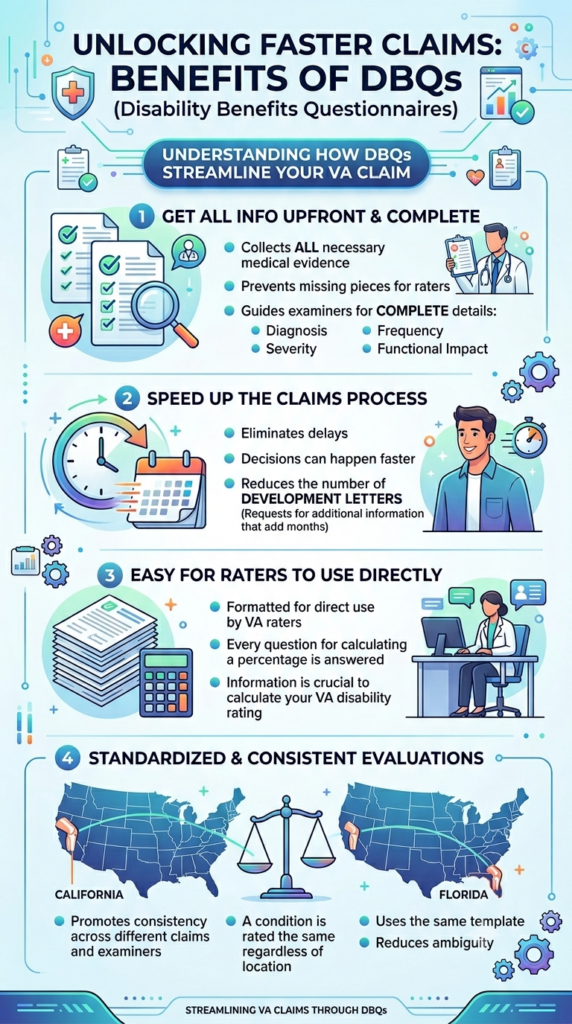
DBQs get all the necessary information upfront, in the right format, so decisions can happen faster.
DBQs can speed up the claims process. They collect all necessary medical evidence in a format VA raters can use directly. When an examiner completes a DBQ, they’re answering every question the rater needs to assign your percentage. This information is crucial to calculate your VA disability rating. No missing pieces.
This can reduce development letters (requests for additional information that add months to your timeline). The forms guide examiners to provide complete details upfront, covering diagnosis, severity, frequency of symptoms, and functional impact all in one document.
By standardizing medical evaluations, DBQs also promote consistency in rating decisions across different claims and examiners. A knee condition evaluated in California should be rated the same as an identical knee condition evaluated in Florida, because both examiners are using the same DBQ template and answering the same questions.
This doesn’t always work perfectly in practice. The framework is designed to reduce ambiguity and speed up processing.
What Specific Information Does a DBQ Capture?
DBQs dig into the details that matter for your rating.
First, they gather detailed information on the diagnosis, severity, frequency, and duration of symptoms related to your specific condition. If you’re claiming migraines, the DBQ asks about headache frequency, intensity, duration, and associated symptoms. If it’s a knee injury, expect questions about pain levels, instability, and how it affects weight-bearing.
The forms also assess the functional impact of your disability on daily life, employment, and social activities. This directly affects your rating. The VA doesn’t just care that you have pain. They need to know how that pain limits your ability to work, walk, sleep, or function.
DBQs include sections for objective medical findings and treatment history. That includes test results, imaging reports, medication lists, and documentation of therapies you’ve tried. The more documented evidence, the stronger your claim.
DBQs include a section for a medical opinion on the nexus between the condition and service connection. This is where the examiner states whether your condition is related to your military service based on the evidence. The standard is “at least as likely as not,” which means a 50% threshold.
Common Misconceptions About DBQs and How to Prepare
Misconception: DBQs are a guaranteed approval for benefits. Reality: DBQs are evidence, not a decision. A completed DBQ doesn’t automatically mean you’ll get service connection or a specific rating. While securing your disability rating is key, many veterans also seek other advantages like VA home loan benefits.
Misconception: Any doctor can complete a DBQ for VA submission. Reality: While private medical opinions are valid, VA prefers and often requires their own C&P exams with VA-trained examiners. You can no longer download a DBQ, have your family doctor fill it out, and submit it as your primary evidence. The VA moved away from public DBQs specifically to maintain control over the examination process.
Preparation: Here’s what helps. When you go to your C&P exam, provide your examiner with a comprehensive history of your condition. Bring lay statements from yourself or people who’ve seen your symptoms. Bring relevant private medical records that document your condition over time.
If you’re getting private medical evidence submitted, sit down with your treating physician beforehand. Walk them through your service history, explain the connection, and make sure they understand what the VA needs to see. An incomplete or vague medical opinion won’t help your claim.
The examiner needs the full picture to complete an accurate DBQ. The more context you provide, the better the documentation will be.
Example Scenario
If you’re a veteran filing a claim for service connection for chronic knee pain, your VA-scheduled C&P exam will include a medical professional completing a DBQ specific to knee and lower extremity conditions. The doctor will evaluate your range of motion, observe any swelling or instability, and record how your pain affects your ability to walk or do daily tasks. The VA rater will use this detailed documentation on the Knee and Lower Leg Conditions DBQ form to determine your disability rating.
Frequently Asked Questions
Can my private doctor complete a DBQ for my VA claim?
Private doctors can provide medical opinions and evidence, but the VA primarily relies on DBQs completed by their own contracted or staff medical examiners during a C&P exam. This ensures consistency and adherence to VA-specific criteria.
Are DBQs the same as a C&P exam?
A DBQ is a *form* used *during* a C&P exam. The C&P exam is the actual medical evaluation, and the DBQ is the structured document the examiner uses to record their findings for the VA.
How can I get a copy of my completed DBQ?
You can request a copy of your completed DBQ through your local VA office, by contacting the VA directly, or by accessing your eBenefits or VA.gov account after your claim process starts.
Do DBQs cover all medical conditions?
The VA has developed specific DBQ forms for a wide range of common service-connected conditions, but not every single possible condition has its own dedicated form. In such cases, general medical examination reports are used.
What happens after a DBQ is completed?
After a medical examiner completes the DBQ, it is submitted to the VA as part of your claims file. VA raters then review the information in conjunction with other evidence to make a decision on service connection and assign a disability rating.
 AllVeteran.com Advisors
With expertise spanning local, state, and federal benefit programs, our team is dedicated to guiding individuals towards the perfect program tailored to their unique circumstances.