













Quick Answer
To check your VA claim status, the easiest and most recommended method in 2026 is through the VA.gov website, specifically the ‘Check your claim or appeal status’ tool. You can also track your claim via the VA mobile app, by calling the VA at 1-800-827-1000, or by contacting a Veterans Service Officer (VSO). Understanding your claim’s current stage, from ‘Claim received’ to ‘Decision ready,’ helps you anticipate next steps and potential timelines. While most claims are processed digitally, veterans can still receive updates by mail if preferred, though this method is significantly slower.
Why This Update
Checking your VA claim status shouldn’t require guesswork. We created this guide so you have every method, link, and step in one place, no digging around VA.gov required.
Author’s Take
The number one thing I hear from veterans mid-claim is ‘I have no idea what’s happening.’ And honestly, that uncertainty is what causes the most stress, not the wait itself. I’ve seen veterans miss requests for evidence because they weren’t checking their portal, and I’ve seen others call the VA daily when their claim was actually moving along fine. My advice: set up the VA mobile app, turn on notifications, and check once a week. If something looks stuck for more than 30 days with no movement, that’s when you loop in a VSO. Don’t wait, but don’t panic either.
Where to Check Your VA Claim Status in 2026
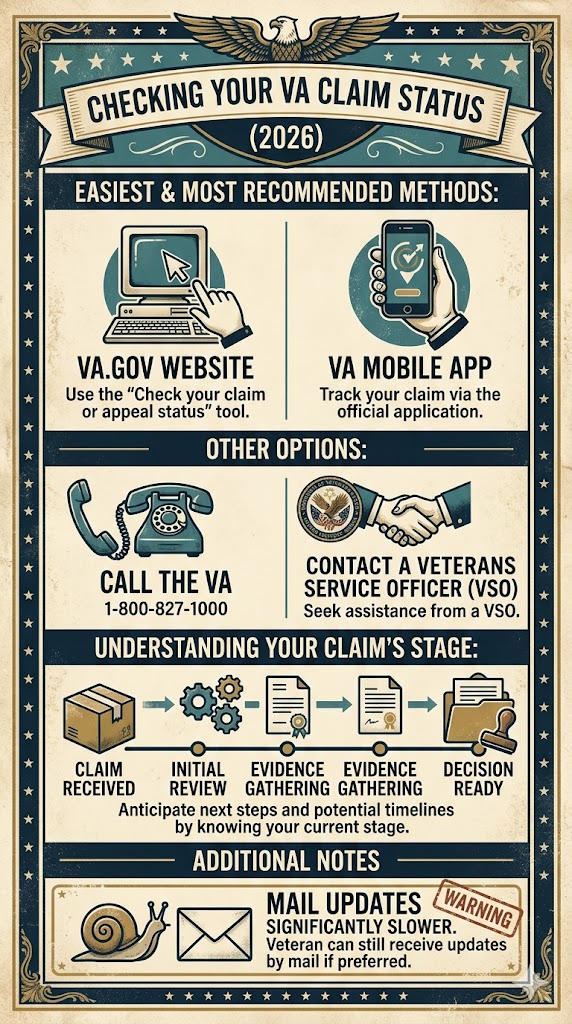
The VA gives you several ways to track your claim. They differ in detail and speed.
VA.gov Portal is your best bet for real-time updates. The ‘Check your claim or appeal status’ tool shows exactly where your claim sits in the pipeline, what documents the VA has received, and whether they’re waiting on anything from you. You’ll need a verified account to access it. Options include ID.me, Login.gov, or DS Logon. Once you’re in, you can see your claim’s current stage, review submitted evidence, and upload additional documents if needed.
The VA Mobile App puts all that same information in your pocket. It’s useful if you’re constantly on the go or prefer checking updates from your phone. You can monitor your claim status, upload documents directly from your camera roll, and manage VA appointments all in one place. The notifications feature is helpful. It’ll ping you when your status changes or when the VA needs something from you.
Calling the VA at 1-800-827-1000 (Monday through Friday, 8:00 a.m. to 9:00 p.m. ET) gets you a verbal update. Have your claim number and personal information ready before you dial. This method works if you don’t have internet access or prefer speaking to someone directly, but expect longer wait times during peak hours.
Veterans Service Officers (VSOs) can access more information. Accredited VSOs have specialized training and can access VA systems and information on your behalf. They often see internal notes and details that aren’t visible to you in the online portal. They can provide specific advice based on their experience with similar claims and can also help veterans discover VA student loan forgiveness options.
Understanding Your VA Claim Status: Common Stages Explained
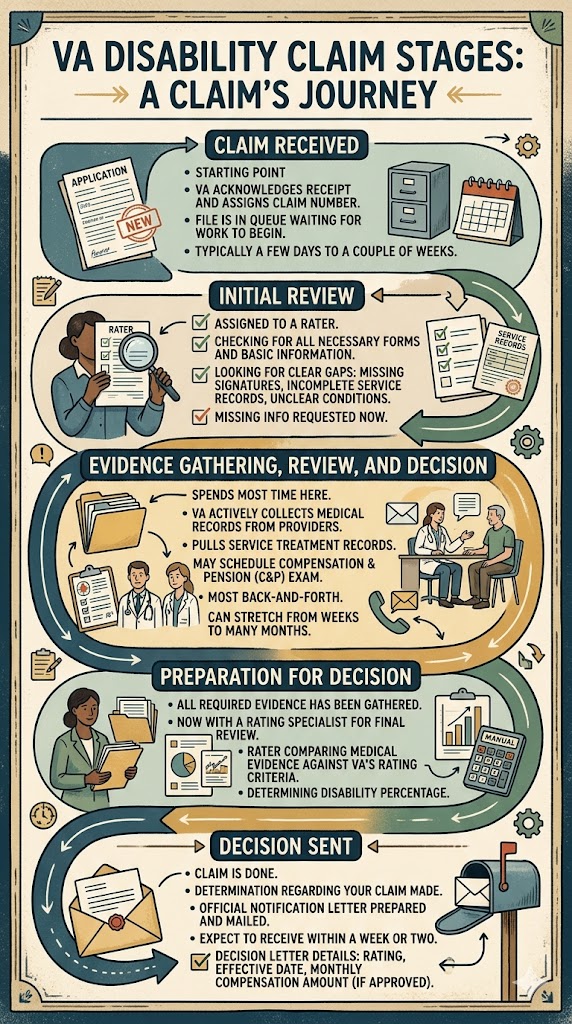
The VA uses specific stage labels to show where your claim is in the process. Here’s what each stage means, along with access comprehensive VA disability resources for more detailed information.
Claim Received is the starting point. The VA has acknowledged receipt of your application and assigned it a claim number. Your file is in the queue, waiting for someone to begin working on it. This stage typically doesn’t last long. Expect a few days to a couple of weeks.
Initial Review means your claim is now assigned to a rater who’s checking that all necessary forms and basic information are present and valid. They’re looking for clear gaps: missing signatures, incomplete service records, or unclear information about your claimed conditions. If something’s missing, they’ll request it now rather than later in the process.
Evidence Gathering, Review, and Decision is where your claim spends most of its time. The VA actively collects medical records from your providers, pulls your service treatment records, and may schedule you for a Compensation & Pension (C&P) exam. This stage involves the most back-and-forth and can stretch from weeks to many months depending on how quickly evidence arrives and whether additional information is needed.
Preparation for Decision means all required evidence has been gathered and your claim is now with a rating specialist for final review. The rater is comparing your medical evidence against the VA’s rating criteria to determine your disability percentage. This is one of the final stages before you get an answer.
Decision Sent means it’s done. The VA has made a determination regarding your claim, and the official notification letter is being prepared and mailed to your address. You should receive it within a week or two. The decision letter will detail your rating, effective date, and monthly compensation amount if approved. To better understand VA disability compensation rates, refer to the latest schedules.
What to Do If Your VA Claim Status is Stalled or Confusing
Sometimes your claim sits at the same status for weeks with no apparent movement. Here’s what to do.
Check for Missing Information first. The VA portal often indicates if they’re waiting for specific documents or responses from you, a medical provider, or another agency. Look for any messages or alerts in your online account. A claim that appears “stalled” is often just waiting on a C&P exam report or civilian medical records that take time to arrive.
Contact Your VSO if the portal doesn’t clarify the holdup. An accredited VSO can access more detailed internal notes and often identify specific issues faster than you can by calling the general hotline. They connect you with the VA and can help move things forward when something’s stuck.
Call the VA Hotline at 1-800-827-1000 for direct inquiries. Have your claim number ready and be specific about what you’re seeing online. The representative can sometimes see notes or pending actions that aren’t reflected in your online status yet.
Understand Average Processing Times to manage expectations. Claims vary widely in complexity. A straightforward supplemental claim might move in a few months, while an initial claim for multiple complex conditions could take over a year. Several factors influence claim processing, including evidence gathering and C&P exam scheduling. Current processing time averages can be found at the VA’s process times page. These figures update regularly and vary by claim type and regional office.
Next Steps After Your VA Claim Decision Is Made
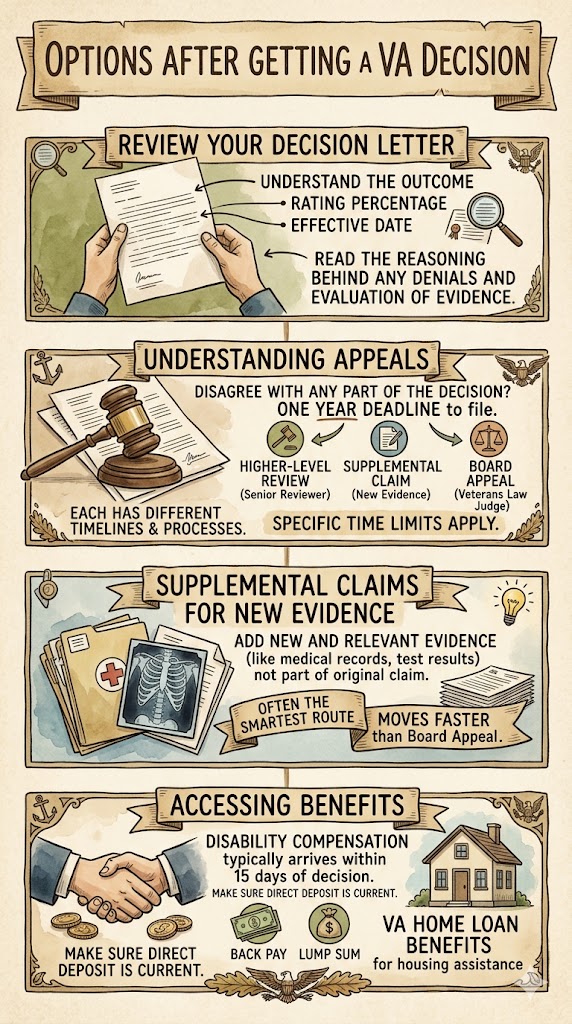
Getting a decision doesn’t necessarily mean the process is over. You have several options.
Review Your Decision Letter carefully when it arrives. It explains the outcome, your awarded rating percentage for each condition, the effective date of your benefits, and the reasoning behind any denials. The letter also outlines your appeal rights and deadlines. Don’t just look at the rating. Read the rationale section to understand how the VA evaluated your evidence.
Understanding Appeals matters if you disagree with any part of the decision. You generally have one year from the date of the decision letter to file an appeal. Your options include a Higher-Level Review (a senior reviewer looks at the same evidence with fresh eyes), a Supplemental Claim (you submit new relevant evidence), or a Board Appeal (a Veterans Law Judge reviews your case). Each option has different timelines and processes. Each has specific time limits for action.
Supplemental Claims for New Evidence are often the smartest route if you have medical records, test results, or other documentation that wasn’t part of your original claim. The VA defines a Supplemental Claim as adding new and relevant evidence that could change the outcome. This path often moves faster than a Board Appeal and gives you another shot at a favorable decision.
Accessing Benefits happens quickly after approval. Make sure your direct deposit information is current in your VA profile. Disability compensation typically begins arriving within 15 days of the decision. You’ll receive back pay to your effective date in a lump sum. In addition to these, many veterans also explore comprehensive VA home loan benefits for housing assistance.
Factors Influencing VA Claim Processing Times
Not all claims move at the same speed. Several factors determine how long yours will take.
Claim Type and Complexity is the biggest variable. A straightforward increase request for a condition the VA already rates might take a few months. An initial claim involving multiple conditions typically takes longer. This is especially true for complex diagnoses like PTSD or traumatic brain injury. These require more evidence and more detailed medical review.
Medical Evidence Gathering can add months to your timeline. If the VA needs to request records from multiple civilian doctors or military treatment facilities, each request introduces potential delays. Some providers respond quickly. Others take weeks or send incomplete records that require follow-up requests.
C&P Exam Requirements add another layer of timing. After the VA schedules your exam, you attend it, then wait for the examiner to write and submit the report. That entire cycle can take several weeks to a couple of months depending on examiner availability and workload. It’s crucial to follow best practices for VA disability exams to ensure accurate reporting.
VA Workload fluctuates based on the volume of claims hitting the system. Certain times of year see claim surges, and regional offices handle different caseloads. These factors affect processing speeds across all queues. The VA has worked to standardize timelines through electronic processing.
Claim Accuracy and Completeness from the start makes a measurable difference. Claims submitted with clear, well-organized medical evidence and complete information tend to move through the system more efficiently than those needing extensive clarification or multiple requests for additional documentation.
Example Scenario
If you submitted a new disability claim for a service-connected condition in late 2025, you might initially see your status as ‘Claim Received.’ After a few weeks, it could advance to ‘Evidence Gathering.’ If the VA requires a Compensation & Pension exam, you’d receive notification, and the status would remain ‘Evidence Gathering’ until the exam results are submitted and reviewed. Monitoring the VA.gov portal regularly allows you to see when your claim moves to ‘Preparation for Decision’ and eventually ‘Decision Sent.’ This indicates your official letter is on its way. The letter will detail the outcome of your claim.
Frequently Asked Questions
Can I check my VA claim status without an online account?
While an online account on VA.gov offers the most detailed and current information, you can also check your status by calling the VA at 1-800-827-1000 or by contacting an accredited Veterans Service Officer (VSO) who can access your claim details.
What does ‘Preparation for Decision’ mean for my VA claim?
‘Preparation for Decision’ means that all necessary evidence has been gathered, and your claim is now with a rating specialist for a final review and decision. This is one of the final stages before a determination is made and a decision letter is sent.
How long does it typically take to get a decision on a VA claim?
The processing time for a VA claim varies widely depending on complexity, typically ranging from a few months to over a year, based on factors like claim type, number of conditions, and the time required to gather all necessary evidence and complete C&P exams.
Can I upload documents to my VA claim online?
Yes, you can upload supporting documents directly to your active claim through the VA.gov website or the official VA mobile app. This is often the quickest and most efficient way to provide additional evidence requested by the VA or to submit new information.
What is the difference between an appeal and a supplemental claim?
An appeal (e.g., Higher-Level Review, Board Appeal) is generally for disagreements with a VA decision based on existing evidence. A supplemental claim is filed when you have new, relevant evidence to submit that was not part of the original claim decision and could change the outcome.
How often is my VA claim status updated?
The VA updates claim statuses as they move through different stages of processing. Updates are generally visible within a few business days of a significant action, such as evidence submission, a completed C&P exam, or a change in review status.
 AllVeteran.com Advisors
With expertise spanning local, state, and federal benefit programs, our team is dedicated to guiding individuals towards the perfect program tailored to their unique circumstances.