











When a veteran receives a 100% disabled rating from the Department of Veterans Affairs (VA), it can feel like a relief. You know that the VA will provide you with the support you need. However, there are often questions about what benefits their spouses are eligible for. It’s more than you’d think, and these benefits help ease the burden on families and provide essential support to spouses of fully disabled veterans.
Why This Update
Changes in eligibility reviews and CHAMPVA updates have prompted many families to revisit their entitlements. For the most current information and to apply for benefits, updates can be found on the VA website or by visiting your local VA office.
Tamila’s Take
When a veteran receives a 100% rating, it seems like you’d breathe a sigh of relief. But for spouses, there is a lingering question: what’s next for me? No one hands spouses a checklist of things to go through. You have to dig to get what you are looking for. That’s what makes this information so important. Spouses carry a lot of the weight, often in silence. These benefits aren’t handouts. They’re part of the promise made to our families. Don’t be afraid to claim what you’ve earned.
Who Qualifies as a Spouse of a 100% Disabled Veteran?
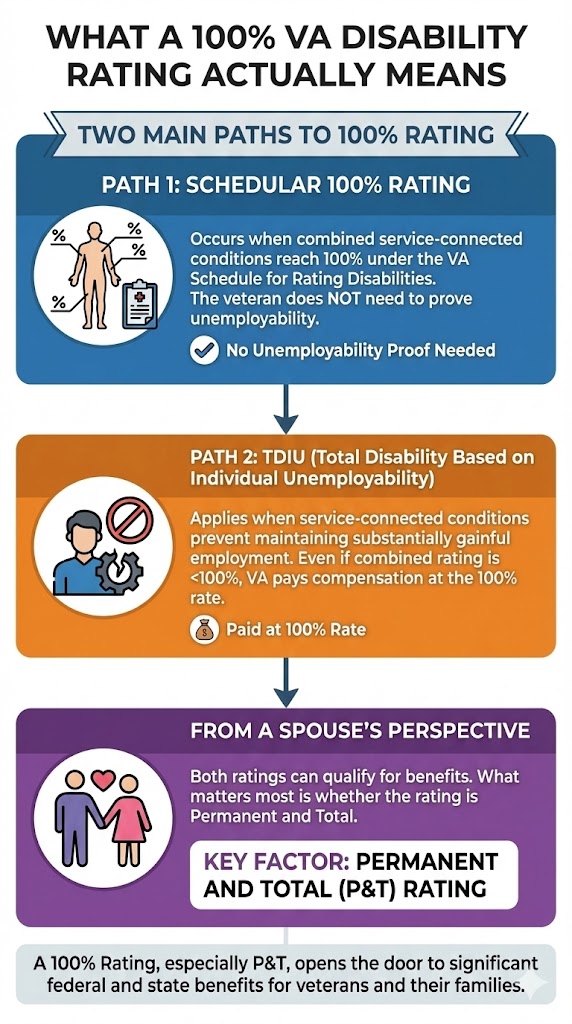
To receive these VA benefits, you must be legally married to a veteran with a disability rating of 100% permanent and total (P&T). A temporary rating may not provide you with the same benefits.
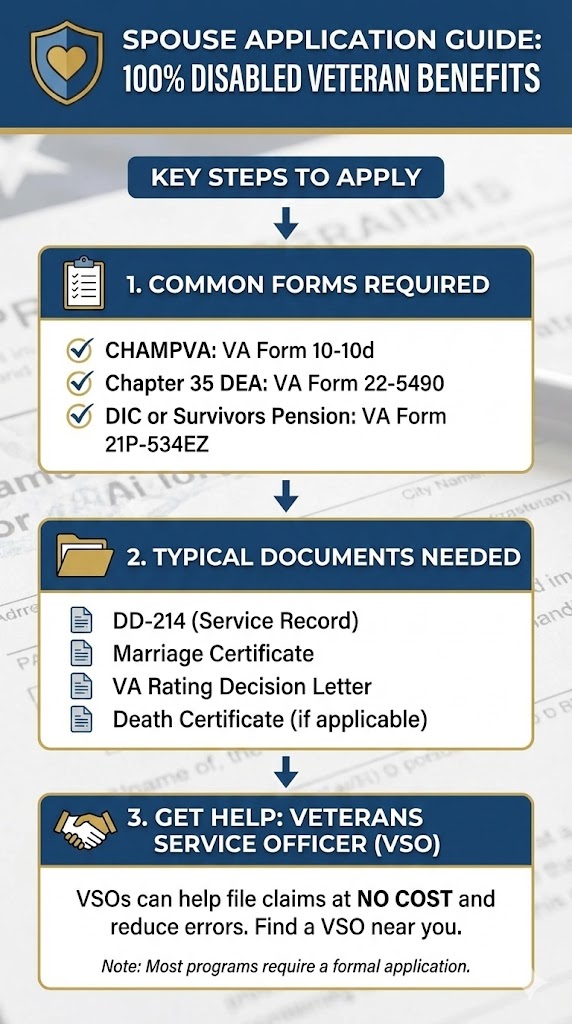
You will also need documentation to be considered. This includes your marriage certificate and the veteran’s VA disability rating decision letter. You may also submit proof of cohabitation or legal recognition of marriage, in lieu of a marriage certificate.
In most cases, the spouse must live with the veteran, but there are exceptions, especially in cases of separation due to medical or safety reasons.
What Benefits for Spouses are Available?
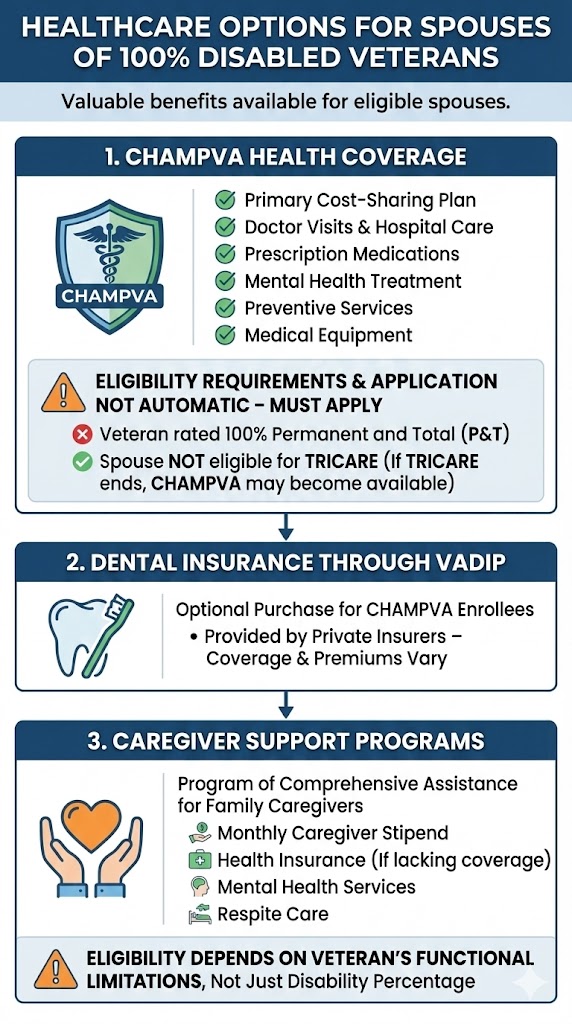
CHAMPVA (Civilian Health and Medical Program of the Department of Veterans Affairs) offers healthcare benefits to spouses and family members of 100% disabled veterans who are not eligible for TRICARE. You’ll need to submit VA Form 10-10d to enroll.
It covers medical services, including hospital stays, surgeries, and prescriptions. After meeting the $50 deductible, the plan pays 75% of qualifying medical costs. Out-of-pocket expenses are capped at $3,000 per year, after which CHAMPVA covers 100% of eligible services.
Additionally, it should be noted that CHAMPVA typically acts as a secondary payer to Medicare or private insurance. Spouses may also qualify for dental benefits through the VA Dental Insurance Program (VADIP), which offers reduced-cost dental coverage.
Education and Career Benefits Available to Spouses
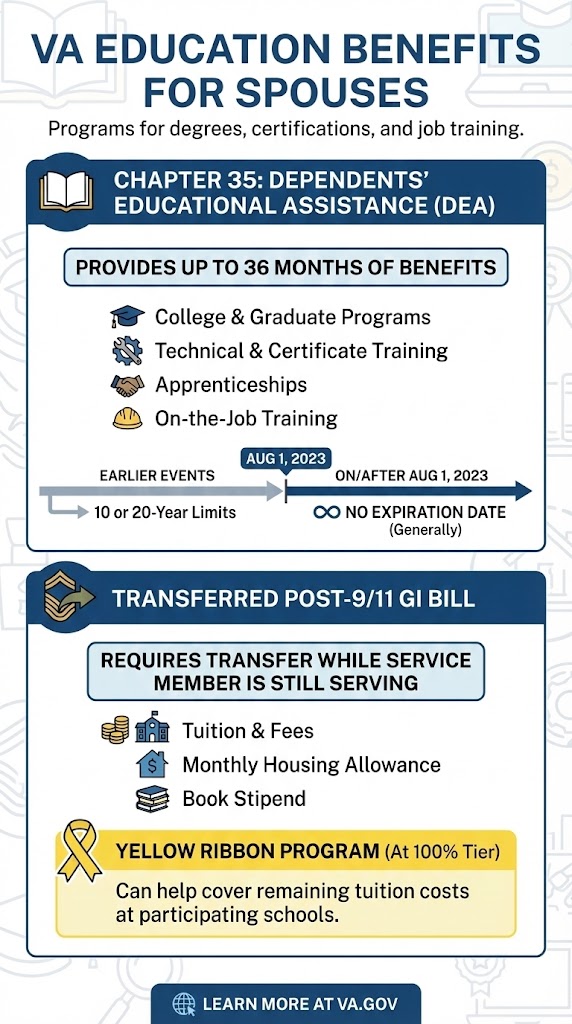
Under the Fry Scholarship or Chapter 35 DEA (Dependents’ Educational Assistance), eligible spouses can receive educational benefits, including education assistance, on-the-job training, and monthly payments through the DEA program, for college, technical, or vocational schools. You can also receive monthly housing stipends and career counseling services.
The Fry Scholarship is primarily for survivors of service members who died in the line of duty, while Chapter 35 benefits apply more broadly to spouses of 100% disabled veterans.
State and Federal Benefits for Spouses of Disabled Veterans
Many states provide property tax exemptions, free or discounted vehicle registrations, and employment assistance to spouses. Certain benefits may also be available to dependent parents and other family members of disabled veterans.
The Program of Comprehensive Assistance for Family Caregivers (PCAFC) provides a monthly stipend and training for caregivers of veterans. Spouses of 100% disabled veterans may also be eligible for VA-backed loans to buy, build, improve, or refinance a home.
Federally, a veteran spouse may receive:
- Commissary and exchange privileges on military bases
- VA caregiver benefits, including training and financial stipends
- Access to VA home loan programs as a surviving spouse
Eligibility and scope of these benefits can vary by state, so it’s essential to check with your state’s Department of Veterans Affairs.
What VA Benefits Continue if the Veteran Passes Away?
If a veteran died with a 100% P&T rating, the veteran’s death may entitle the spouse to certain benefits as an eligible surviving spouse of a deceased veteran.
- Dependency and Indemnity Compensation (DIC) benefits
- Continued CHAMPVA access
- Survivor education benefits
- Access to burial and memorial benefits, including burial costs, burial in a VA national cemetery, and bereavement counseling
DIC benefits provide a tax-free monthly payment, starting at $1,653.07 per month in 2025, with additional compensation for each minor child. To qualify for DIC, the veteran must have been rated 100% disabled for at least 10 continuous years before the veteran’s death, or at least five years from the date of release from active duty, and the death must be related to a service connected condition.
Spouses may lose eligibility for certain VA benefits, especially DIC, if they remarry. After a veteran’s death, a disability claim may need to be filed or updated to continue or access these benefits.
Example Scenario
Jennifer’s husband, a Marine Corps veteran, was awarded a 100% P&T rating after being diagnosed with a debilitating service-connected illness. Jennifer enrolled in CHAMPVA, which helped cover her medical expenses when she lost her private insurance.
She later used Chapter 35 benefits to return to school and start a new career in counseling. When her husband passed away, Jennifer was able to continue her education and receive monthly DIC payments, which helped stabilize her finances during a difficult time.
There are many people who have had similar experiences. Looking into the benefits you can receive is worth it. After all, you paid a price too.
FAQs About Spousal Benefits
Navigating spousal benefits from the VA can be confusing. That said, here are some of the most frequently asked questions about the subject.
What are the healthcare options for a spouse of a 100% disabled veteran?
You may qualify for CHAMPVA, which provides comprehensive medical coverage for spouses who aren’t eligible for TRICARE.
Can spouses of 100% disabled veterans receive education benefits?
Yes, through Chapter 35 DEA or the Fry Scholarship, depending on the veteran’s status and circumstances.
Are caregiver benefits available to spouses?
Yes. Under the Program of Comprehensive Assistance for Family Caregivers, spouses may receive caregiver benefits like training, mental health services, and monthly stipends.
Do spouses qualify for commissary and exchange privileges?
Yes, with proper identification, spouses of 100% disabled veterans can access commissaries and exchanges.
Are there any state-level benefits for spouses?
Many states offer property tax relief, education benefits, and vehicle registration discounts. These vary widely, so check with your state’s veterans affairs office.
What happens to the benefits if the veteran dies?
Spouses may qualify for DIC payments, continued CHAMPVA, and education benefits, as well as burial benefits.
How do I prove I’m eligible for these benefits?
You’ll need marriage records, the veteran’s VA rating decision letter, and in some cases, a death certificate or proof of dependency.
Spouses Deserve Clarity, Not Confusion
Being married to a 100% disabled veteran means you’ve already given so much, from your time to your care and even your stability. The benefits available to you aren’t just perks; they’re part of the promise made to families who serve alongside their veterans. From CHAMPVA to education support and survivor benefits, these programs are designed to ease the burden and honor your role. But navigating them can be overwhelming.
That’s where we come in. At AllVeteran.com, we help veterans and their families understand what they’re entitled to and how to access it. Start with our free medical evidence screening and let us help you claim the benefits your family has earned.
 AllVeteran.com Advisors
With expertise spanning local, state, and federal benefit programs, our team is dedicated to guiding individuals towards the perfect program tailored to their unique circumstances.