













Total Disability Based on Individual Unemployability (TDIU) is an important part of the benefits provided by the Department of Veterans Affairs (VA). TDIU allows veterans who cannot maintain gainful employment to receive VA compensation at the 100% disability rate, even if their combined rating is lower.
TDIU is specifically for cases where service connected disabilities render a veteran unable to work. However, to receive this level of compensation, veterans must meet certain criteria that prove their conditions prevent them from working full-time.
Tamila’s Take
As an Army veteran, I’ve seen far too many vets push themselves past their limits because they felt guilty admitting they couldn’t work anymore. TDIU isn’t about weakness. If your disabilities make full‑time work impossible, you deserve compensation at the 100% level, even if your rating doesn’t add up to 100% on paper. That’s exactly why TDIU exists.
I’ve walked veterans through this process who thought they’d never qualify, only to realize their symptoms, flare‑ups, and limitations were far more severe than they’d been acknowledging. The key is being honest about what you can and can’t do, documenting everything, and not letting pride keep you from applying. You served your country. You shouldn’t have to struggle alone just to make ends meet.
Why This Update
TDIU pays the same rate as 100% disability benefits, which are updated annually with the COLA. This article reflects 2026 rates.
What Is TDIU?
Total Disability based on Individual Unemployability (TDIU) is a VA program that compensates veterans at the 100% disability payment rate when their service-connected conditions prevent them from holding substantially gainful employment. For example, a veteran with a combined 70% rating for PTSD and back injuries could qualify if those conditions prevent consistent employment.
Under TDIU, veterans may have ratings below 100% but still receive VA 100% pay. The benefit focuses on the ability to work, not just the disability percentage.
TDIU Eligibility Requirements
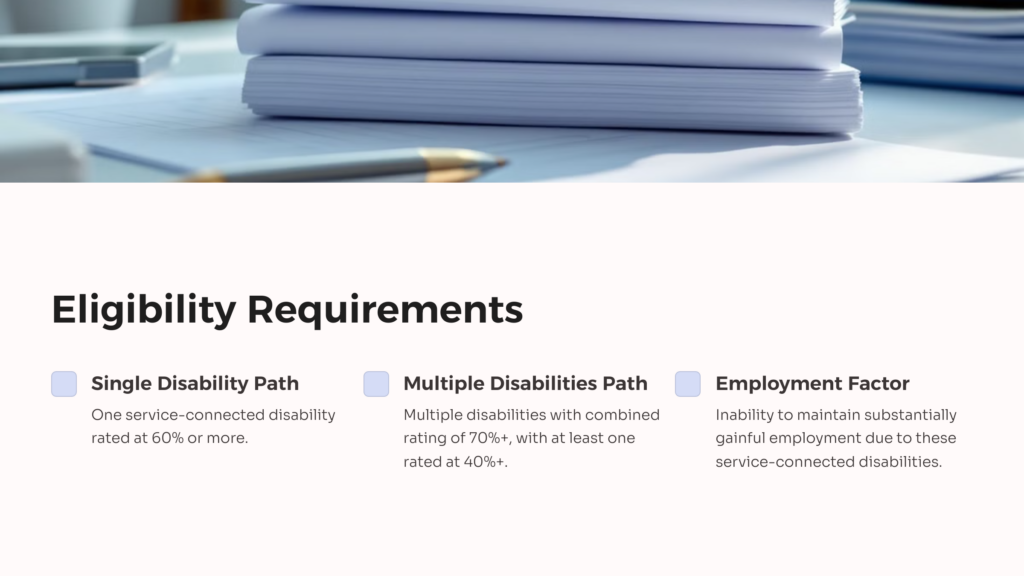
To meet TDIU eligibility requirements, veterans must meet both rating and employment criteria.
You must have one service-connected disability rated 60% or higher, or a combined disability rating of 70% or higher with at least one disability rated 40% or higher.
If you have multiple service connected disabilities affecting a single body system, these may be considered together for eligibility purposes. Even if you have a lower disability rating and do not meet the minimum rating requirements, you may still qualify for TDIU on a case by case basis, such as in situations involving frequent hospitalizations or unusual circumstances related to a single disability.
Where employment is concerned, you must also show that your disabilities prevent substantially gainful employment. Substantially gainful employment generally means work that pays above the federal poverty threshold. Marginal employment is defined as earned annual income that does not exceed the poverty threshold for one person.
TDIU vs. 100% VA Disability
Many veterans confuse TDIU vs 100% disability. Both pay at the same compensation level, providing benefits at the same level for those who qualify, regardless of their specific VA disability rating. Veterans granted TDIU receive monthly payments equivalent to a 100% disability rating ($3,938.58 per month for a single veteran in 2026).
A 100% schedular rating is based purely on disability percentages, and there are no employment restrictions. TDIU, on the other hand, is based on the inability to maintain employment, and veterans receive 100% payment, despite lower combined ratings.
Can You Work While Receiving TDIU Benefits?
This is one of the most common questions about VA TDIU benefits. Veterans receiving TDIU generally cannot hold substantially gainful employment, such as a steady job that provides consistent, reliable income, but they may still work under certain conditions.
They may have marginal employment with an income below the poverty level. Odd jobs and part-time work are generally considered marginal employment and do not count as a steady job.
Veterans can also receive TDIU benefits if they are working in protected environments, like a family business or a position provided by a friend or family member. In these cases, annual income from such work must remain below the poverty threshold to maintain eligibility.
TDIU benefits can also be awarded on a temporary basis for specific situations such as extended hospital stays or surgeries.
How to Apply for TDIU
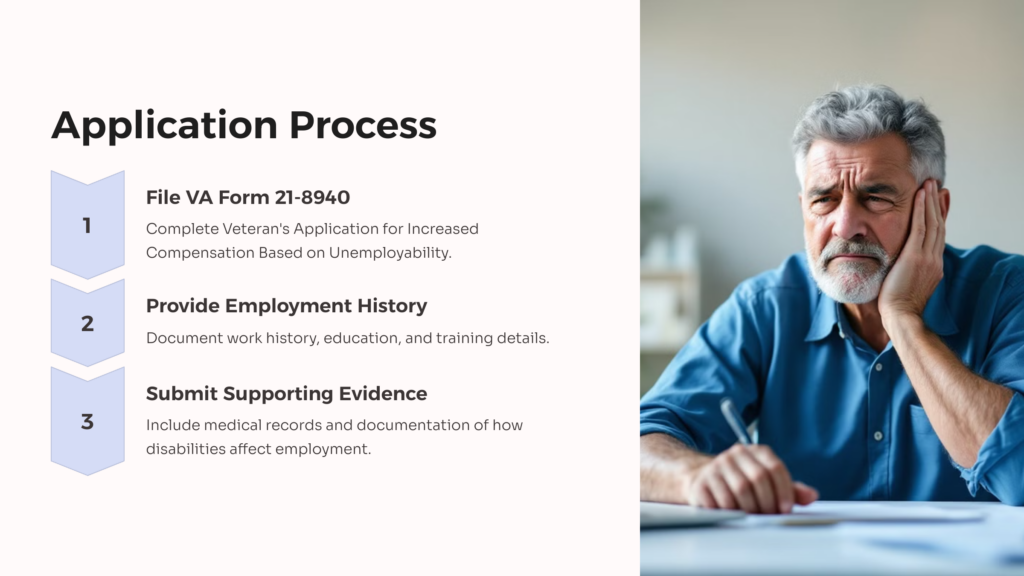
If you believe you qualify, here is how to file a TDIU claim.
- Submit a VA Form 21-8940. This form is the official application for Total Disability Individual Unemployability.
- Provide employment history. You must list jobs held during the last five years of employment, detailing your work history, specific job duties, and any relevant training.
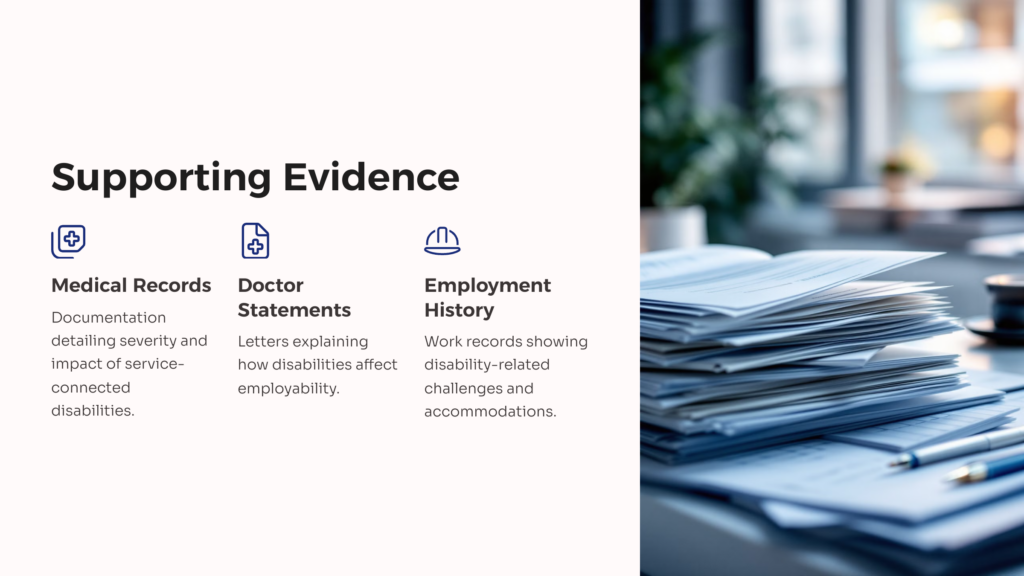
- Submit medical evidence and be sure to include supporting documents such as a doctor’s report and medical test results to provide evidence of how your service-connected conditions prevent you from maintaining employment.
- Verification of previous employment must be done. The VA may send VA Form 21-4192 to your previous employers to verify employment details.
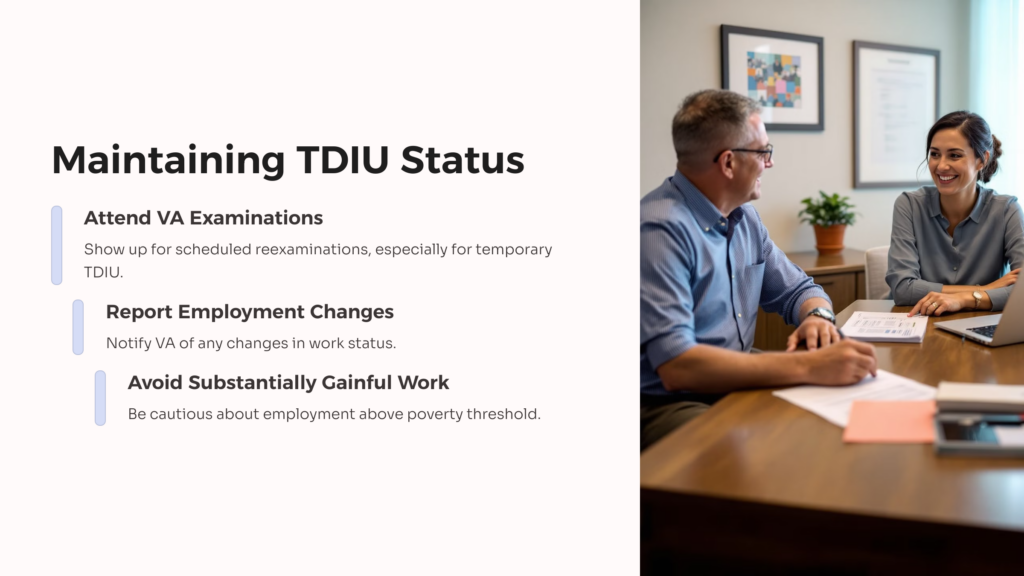
- Attend a C&P exam. The VA may schedule an examination to evaluate how your disabilities affect work capability.
TDIU Example Scenario
Michael, a former Army mechanic, had a veteran’s disability resulting from a service connected condition, with a combined 70% disability rating for PTSD and chronic back pain. Although his rating was below 100%, his conditions made it impossible for him to continue working full-time.
After submitting VA Form 21-8940 and medical documentation from his doctors, Michael applied for disability compensation and disability benefits. The VA approved his claim, and he now receives compensation at the 100% rate through TDIU.
Frequently Asked Questions
What is TDIU?
TDIU stands for Total Disability based on Individual Unemployability, allowing veterans to receive 100% compensation when their disabilities prevent employment.
Do I need a 100% disability rating to qualify for TDIU?
No. Veterans with ratings as low as 60% or 70% combined may qualify if they cannot maintain gainful employment.
What form do I use to apply for TDIU?
You must submit VA Form 21-8940, the Application for Increased Compensation Based on Unemployability.
Can I work while receiving TDIU benefits?
Yes, but only under limited circumstances such as marginal or protected employment.
How much does TDIU pay?
TDIU pays the same monthly rate as a 100% VA disability rating ($3,938.58 per month for a single veteran).
What income limit applies to TDIU?
Income must generally remain below the federal poverty threshold unless employment is in a protected environment.
Can the VA take away TDIU?
Yes, if evidence shows you can maintain substantially gainful employment again. However, the VA must follow regulations and provide you with notice and an opportunity to respond before reducing or severing your TDIU benefits.
Securing the Compensation You Deserve
TDIU exists for one reason: to ensure that veterans whose service‑connected conditions prevent them from working can still receive financial stability at the 100% compensation level. If your disabilities make full‑time employment impossible, you shouldn’t have to struggle or settle for a rating that doesn’t reflect your reality. Understanding the eligibility rules, documenting how your conditions impact your ability to work, and submitting the right forms are all essential steps toward getting the support you’ve earned.
Whether you’re applying for TDIU for the first time or considering an increase because your symptoms have worsened, remember that you don’t have to navigate the process alone. With the right evidence and guidance, you can build a strong claim that clearly shows why you qualify.
 AllVeteran.com Advisors
With expertise spanning local, state, and federal benefit programs, our team is dedicated to guiding individuals towards the perfect program tailored to their unique circumstances.