













Getting a VA disability decision that doesn’t seem right can feel discouraging, especially when you know it doesn’t match your health situation or service record. The good news is, you don’t have to accept it as the final word. The VA has several ways for veterans to challenge a decision without starting the whole process from scratch. One of the quickest options is a Higher-Level Review using VA Form 20-0996. This form is also known as a 0996 decision review request and is used to request a review of a denied claim. With this approach, a more experienced reviewer takes a fresh look at your case, without adding new evidence, and you could get a faster, more favorable outcome.
What Is VA Form 20-0996?
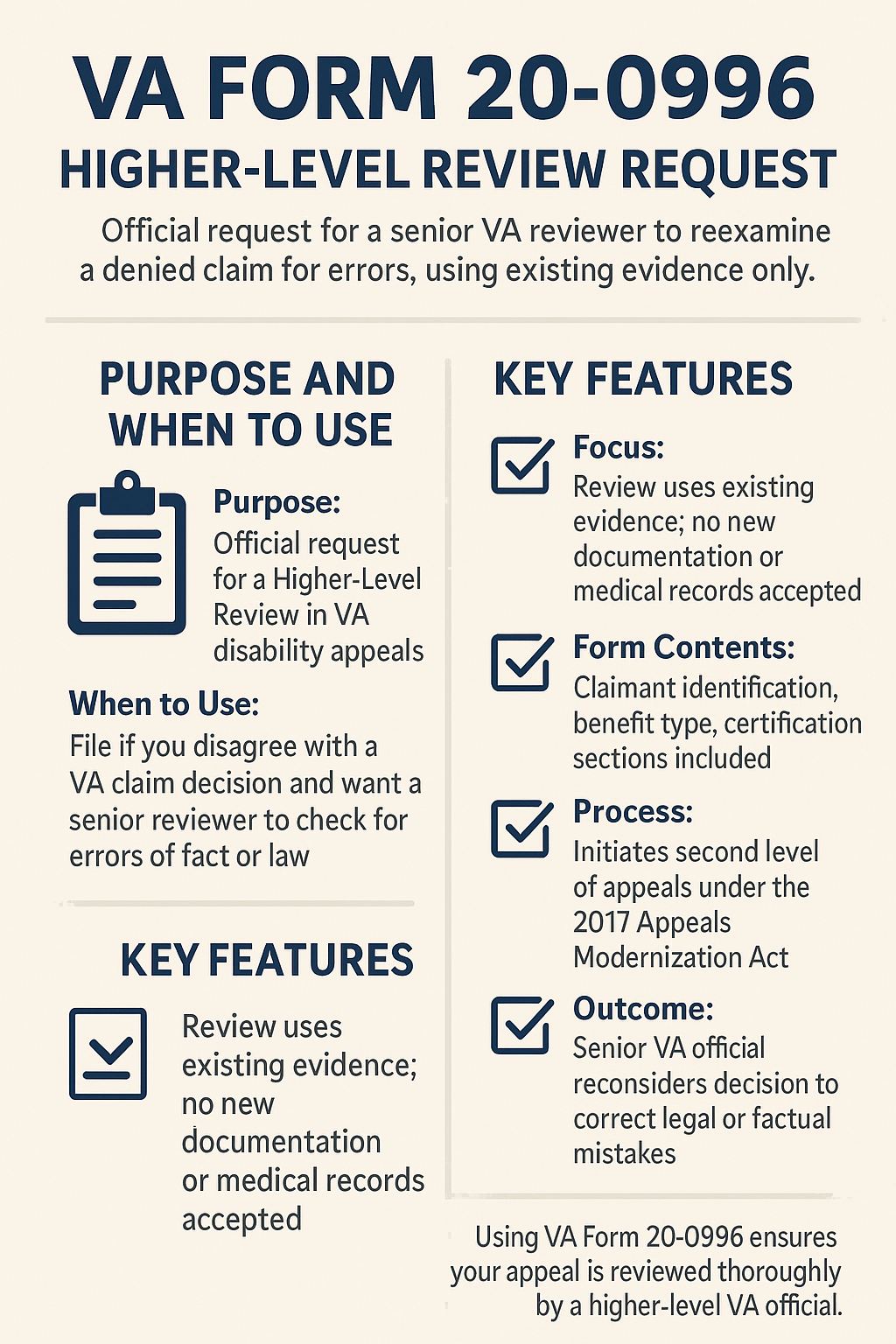
VA Form 20-0996 is the official request for a Higher-Level Review under the VA disability appeal process. Veterans may file the form as a decision review request to seek a more senior review of a denied claim. This form signals to the US Department of Veterans Affairs that you disagree with a decision on your claim and want a more senior reviewer to take another look. You may file VA Form 20-0996 to request higher level review if you disagree with a VA decision. The decision review request process is designed to ensure errors of fact or law are corrected. This review does not involve new documentation or medical evidence; instead, it focuses on the same facts presented in your initial claim, but reevaluated for legal or factual errors.
Form 20-0996 contains several sections, including areas for claimant identification, benefit type, and certification. You can find the current version of this form and instructions for filing at the VA’s Form 20-0996 page. Submitting this form initiates the second level in the VA’s modernized appeals structure under the Appeals Modernization Act of 2017. Requesting higher level review allows your case to be reconsidered by a more senior VA official. The US Department of Veterans Affairs reviews each decision review request.
Understanding the Higher-Level Review Process
A Higher-Level Review is pretty much what it sounds like; it’s a fresh look at your claim by a senior VA reviewer who had nothing to do with the original decision. Higher level reviews are conducted by a senior level adjudicator who was not involved in the original decision. These reviewers have the experience to catch mistakes, like when your evidence was misunderstood or the wrong rules were applied.
When you submit VA Form 20-0996, they’ll go over your original claim as it is—no new medical records, statements, or documents are added. This level review affords veterans the opportunity to have their claims re-evaluated for errors in fact or law. That’s why this option works best if you’re confident the VA made a clear error or overlooked something in the law or rating criteria.
Most reviews take about 4 to 6 months, but some are wrapped up sooner. You can also request an informal conference—a phone call where you or your representative can walk the reviewer through exactly why you think the first decision missed the mark.
Eligibility Criteria for Filling out VA Form 20-0996
When you request higher level review, your claim must meet certain requirements. First, you must have received a decision on your initial claim or a supplemental claim. If you haven’t received a decision yet, or if you want to submit new evidence, the Higher-Level Review option is not appropriate. However, if your claims request being denied, you may still have options to challenge the decision.
You are eligible to file VA Form 20-0996 for decisions involving:
- VA disability compensation
- Dependency claims
- Pension benefits
- Burial benefits
- Other VA benefits involving eligibility or payments
If you have received a supplemental claim request denial, you can use VA Form 20-0996 to request a review.
You cannot use this process if you have already requested a Higher-Level Review for the same issue or if you want to submit new evidence—that would require a supplemental claim instead. If your claim is part of a legacy appeal (pre-2019), you may need to opt into the modern review system before proceeding. Additionally, if the VA has denied your supplemental claim, you may file a claim request for higher-level review using this form.
Benefit Type and Claim Information
When filling out VA Form 20-0996 for a Higher-Level Review, it’s crucial to accurately select the type of benefit and provide the correct claim information. The Department of Veterans Affairs processes a wide range of claims, including disability compensation, pension, and other benefits. If you’ve filed a Supplemental Claim and the VA has denied your request, you may still have options to receive benefits by requesting a Higher-Level Review using Form 20-0996.
In Section III – Benefit Type, you’ll need to specify exactly which benefit you want reviewed. This step is essential because it directs the VA to the specific area of your claim that needs a second look. If you have more than one benefit issue you’d like reviewed, you must file a separate Higher-Level Review request for each issue. Taking the time to accurately complete this section when filling out VA Form 20-0996 helps ensure the VA reviews the correct part of your claim and avoids unnecessary delays. If you’re unsure which type to select, consider reaching out to a Veterans Affairs authorized representative for guidance before you file VA Form 20-0996.
Step-by-Step Guide to Submitting VA Form 20-0996
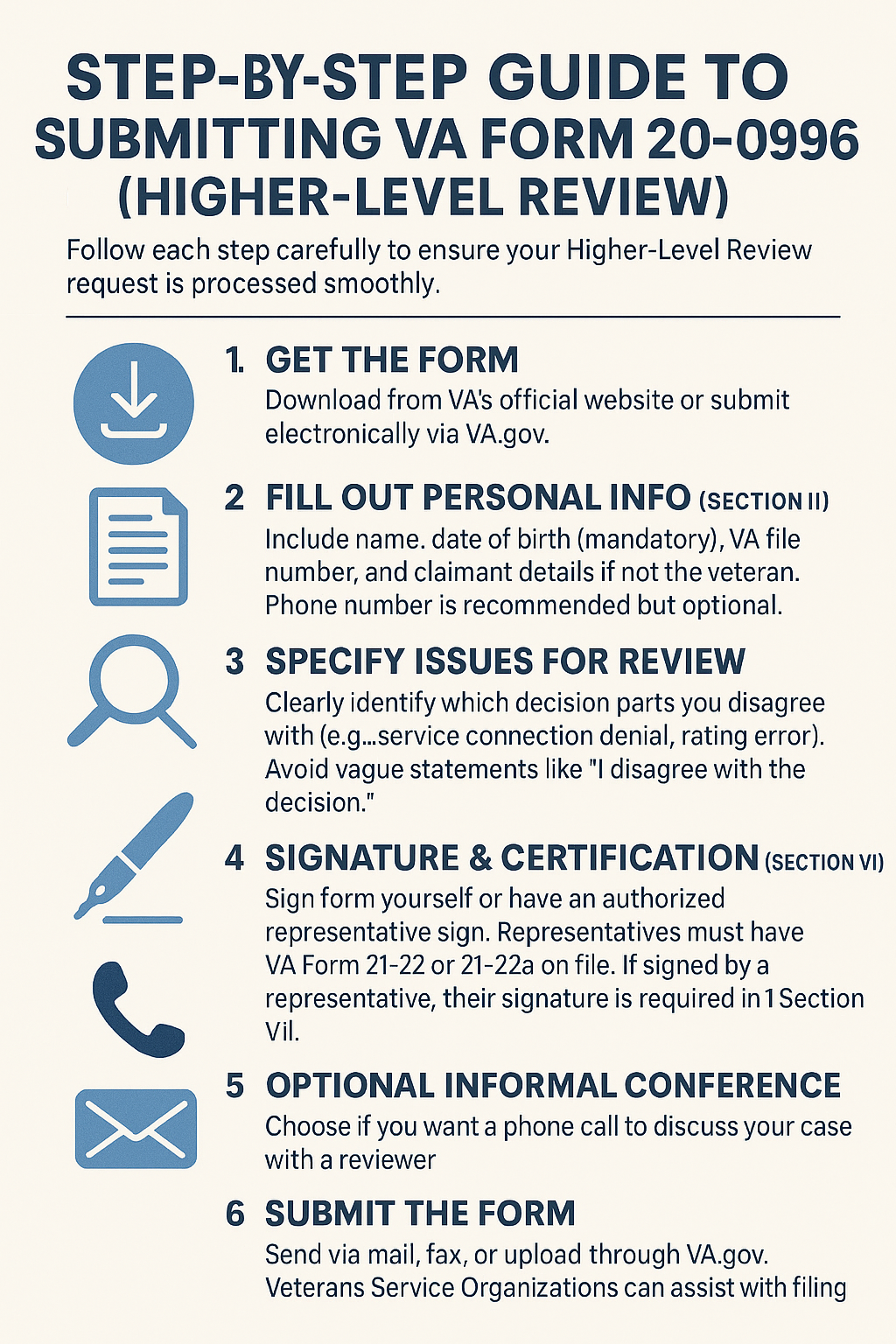
Filing for a Higher-Level Review is straightforward, but it’s important to follow each step carefully. First, download the form from the VA’s official site, or log into your VA.gov account to submit it electronically.
Start by filling out your personal information.
Section II – Claimant Identification, contains eight fields intended to identify the veteran or claimant, including name, date of birth, and VA file number. The date of birth is a mandatory field and should never be left blank. While providing a telephone number is recommended, missing it does not necessarily prevent your application from being processed. Identification information is required for individuals other than the veteran, and must be completed accurately.
Next, indicate which specific issues you want reviewed. You must clearly identify the specific area of disagreement you wish to have reviewed. Be clear and accurate—general statements like “I disagree with the decision” are not enough. The VA needs to know which part of your decision you are disputing, such as a service connection denial or an underrating.
Section VI of the form requires your signature and certification, and must be completed accurately. If you are unable to sign, a separate alternate signer certification may be required to validate your request. An authorized representative may sign and submit your VA Form 20-0996 on your behalf, provided the proper VA Form 21-22 or VA Form 21-22a is on file. An affairs authorized representative may act for you if you have completed the necessary authorization forms. VA Form 21-22 or VA Form 21-22a are required documentation for representatives. Section VII – Authorized Representative is where your representative must sign if they are submitting the form for you, and the VII authorized representative signature is essential for processing if you are using a representative.
You can also choose whether to request an optional informal conference. This gives you the chance to speak directly with the reviewer via a telephone number. While it’s not required, many veterans find it helpful for clarifying their position.
Once the form is complete, you can submit it by mail, fax, or through your VA.gov account. If you have a Veterans Service Organization representative, they can also help you file.
Security and Electronic Signatures When Filing Online
Filing VA Form 20-0996 online offers a secure and efficient way to request a Higher-Level Review. The Department of Veterans Affairs uses advanced security measures, including end-to-end encryption and secure cloud storage, to protect your personal information throughout the process. When filling out VA Form 20-0996 electronically, you can add your signature in several ways—by typing, drawing, uploading an image, or using a digital camera to capture your signature. These electronic signatures are legally binding and accepted by Veterans Affairs.
Online filing also streamlines the process, allowing you to instantly share your completed form via email, fax, or a secure link, and to download or store it in your preferred cloud service. This not only speeds up your application but also ensures your information is handled safely and in compliance with VA regulations. By using the online tools provided for VA Form 20-0996, you can confidently submit your Higher-Level Review request, knowing your data is protected every step of the way.
What to Expect After You File for Higher-Level Review
Once your request is received, the VA assigns a senior adjudicator to your case. The reviewer examines the entire claim file to determine whether the original decision contained a factual, legal, or procedural error. This includes reviewing your original application, any service treatment records, C&P exam results, and relevant law.
If you opted for an informal conference, the reviewer will contact you or your representative to schedule a phone call, usually within a few weeks. During this conversation, you can point out specific issues or errors, though no new evidence can be submitted.
After the review, the VA will issue a new decision. This may result in a grant, a change in disability rating, or a continued denial. If you disagree with the outcome, you can pursue other VA decision review options such as a supplemental claim or appeal to the Board of Veterans’ Appeals.
Common Mistakes to Avoid When Requesting a Review
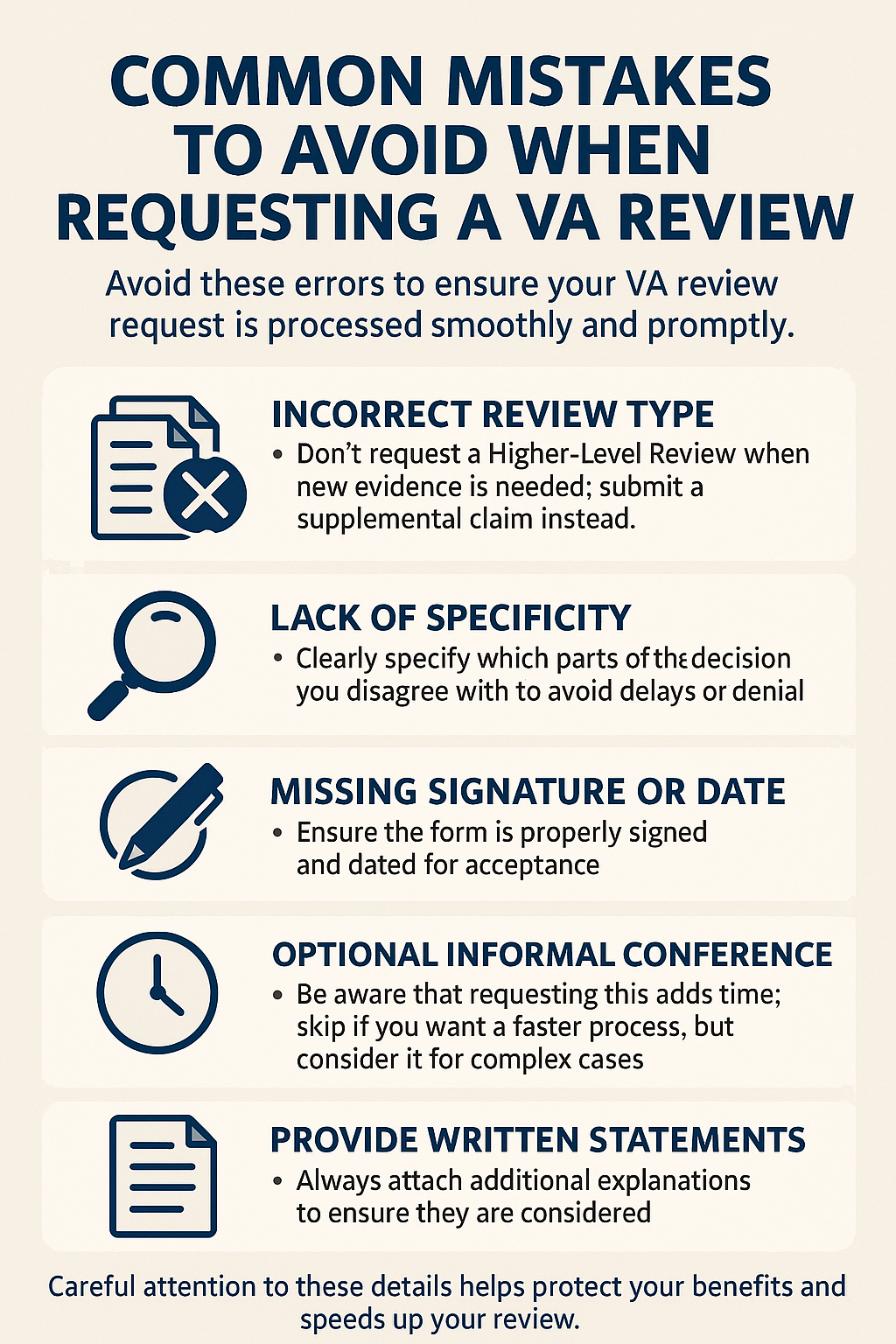
Filing VA Form 20-0996 may seem simple, but avoidable errors can delay or damage your case. A mistake could be grounds for rejection of your review request, so double-check all information. One of the most common mistakes is requesting a Higher-Level Review when you actually need to submit new evidence. Since this review is based only on existing records, claims requiring updated medical opinions or new documentation should be filed as a supplemental claim instead.
Another issue is failing to specify which parts of the decision you disagree with. The VA needs clarity in order to process your request correctly. Vague language or incomplete information may lead to a denied review or significant delays. The form must be properly signed and dated to be accepted by the VA.
Also, remember that requesting an informal conference adds time to the process. If you’re seeking speed over conversation, you may choose to skip the call. However, the conference can be beneficial if your case involves complex legal interpretation or unclear documentation. If you are submitting additional explanations, a written statement must accompany your form to ensure your concerns are considered.
When to Consider Other VA Appeal Options
While Higher-Level Review is a valuable tool, it’s not always the best fit for every claim. If you have new medical evidence, updated service records, or fresh lay statements, a supplemental claim may be more appropriate. If you have new evidence, you may submit a supplemental claims request instead of a higher-level review. This route allows you to introduce new material that could directly change the VA’s decision.
Alternatively, if you want your case heard by a Veterans Law Judge, you can request a formal appeal to the Board of Veterans’ Appeals using VA Form 10182. This route often takes longer—sometimes over a year—but it offers additional legal protections and can include hearings if requested.
Understanding which option fits your situation is key to getting the best outcome possible. Working with a VA-accredited representative or Veterans Service Organization can make this decision easier and ensure all paperwork is filed correctly and on time.
FAQs About VA Form 20-0996 and Higher-Level Review
There are some commonly asked questions about the Higher-Level review process. These quick FAQs might help you better understand what’s next.
- Can I submit new evidence with my Higher-Level Review request? No. The Higher-Level Review only considers evidence that was in your record at the time of the initial decision.
- How long does a Higher-Level Review take? Most reviews are completed within four to six months, though timelines may vary depending on workload and case complexity.
- Is the informal conference required? No. It’s optional but can be helpful if you want to clarify points or highlight possible errors in the original decision.
- Can I request a Higher-Level Review more than once? Only once per issue. If you’ve already used this option for a specific condition, you must file a supplemental claim or appeal to the Board for further review.
- Do I need a lawyer or VSO to file Form 20-0996? No, but it helps. Accredited representatives can ensure you file correctly and improve your chances of a favorable outcome. Working with an experienced veteran affairs attorney can provide valuable guidance, especially when handling complex claims and navigating VA bureaucracy. Contact an experienced veteran affairs attorney today for guidance, or contact an experienced veteran for assistance with your VA form submissions.
Don’t Settle for a Wrong Decision—Take Action
When the VA makes a decision that doesn’t truly reflect your condition, it can be frustrating, but it’s far from the end of the road. With VA Form 20-0996 and the review process, you get a real second chance to have your case reviewed. Maybe the VA missed important evidence, applied the wrong rules, or just made a mistake. Either way, you still have the right to push back.
If you think your claim deserves another look, take action now. Get help, start the process, and you could be just one form away from a fairer, more accurate decision.
Allow us to guide you through the process of receiving benefits you deserve. Begin today by taking our free medical evidence screening, at Allveteran.com.
 AllVeteran.com Advisors
With expertise spanning local, state, and federal benefit programs, our team is dedicated to guiding individuals towards the perfect program tailored to their unique circumstances.