













The VA’s “duty to assist” is a legal obligation to help veterans gather evidence for disability claims. This duty, outlined in the Veterans Claims Assistance Act of 2000 (VCAA), requires the VA to obtain relevant records and provide medical exams.
A duty to assist error occurs when the VA fails in this responsibility, potentially leading to denied or undervalued claims. The situation becomes more significant when “favorable findings”—VA determinations supporting parts of a claim—already exist, yet the VA still fails to develop the claim fully. Understanding these errors, especially in conjunction with favorable findings, is crucial for veterans to navigate appeals and secure the benefits they have earned.
Why This Update
We want to make sure our information is as up-to-date as possible! As of February 2026, this is the information we have on the VA Duty to Assist.
Tamila’s Take
I’ve seen it happen too many times. Veterans do everything right, submit their claims, and then get stuck because the VA didn’t follow through. Missing records, no C&P exam, or just silence. That’s a duty to assist error, plain and simple. And if the VA already admitted something in your favor? That’s your leverage. Don’t let their mistake cost you what you’ve earned. Push back. You’re not asking for a handout. You’re asking them to do their job.
The VA’s Duty to Assist: Legal Foundations
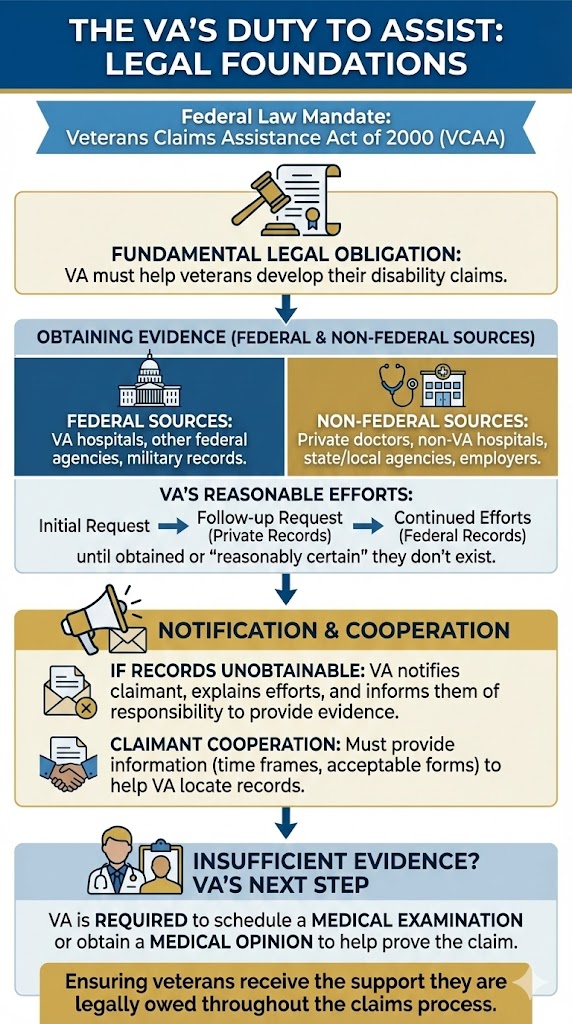
The duty to assist is a fundamental legal obligation that requires the VA to help veterans develop their VA disability claims. This duty is required by federal law, specifically the Veterans Claims Assistance Act of 2000 (VCAA). The VCAA established clear requirements for how the VA must support veterans throughout the claims process.
The VA’s duty to assist includes obtaining evidence from both federal and non-federal sources, such as private health care providers, non-VA hospitals, state or local agencies, and current or former employers. The VA’s reasonable efforts involve making an initial request and at least one follow-up request for private records, and continued efforts for federal records until they are obtained or it is reasonably certain they do not exist.
If the VA cannot obtain relevant records necessary to substantiate a claim, it must notify the claimant, explain the efforts made, and inform the claimant that they are ultimately responsible for providing evidence to substantiate the claim. Claimants must cooperate with the VA’s efforts by providing sufficient information, such as the approximate time frame covered and the form acceptable to the custodian, to help the VA identify and locate the records sought.
The VA may seek a new source or make subsequent requests if initial efforts to obtain records are unsuccessful. If evidence is insufficient, the VA is required to schedule a medical examination or obtain a medical opinion to help prove a claim.
What Constitutes a VA Duty to Assist Error?
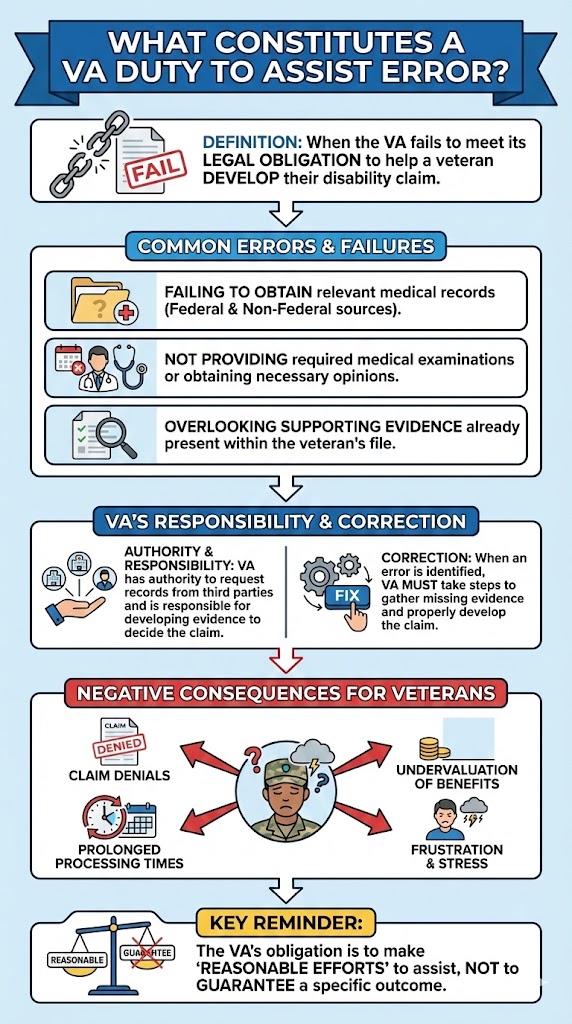
A duty to assist error happens when the VA doesn’t meet its legal obligation to help a veteran develop their claim.
Common errors include failing to obtain relevant medical records, not providing required medical examinations, or overlooking supporting evidence within a veteran’s file. When a duty to assist error is identified, the VA must take steps to fix the error by gathering missing evidence and properly developing the claim.
The VA has the authority to request records from various sources, including third parties, and is responsible for developing the evidence necessary to decide the claim. These errors may lead to claim denials, undervaluation of benefits, prolonged processing, and frustration and stress for veterans who are navigating the system.
Remember the VA’s obligation is to make “reasonable efforts,” not to guarantee a specific outcome.
Favorable Findings in VA Claims
Favorable findings are official determinations made by the VA that support specific elements or aspects of a veteran’s claim. These findings establish important facts that form the foundation of a case for benefits.
Examples include establishing that an injury occurred in service, confirming service connection, or acknowledging the severity of a condition. These findings are binding on the VA for future claim decisions. This means facts don’t need to be proven again once they’re established.
Favorable findings may significantly strengthen a case for benefits by supporting important parts of a claim. Once established, these determinations provide a stable foundation for additional claims or increased ratings.
Intersecting Duty to Assist Errors with Favorable Findings
This critical scenario occurs when the VA fails its duty to assist despite the presence of evidence that could lead to favorable findings. The intersection of these two concepts represents a serious concern for veterans who are seeking benefits.
The impact includes claim denials that may feel unjust, undervaluation of conditions, and delays in receiving appropriate compensation. When the VA fails to develop evidence that could lead to favorable findings, veterans may lose critical determinations. These determinations would support not only a current claim but future related claims as well.
For instance, the VA might fail to obtain records that would prove service connection, or neglect to provide an exam necessary to establish the severity of a condition. When a duty to assist error is identified during a higher-level review or appeal, the regional office may close the review and open a new claim to gather missing evidence.
This process is case based, meaning the VA reviews each claim according to its specific details and may remand or reopen claims to ensure all necessary evidence is collected and a fair decision is made.
Steps to Address and Appeal VA Duty to Assist Errors
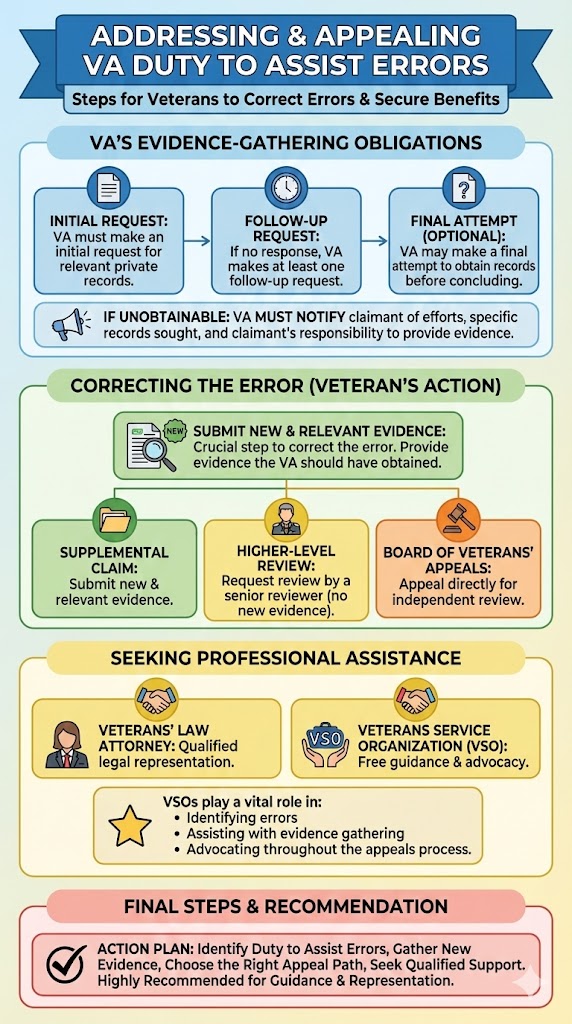
When gathering evidence, the VA is required to make an initial request for relevant private records and, if no response is received, at least one follow-up request. The VA may also make a final attempt to obtain such records before concluding the evidence-gathering process.
If the VA cannot obtain such records, it must notify the claimant and provide the efforts made to obtain the records, the specific records sought, and the claimant’s responsibility to provide evidence to substantiate the claim.
Submitting new, relevant evidence that the VA should have obtained is a crucial step in correcting the error. Veterans can file a Supplemental Claim with new evidence, request a Higher-Level Review by a senior reviewer, or appeal directly to the Board of Veterans’ Appeals.
Seeking assistance from a qualified veterans’ law attorney or a Veterans Service Organization (VSO) is highly recommended for guidance and representation. VSOs play a vital role in identifying errors, assisting with evidence gathering, and advocating for veterans throughout the appeals process.
Example Scenario
A veteran filed a claim for a knee injury sustained in service. The veteran mentioned receiving physical therapy at a military facility during service, but the VA failed to request the relevant personnel records from the appropriate agency or department responsible for maintaining such records. This happened even though other service records indicated knee pain.
The VA denied the claim, citing insufficient evidence of chronicity. This represents a duty to assist error, as the VA failed to pursue relevant evidence by not obtaining the necessary personnel records from the correct agency or department. If initial requests for records are unsuccessful, the VA should seek a new source for the relevant records to fulfill its evidentiary obligations. This evidence could have led to a favorable finding on the service connection or chronicity of the injury.
Frequently Asked Questions
What is the primary purpose of the VA’s duty to assist?
The primary purpose is to ensure veterans receive fair consideration for their disability claims by obligating the VA to help gather necessary evidence to support their claim.
Can a duty to assist error be overlooked if a veteran has favorable findings?
No, a duty to assist error is significant even with favorable findings. It means the VA failed to fully develop the claim, potentially preventing even stronger or additional favorable findings.
How long does the VA’s duty to assist last?
The duty to assist is an ongoing obligation throughout the entire claims process, from initial filing through any appeals, as new evidence may emerge or be needed.
What should a veteran do if they suspect a duty to assist error has occurred?
If a veteran suspects an error, they should gather any missing evidence, consider filing a Notice of Disagreement (NOD), or seek assistance from a Veterans Service Organization (VSO) or a veterans’ law attorney.
Are all VA claim processing mistakes considered duty to assist errors?
No, not every mistake is a duty to assist error. The VA’s obligation is to make “reasonable efforts” to assist, and minor clerical errors or situations where the veteran fails to cooperate may not qualify.
What role do Veterans Service Organizations (VSOs) play in identifying these errors?
VSOs are crucial. They can help veterans identify potential duty to assist errors, assist with gathering evidence, and represent them during the appeals process to ensure the VA fulfills its obligations.
Let us help you at Allveteran.com. We are here to smooth out the confusion surrounding these benefits!
 AllVeteran.com Advisors
With expertise spanning local, state, and federal benefit programs, our team is dedicated to guiding individuals towards the perfect program tailored to their unique circumstances.