













Filing a VA Clear and Unmistakable Error (CUE) claim is a legal motion used to correct an obvious, outcome-changing error in a final VA decision. Rather than an appeal or a new claim, it’s a request for the VA to admit a mistake it made in applying the law or reviewing the facts at the time of the original decision. A successful CUE claim can result in retroactive benefits dating back to the original effective date.
With growing access to digital claims files, more veterans are able to identify errors, and correcting them could mean tens of thousands in back pay. So, here is everything you need to know about CUE claim filing, and what it could mean for you in the long run.
Tamila’s Take: The Truth About CUEs That Veterans Need to Hear
If you’ve ever looked at an old VA decision and felt in your gut that something wasn’t right, you’re not alone. A lot of us trusted the VA’s first decision because we didn’t know any better. We assumed they reviewed everything, applied the law correctly, and gave us the rating we deserved. But years later, sometimes decades, you look back and realize the VA missed something big.
That’s where CUE comes in, and let me tell you: it’s one of the most misunderstood tools veterans have.
What Is a VA CUE (Clear and Unmistakable Error)?
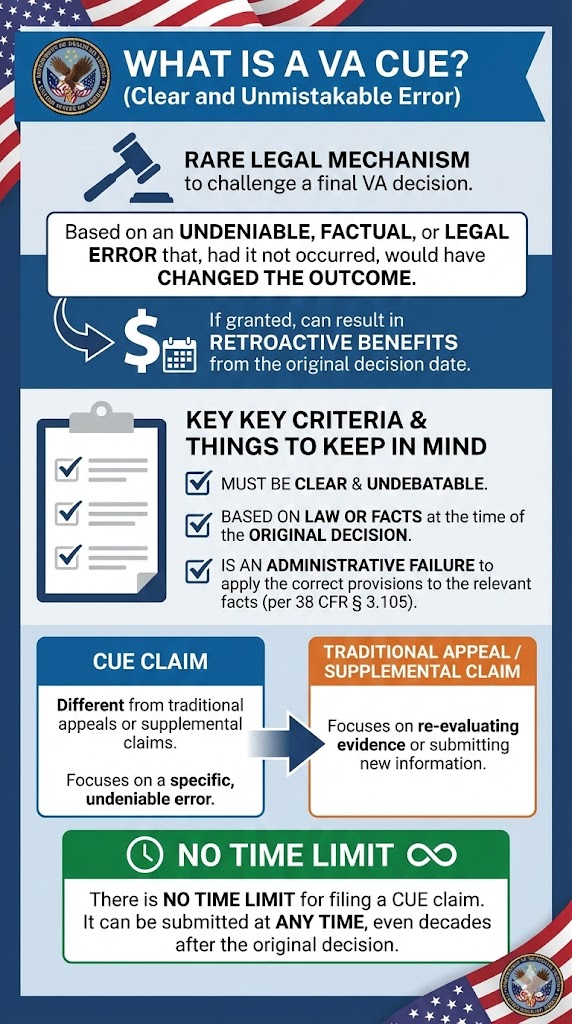
A CUE is a rare legal mechanism that allows a veteran to challenge a final VA decision based on an undeniable, factual, or legal error that, had it not occurred, would have changed the outcome. A VA CUE filing can result in retroactive benefits from the original decision date, if granted.
There are a few things that you should keep in mind. First, it must be clear, undebatable, and based on the law or facts at the time of the original decision.
Additionally, CUE claims are different from traditional appeals or supplemental claims. According to 38 CFR § 3.105, a CUE is “an administrative failure to apply the correct statutory or regulatory provisions to the correct and relevant facts.” Knowing when to file and what mistakes could hold you back from your deserved benefits is key.
There is no time limit for filing a CUE claim; it can be submitted at any time, even decades after the original decision.
When Filing a VA CUE Claim Makes Sense and When It Doesn’t
CUEs are not meant to fix disagreements over VA judgment or re-evaluate new evidence. They apply only when:
- The VA ignored key, relevant evidence that was in the file at the time.
- The VA’s failure to apply the correct law or regulation.
- The specific error clearly changed the outcome of the decision.
When Not to File a CUE:
- If you have new evidence to support your claim, file a supplemental claim instead.
- If you simply disagree with your VA disability rating, or how the VA weighed the evidence, that’s a job for a Higher-Level Review or Board Appeal.
In short: use a CUE only if you’re pointing out a legal or procedural error that no reasonable adjudicator would have made.
How to File a VA CUE Motion Correctly
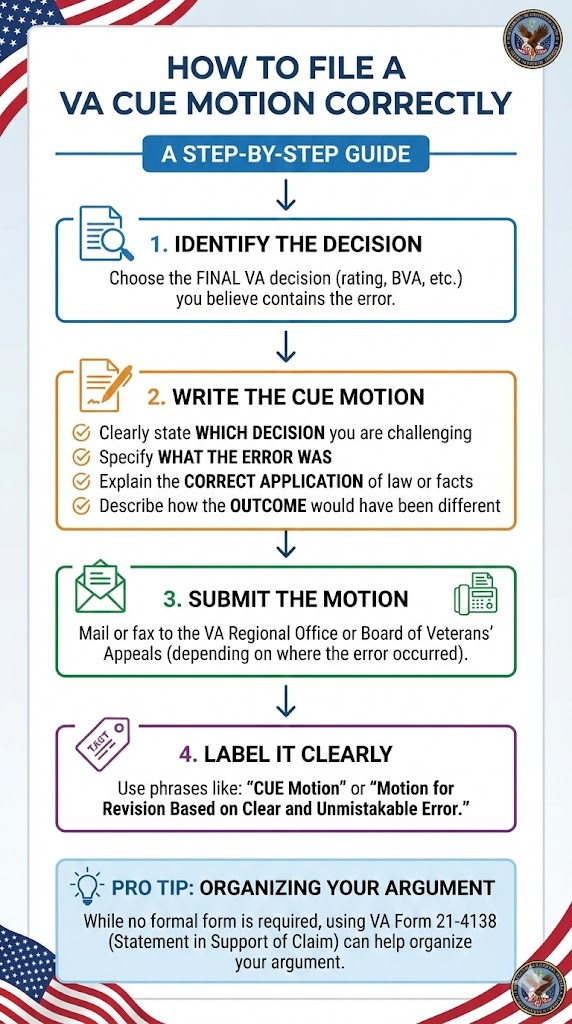
To file a valid CUE motion, follow these steps:
- Identify the Decision: Choose the final VA decision (rating decision, BVA decision, etc.) you believe contains the error.
- Write the CUE Motion: Clearly state:
- Which decision you are challenging
- What the specific error was
- What the correct application of law or facts should have been
- How the outcome would have been different with the correct facts
- Submit the Motion:
- Mail or fax your motion to the VA Regional Office or Board of Veterans’ Appeals (depending on which made the error).
- Label it clearly: “CUE Motion” or “Motion for Revision Based on Clear and Unmistakable Error.”
VA CUE motions do not have a formal form, but using VA Form 21-4138 (Statement in Support of Claim) can help organize your argument.
Common VA CUE Mistakes That Can Delay or Deny Your Claim
Anyone submitting a VA CUE will want to know the mistakes they should avoid. Certain moves could delay your claim or lead to it being denied altogether.
- Submitting new evidence: The VA cannot consider any documents not in the record at the time of the original decision.
- Making general allegations: You must cite specific laws or errors in fact.
- Filing too soon: Only final decisions are eligible for CUE. If your claim is still pending or appealable, CUE does not apply.
If you’re unsure whether your situation qualifies, consult with a VA accredited attorney or claims agent.
Real-World Example of How Filing a CUE Claim Can Change Things
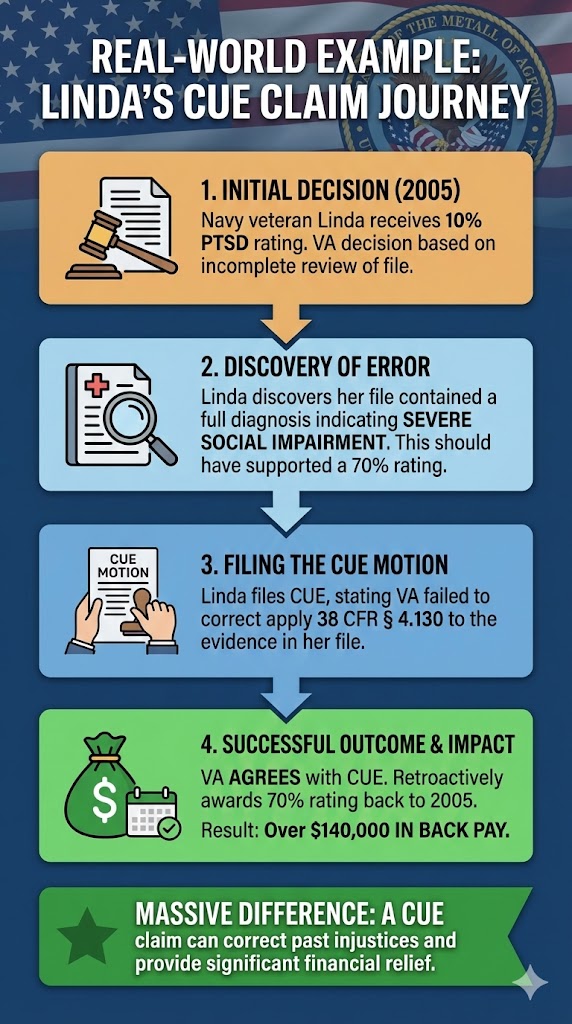
Sometimes, it helps to have a plausible example when you are talking about VA matters. Consider Linda, a Navy veteran, who received a 10% rating for PTSD in 2005. She recently discovered that her VA file at the time included a full diagnosis indicating severe social impairment, which should have supported a 70% rating.
As a result, she filed a CUE motion, stating that the VA failed to apply 38 CFR § 4.130 correctly. After review, the VA agreed and retroactively awarded her a 70% rating back to 2005, resulting in over $140,000 in back pay. That could make a massive difference in someone’s life.
FAQs About Filing a VA CUE
You want to go into filing a VA CUE with all the information you could possibly have. These are some of the most frequently asked questions (FAQs) about the process.
- What is a CUE in a VA claim? A CUE (Clear and Unmistakable Error) is a legal correction of a final VA decision based on an obvious mistake in law or fact.
- Can I file a CUE instead of an appeal? Only if your decision is final and the error is clear-cut based on the record. Otherwise, file a Higher-Level Review or Supplemental Claim.
- How do I file a CUE motion? Write a clear letter identifying the decision, the error, and what should have happened. Submit it to the VA or BVA.
- Can I use new evidence in a CUE? No. CUE decisions are based solely on the record and laws that existed at the time the original decision was made.
- Is there a deadline for filing a VA CUE? No. You can file a CUE at any time after the decision becomes final.
- What’s the difference between an appeal and a CUE? Appeals challenge VA decisions with new arguments or evidence. CUE corrects past errors that were never properly decided.
- Can a CUE change my effective date? Yes. If granted, the VA must pay you retroactively from the original claim date as if the error never happened.
Correctly Filing a CUE Could Change Everything
Filing a VA CUE is one of the most powerful tools veterans have to correct past mistakes in their claims, but it’s also one of the most misunderstood. When used correctly, a CUE can reopen the door to benefits you should have received years ago, restoring the rating, compensation, and recognition that were rightfully yours from the start.
If you believe the VA overlooked evidence, misapplied the law, or made an undeniable error in your past decision, you don’t have to navigate the process alone. AllVeteran.com can help you review your old decisions, identify potential CUEs, and gather the documentation needed to build a strong, well‑supported motion.
 AllVeteran.com Advisors
With expertise spanning local, state, and federal benefit programs, our team is dedicated to guiding individuals towards the perfect program tailored to their unique circumstances.