













A General Discharge Under Honorable Conditions is a type of administrative discharge, governed by military regulations across all branches of the armed forces. It signifies satisfactory service but with notable issues, such as minor disciplinary infractions or failure to meet certain standards. While not as favorable as an Honorable Discharge, it is still considered non-punitive and issued under honorable conditions.
There are eight types of military discharge, divided into administrative and punitive categories. A General Discharge is classified as an administrative discharge, distinguishing it from punitive discharges that result from court-martial proceedings.
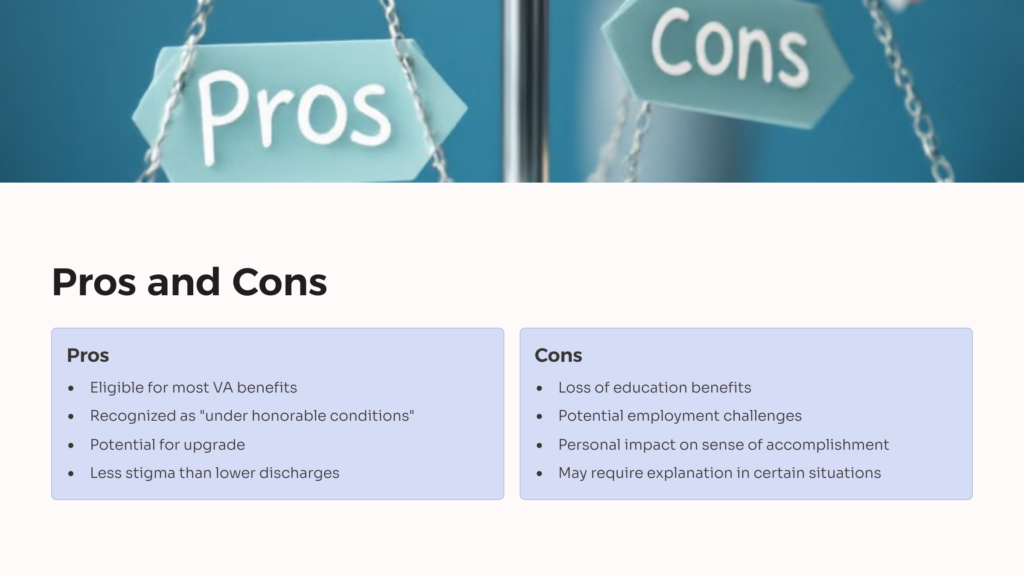
Veterans with this discharge are typically eligible for most VA benefits, including healthcare, disability compensation, and home loan guarantees. However, a significant exception is often federal education benefits like the GI Bill. A General Discharge may also limit a service member’s ability to reenlist in the military, often requiring a waiver, and can impact future military career opportunities.
This type of discharge occupies a middle ground on the spectrum of military separations, offering more support than punitive discharges but less comprehensive access than an Honorable Discharge.
Why This Update
We always want to make sure we are providing clear, updated information so you can always make the best decision for your benefits.
Tamila’s Take
When I talk to veterans with a General Discharge, I hear the same thing over and over: “I didn’t think I’d qualify for anything.” That’s the myth. The truth? A General Discharge under honorable conditions still opens the door to most VA benefits, including health care, disability compensation, and even home loans.
Yes, it’s not the same as an Honorable Discharge. You may lose access to the GI Bill, and some employers might ask questions. But this discharge doesn’t define your worth or erase your service. It means you faced challenges and still showed up.
I’ve worked with veterans who carried shame over their discharge for years, only to find out they were eligible for more than they thought. Some even successfully upgraded their discharge status with the right documentation and support.
Understanding a General Discharge Under Honorable Conditions
A General Discharge Under Honorable Conditions is issued for service members whose performance and duty performance were generally satisfactory but did not fully meet military standards for personal conduct. These might include minor disciplinary issues, failure to meet fitness standards, or other conduct that didn’t rise to the level requiring more severe action. Despite these issues, this discharge type remains classified as “under honorable conditions” and is non-punitive in nature.
A General Discharge is still considered a form of honorable service, as it is based on a service determination of whether the service member met the required standards. This type of discharge can result from involuntary separation or administrative separation processes. While it’s not as favorable as an Honorable Discharge, it acknowledges that the service member generally met their obligations despite some shortcomings.
Eligibility for VA Benefits with a General Discharge
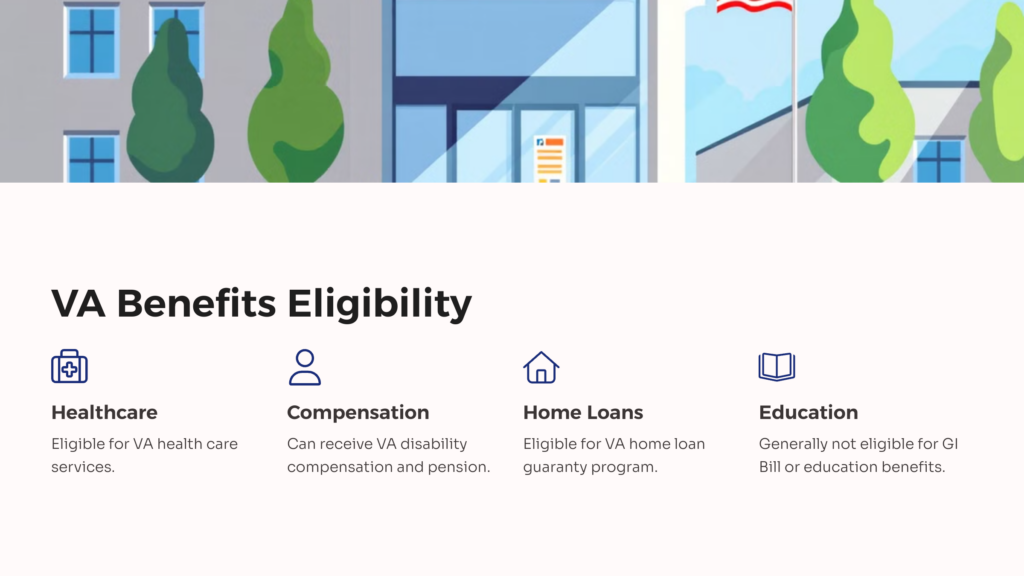
Veterans with a General Discharge Under Honorable Conditions typically maintain access to most veterans benefits and military benefits. This includes VA health care, health care benefits, disability compensation for service-connected conditions, VA pension programs, and VA home loan guarantees. The VA may conduct a “character of discharge” review, also known as a service determination, in some cases to determine benefit eligibility, particularly when there are complexities surrounding the discharge circumstances.
The most significant limitation involves federal education benefits. Veterans with a General Discharge typically cannot access GI Bill benefits, which require an Honorable Discharge. Post-9/11 GI Bill, 38 CFR § 21.9525(a)(1) explicitly requires an honorable discharge for eligibility, confirming that General Discharges do not qualify for federal VA education benefits.
Veterans with a General Discharge may qualify for an automatic review if their discharge was due to PTSD or other mental health conditions.
Civilian Employment and Career Implications
A General Discharge carries considerably less stigma than Other Than Honorable or Dishonorable discharges. Many civilian employers may view it as acceptable, particularly those outside government contracting or military-adjacent industries. For many veterans transitioning to civilian life and entering the civilian world, a General Discharge may present some challenges in civilian employment, but many employers may not even ask about the specific type of discharge. Employers may review the DD-214 form, which lists the nature of discharge, and may run background checks that include discharge details.
However, some employers with strong military ties or those hiring for positions with government contractors may prefer candidates with Honorable Discharges. Federal jobs and veterans preference are generally available to those with a General Discharge, and many veterans find that most employers do not consider discharge status unless it is dishonorable. Federal and state laws prohibit discrimination against a veteran from housing or employment on the basis of an unfavorable discharge from military service, as long as it is not a dishonorable discharge.
Security clearances may require additional review during the process. Jobs requiring high-level security clearances may involve more scrutiny of the circumstances surrounding a General Discharge. Veterans can prepare to discuss their military service in a positive light, focusing on skills gained and achievements accomplished while being honest about their discharge circumstances. Highlighting post-service accomplishments may help address any concerns potential employers might have.
How a General Discharge Compares to Other Military Separations
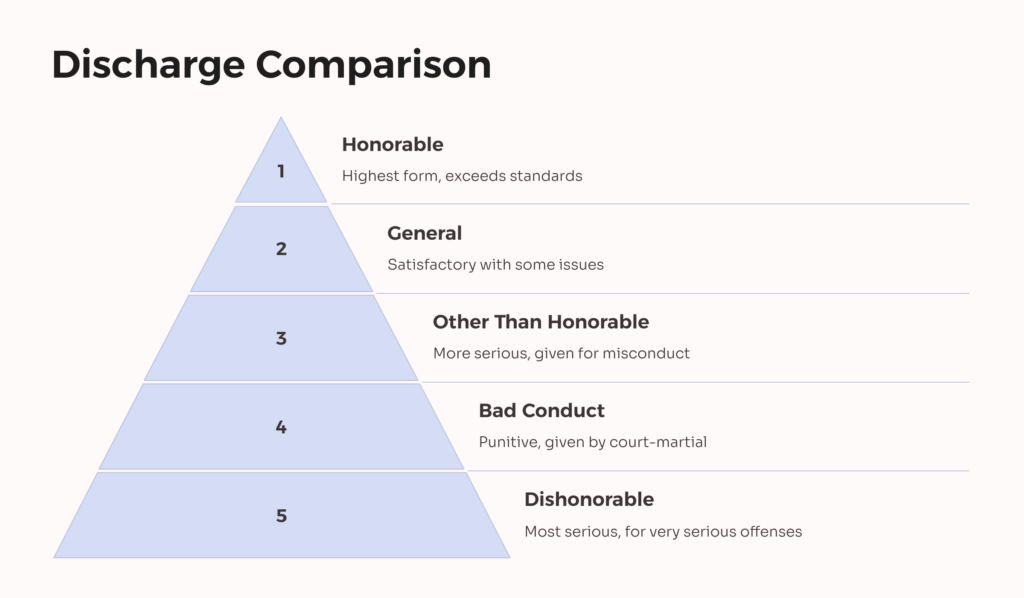
Military discharges exist on a spectrum from Honorable (the highest designation) to Dishonorable (the most severe punitive discharge), with the legal processes for punitive discharges governed by military justice. An Honorable Discharge signifies exemplary service and grants full access to all federal veteran benefits, including education benefits.
A General Discharge, also known as general under honorable conditions, is an administrative discharge given to service members whose performance was satisfactory but who did not meet all standards, often due to minor misconduct. This type of administrative discharge provides substantial benefits, though not the full range available to those with Honorable Discharges.
Other Than Honorable (OTH) discharges represent a more severe form of administrative separation and are issued for serious misconduct, such as security violations or repeated infractions. An OTH discharge is considered a significant departure from expected conduct and performance standards, resulting in significantly limited VA benefits.
Punitive discharges, such as Bad Conduct Discharge (BCD) and Dishonorable Discharge (DD), are imposed by special court martial or general court martial authorities, especially for enlisted service members, and lead to severe loss of benefits and certain civilian rights.
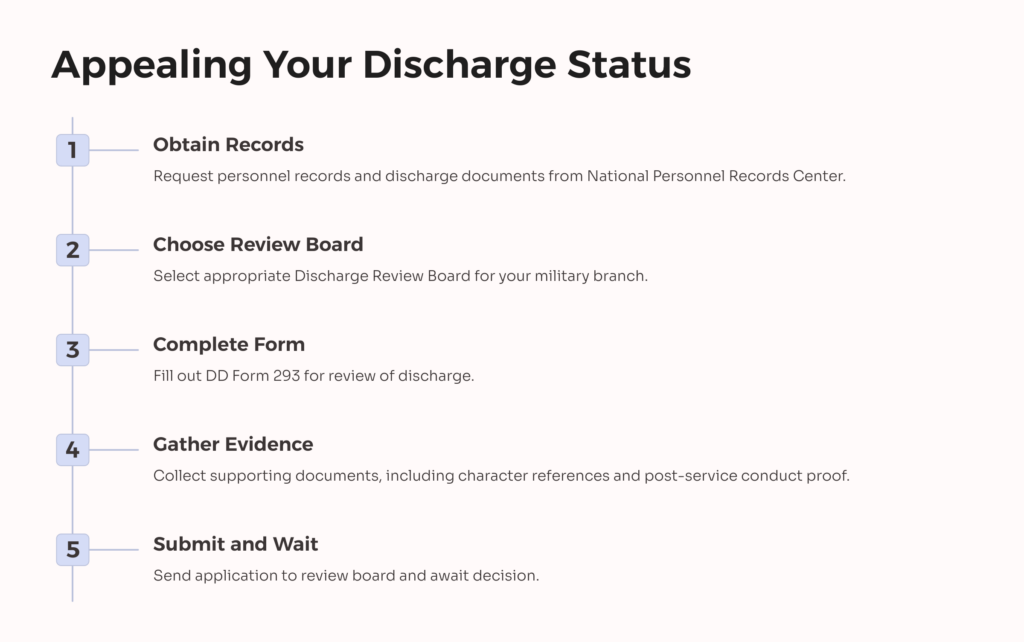
Each military branch has its own Discharge Review Board (DRB) for handling discharge upgrade requests, and veterans can apply to their branch’s discharge review board to seek an upgrade if they believe their discharge was unjust or improper.
Appealing or Upgrading Your General Discharge Status
Veterans who feel their General Discharge was unjust or who have demonstrated significant positive post-service conduct may apply for a discharge upgrade to seek an honorable characterization if justified. The discharge upgrade process involves obtaining complete military records, completing DD Form 293, gathering supporting evidence, and submitting the application to the appropriate service-specific Discharge Review Board.
Veterans with mental health conditions, such as PTSD or those who experienced military sexual trauma (MST), may have additional grounds for a discharge upgrade, and in some cases, may qualify for an automatic review based on their mental health status. Supporting evidence is crucial and can include character references from employers or community leaders, proof of positive post-service conduct such as educational achievements or community service, and documentation showing the original discharge was inequitable or improper.
The appeal process for a discharge upgrade can be complex and time-consuming. Veterans can request a hearing to present their case in person during the process. The Discharge Review Board will review the case and make a decision regarding the upgrade. The appeal must be filed within 15 years of the date of separation; beyond that, appeals go to the Board for Correction of Military Records. Working with Veterans Service Organizations (VSOs) or military law attorneys may improve the chances of a successful appeal.
Example Scenario
After serving four years in the Navy, Mark received a General Discharge Under Honorable Conditions after experiencing challenges with following orders during a stressful period. While he was eligible for VA healthcare and a home loan, he learned he couldn’t use the Post-9/11 GI Bill for his engineering degree. Determined, Mark utilized state-level veteran education benefits and sought counsel from a VSO to explore the possibility of upgrading his discharge, demonstrating his positive post-service conduct.
Frequently Asked Questions
What is the main difference between an Honorable and a General Discharge?
The main distinction is that a General Discharge often limits access to federal education benefits like the GI Bill, whereas an Honorable Discharge grants full access to all federal veteran benefits. An Honorable Discharge also signifies a higher standard of service.
Can I get VA disability benefits with a General Discharge?
Yes, veterans with a General Discharge Under Honorable Conditions are generally eligible for VA disability compensation, provided their service-connected condition meets the VA’s criteria for a legitimate claim.
Does a General Discharge affect my ability to get a job?
While it’s considered ‘under honorable conditions,’ some employers, particularly those with strong military connections or requiring high security clearances, may prefer candidates with an Honorable Discharge. However, many civilian jobs may not be significantly affected.
Are there any education benefits available if I have a General Discharge?
Federal education benefits like the GI Bill are typically unavailable. However, some states offer their own veteran education benefits, and many colleges and universities provide scholarships or programs that are accessible to veterans regardless of discharge type.
How long do I have to appeal my General Discharge?
Generally, you have up to 15 years from your discharge date to apply to your service branch’s Discharge Review Board. For cases beyond 15 years, appeals must be submitted to the Board for Correction of Military Records.
Will a General Discharge prevent me from getting a security clearance?
A General Discharge may require additional review during the process of obtaining certain security clearances, especially for higher levels. The specific reasons for the discharge will be thoroughly reviewed as part of the clearance investigation.
What resources are available to help veterans with a General Discharge?
Veterans Service Organizations (VSOs) like the American Legion or VFW, VA Vet Centers, state Veterans Affairs offices, and military legal aid services can provide invaluable assistance with benefits, discharge upgrades, and career guidance.
At AllVeteran.com, we want to help you figure out your benefits! reach out to us if you have questions about what you qualify for with a general discharge or if you want to try to upgrade your discharge status!
 AllVeteran.com Advisors
With expertise spanning local, state, and federal benefit programs, our team is dedicated to guiding individuals towards the perfect program tailored to their unique circumstances.