












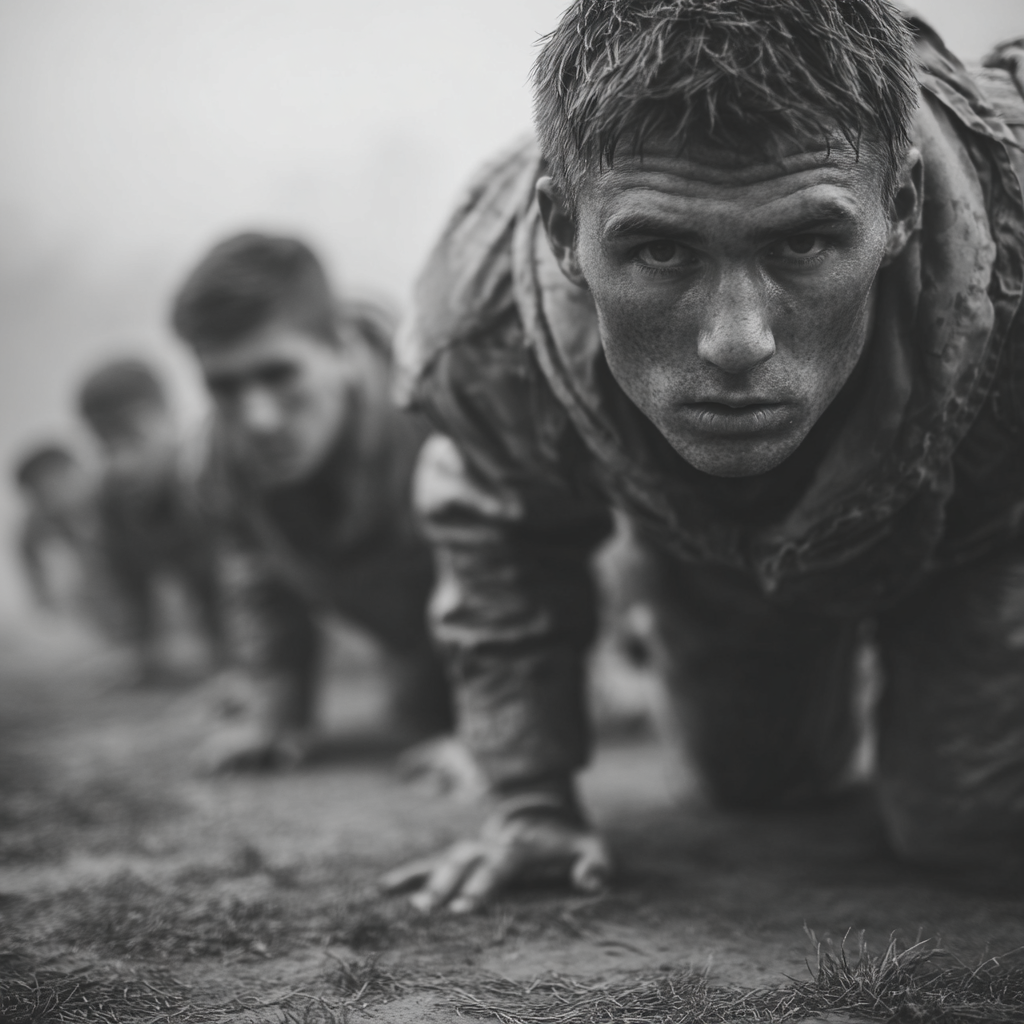
Becoming an 11B Infantryman in the U.S. Army requires meeting stringent physical, mental, and academic criteria. Prospective recruits must be U.S. citizens or permanent residents, typically between 17 and 35 years old, and possess a high school diploma or GED. To qualify for the 11B Infantryman role, recruits must achieve a Combat (CO) ASVAB score of 87.
Physical fitness is paramount, demanding excellent cardiovascular health, strength, and endurance to withstand the rigors of combat training and field operations. Infantry recruits must meet specific physical requirements, including a physical profile of 111221 and correctable vision of 20/20 in one eye and 20/100 in the other. Candidates must also pass a physical exam and background check with no major law violations. Tattoos must adhere to Army guidelines, prohibiting extremist, racist, or sexist content, with limitations on visible areas.
Beyond initial enlistment, trainees must successfully complete Basic Combat Training (BCT) and Advanced Individual Training (AIT) to earn the 11B designation, committing to the demanding lifestyle of a combat soldier.
Why This Update
We want to make sure we have accurate information on all opportunities available to military members!
Understanding the 11B Infantryman Role
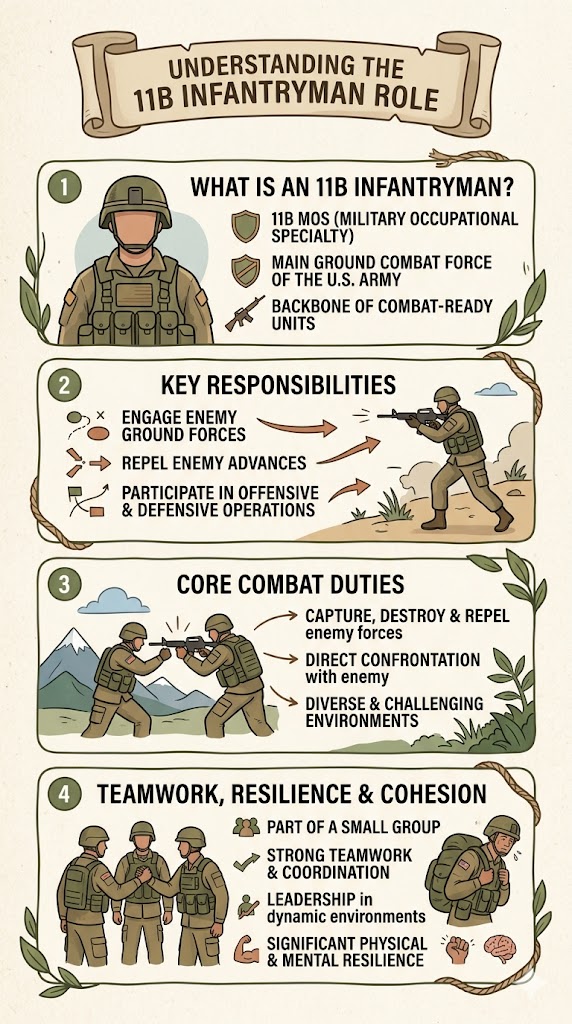
The 11B MOS (Military Occupational Specialty) designates an Infantryman who serves as the main ground combat force of the U.S. Army. This role forms the backbone of the Army’s combat-ready units, with responsibilities that include engaging enemy ground forces, repelling enemy advances, and participating in both offensive and defensive operations.
As an infantry soldier, the 11B has many duties, including capturing, destroying, and repelling enemy ground forces during combat operations. These soldiers are trained to confront enemy forces directly in diverse and challenging combat environments.
Soldiers in this role are often part of a small group, requiring strong teamwork, leadership, and coordination in dynamic environments. The role demands significant physical and mental resilience, often involving extended periods in harsh conditions. Success requires not just individual capability, but the ability to work effectively as part of a cohesive team under the most challenging circumstances.
Initial Eligibility and ASVAB Score Requirements
Candidates must be U.S. citizens or lawful permanent residents to qualify for the 11B MOS. Age requirements typically range from 17 to 35, with parental consent needed for those under 18. A high school diploma is generally required, though a GED may be accepted with additional conditions.
A qualifying score of 87 on the Armed Services Vocational Aptitude Battery (ASVAB) is mandatory for the 11B MOS. Moral character standards include a clean criminal record and no significant legal issues, as the Army conducts thorough background checks on all potential recruits.
Basic Training: Physical and Mental Fitness Standards
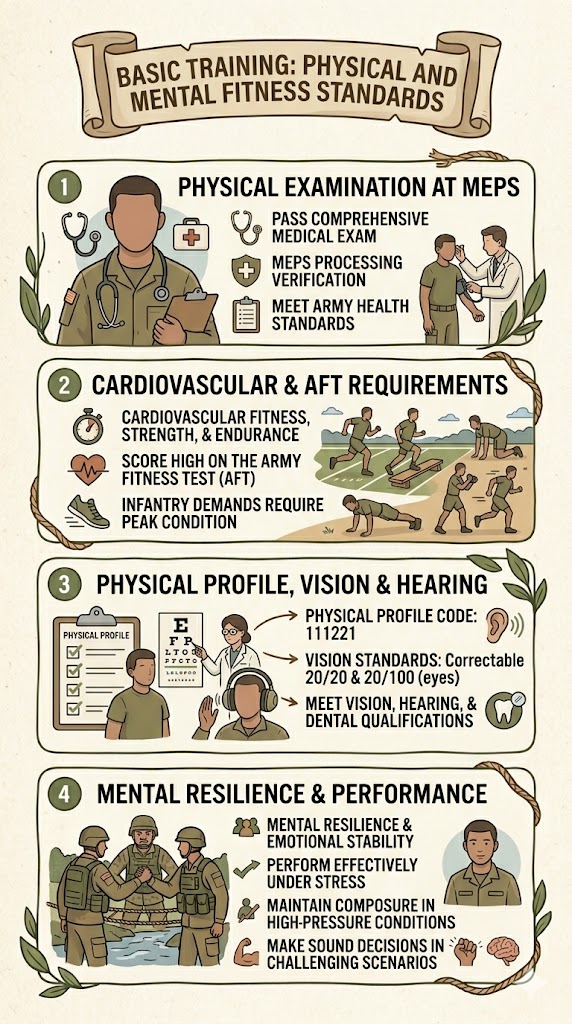
Candidates must complete and pass a comprehensive physical examination during MEPS (Military Entrance Processing Station) processing to verify they meet the Army’s health standards.
Strong cardiovascular fitness, strength, and endurance is important for the demanding nature of infantry work, and candidates must score high enough on the Army Fitness Test (AFT). Infantry recruits must meet a physical profile requirement of 111221 and have correctable vision of 20/20 in one eye and 20/100 in the other eye. Specific vision, hearing, and dental standards must be met to qualify.
Mental resilience, emotional stability and the ability to perform under stress are considered important qualities for someone in this role. The psychological demands of combat operations require individuals who can maintain composure and make sound decisions in high-pressure situations.
Basic Combat Training and Advanced Individual Training
All recruits enter the Army Infantry Training Program through One Station Unit Training (OSUT), which is now 22 weeks long—consisting of 10 weeks of Basic Combat Training (BCT) and 12 weeks of Advanced Individual Training (AIT). OSUT provides a continuous training pipeline that covers fundamental soldiering skills, discipline, and physical conditioning, followed by specialized infantry job training.
Since 2019, the Army expanded its Infantry Training curriculum to include more combative courses, lifesaver courses, and different weapons qualifications. Job training during AIT includes squad tactical training, urban terrain operations, and night land navigation. Infantrymen also receive instruction in landmine warfare, anti armor techniques, anti tank mines, and tactical combat casualty care.
Training covers basic combative training, night shooting, and vehicle platform training, where soldiers learn to operate and perform maintenance on military vehicles. Soldiers are taught to maintain and store combat weapons, and to maintain communications equipment. Infantrymen regularly practice with rifles, machine guns, and other complex weapon systems to maintain proficiency.
As part of their responsibilities, infantrymen conduct reconnaissance operations, evaluate terrain, select weapon emplacement, and record operational information. During combat, they are trained to request, observe, and adjust direct supporting fire, and engage targets.
The fire team and infantry team concepts are emphasized throughout training, with leaders providing tactical and technical guidance to their teams. Candidates must successfully complete both BCT and AIT to officially earn the 11B MOS and be assigned to an infantry unit.
Career Progression and Additional Infantry Training
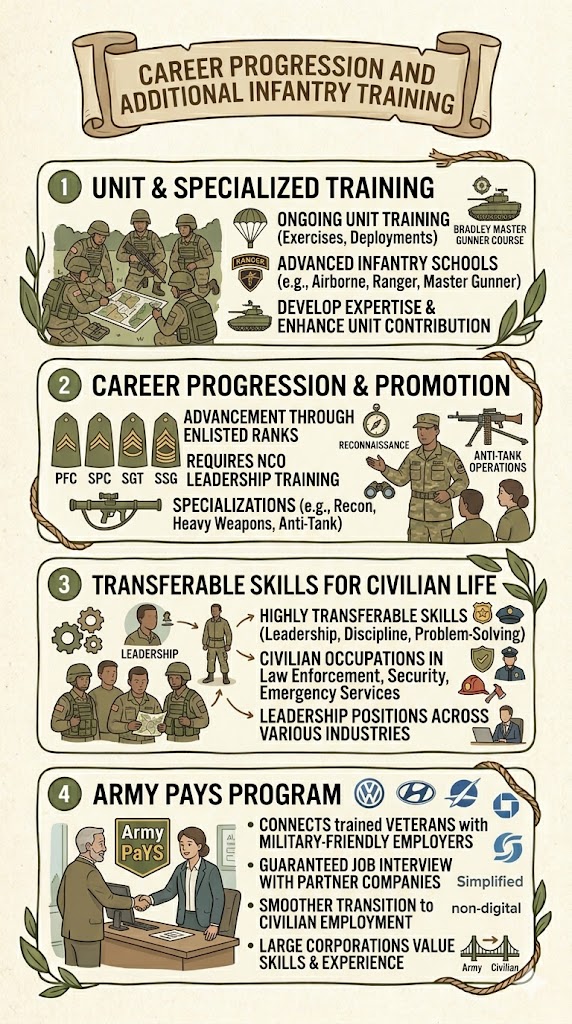
After initial training, individuals in the 11B role receive ongoing training in their units, participating in exercises, deployments, and specializations. Opportunities exist for advanced infantry training, such as Airborne School, Ranger School, or Bradley Master Gunner Course. These specialized schools allow soldiers to develop expertise in specific areas and enhance their contributions to their units.
Career progression involves promotion through enlisted ranks, often requiring NCO (Non-Commissioned Officer) leadership training. Soldiers in this role can specialize in areas like reconnaissance, heavy weapons, or anti-tank operations.
Skills developed in the 11B role, such as leadership, discipline, and problem-solving, are highly transferable to civilian occupations in law enforcement, security, emergency services, and leadership positions across various industries.
The Army PaYS program connects trained veterans and experienced and trained veterans with military friendly employers, guaranteeing a job interview with partner companies as part of the transition to civilian life. This program is designed to help soldiers and retirees find employment with large corporations that value the skills and experience gained through military service, making the transition to civilian employment smoother and more successful.
Example Scenario
If you are considering joining the Army and are drawn to a direct combat role, understanding the 11B requirements is crucial. You would need to ensure your physical fitness is excellent and that you can meet the mental challenges of rigorous training.
For example, one aspiring recruit found that preparing for the ASVAB well in advance of their enlistment helped them achieve the necessary scores for their desired infantry position, allowing them to confidently pursue their goal of becoming an 11B.
Frequently Asked Questions
Can I join the Army as an 11B with a GED?
While a high school diploma is preferred, the Army may accept a GED with additional requirements, such as a higher ASVAB score or completion of some college credits. It’s best to consult with a recruiter for the most accurate information.
What are the vision requirements for 11B?
Vision requirements are assessed during the MEPS physical. While correctable vision is generally acceptable, specific standards apply, and certain uncorrectable conditions or significant visual impairments may be disqualifying for infantry roles.
How long is 11B AIT?
11B Advanced Individual Training (AIT) is approximately 12 weeks long, following the 10 weeks of Basic Combat Training. This combined training period is often referred to as One Station Unit Training (OSUT).
Is being an 11B dangerous?
Yes, the 11B Infantryman role involves direct combat and is inherently dangerous. Soldiers in this role are often in combat situations, which involves significant risks due to the nature of their mission and exposure to hostile environments.
Can women be 11B?
Yes, all combat roles, including the 11B Infantryman MOS, are open to qualified women who meet the stringent physical, mental, and training standards.
What kind of training do 11Bs receive after AIT?
After AIT, individuals in the 11B role receive continuous unit-level training, which includes advanced tactics, weapon systems proficiency, field exercises, and opportunities for specialized schools like Airborne, Ranger, or Pathfinder School, depending on their assignment and career path.
What are the typical qualities of a successful 11B?
Successful individuals in the 11B role typically possess strong physical stamina, mental toughness, adaptability, teamwork skills, discipline, and a high level of motivation and resilience. They must be able to perform effectively under pressure and in challenging conditions.
 AllVeteran.com Advisors
With expertise spanning local, state, and federal benefit programs, our team is dedicated to guiding individuals towards the perfect program tailored to their unique circumstances.