













Agent Orange compensation provides financial support and healthcare benefits to eligible veterans and their families affected by exposure to the herbicide during military service. The U.S. Department of Veterans Affairs (VA) offers disability compensation for presumptive conditions like certain cancers, diabetes, and heart problems, with amounts varying based on disability rating and dependents.
Recent legislation, such as the PACT Act and the Blue Water Navy Vietnam Veterans Act of 2019, has expanded eligibility and added new presumptive conditions and locations for Agent Orange compensation.
Survivor benefits are available for families of veterans who died due to Agent Orange-related illnesses.
The application process involves gathering medical and service records and filing a claim with the VA. Proving exposure and service connection can be challenging, but resources like Veterans Service Organizations are available to assist.
Why This Update
Information on VA benefits, particularly about Agent Orange, can change over time. We want to make sure our content is as correct and up-to-date as possible!
Tamila’s Take
I’ve heard the story all too often. Veterans who were exposed to Agent Orange and didn’t even know it until decades later, until the cancer showed up, or the heart problems started. Watching them battle for recognition can be heartbreaking. The worst part? Some of them didn’t live long enough to see a dime. If you think you were exposed, don’t wait. Get it on record, get the help, and make sure your family’s protected too. You already paid the price, and you shouldn’t have to fight for the receipt.
Agent Orange Exposure Impacts
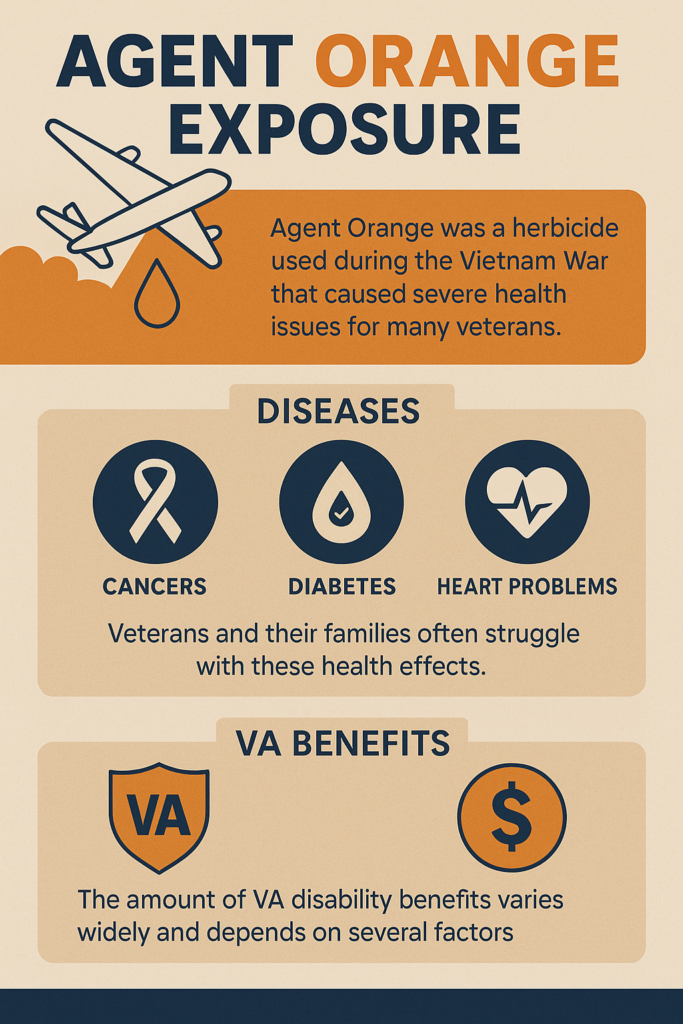
Agent Orange was a tactical herbicide used by the U.S. military during the Vietnam War for defoliation purposes. The chemical contained dioxin, a highly toxic substance that has been linked to serious long-term health consequences for those exposed. Understanding the scope of this exposure and its impacts is essential for veterans seeking compensation.
Exposure is linked to a range of health problems and conditions, including various cancers, Type 2 diabetes, Parkinson’s disease, and heart disease. The VA maintains a list of “presumptive conditions” for Agent Orange exposure, simplifying the claim process for veterans who served in specific areas during qualifying periods. This presumptive service connection means veterans don’t have to prove direct causation between their service and their illness.
The VA presumes a service connection for certain health conditions. Certain birth defects in children of veterans exposed to Agent Orange are also recognized for benefits.
Types of Agent Orange VA Disability Compensation and Benefits
VA Disability Compensation provides monthly tax-free payments for veterans with service-connected disabilities linked to Agent Orange exposure. The amount you receive depends on your disability rating and the number of dependents you have.
VA Survivor Benefits (DIC) offer financial support for eligible surviving spouses, children, and parents of veterans who died from Agent Orange-related conditions. This Dependency and Indemnity Compensation helps families after the loss of a family member.
Healthcare Benefits grant access to VA healthcare services for conditions related to Agent Orange. This can include treatment, medication, and ongoing care management.
Additional Support may include vocational rehabilitation, education assistance, and special monthly compensation for severe disabilities. These programs recognize that Agent Orange-related illnesses can affect multiple areas of a veteran’s life.
Eligibility Criteria and Presumptive Service Connection
To be eligible for Agent Orange compensation, veterans must have served in specific locations and during particular timeframes where Agent Orange was used. This includes service in Vietnam between 1962 and 1975, the Korean Demilitarized Zone, and certain U.S. waterways and territorial waters. The VA website provides detailed information about all qualifying locations and service periods.
A diagnosis of a health condition recognized by the VA as presumptive to Agent Orange exposure is a key factor in establishing eligibility. For presumptive conditions, the VA assumes a service connection, removing the need for veterans to prove direct causation. This presumptive approach acknowledges the widespread nature of herbicide use and the difficulty of documenting individual exposure decades after service.
Veterans who served in unlisted areas may still qualify if they can provide sufficient evidence of direct exposure and a service connection to their condition. While this requires additional documentation, it ensures that all veterans who were actually exposed have a path to benefits. Working with a Veterans Service Organization (VSO) can help you gather the necessary evidence to support your claim.
Applying for Agent Orange Compensation
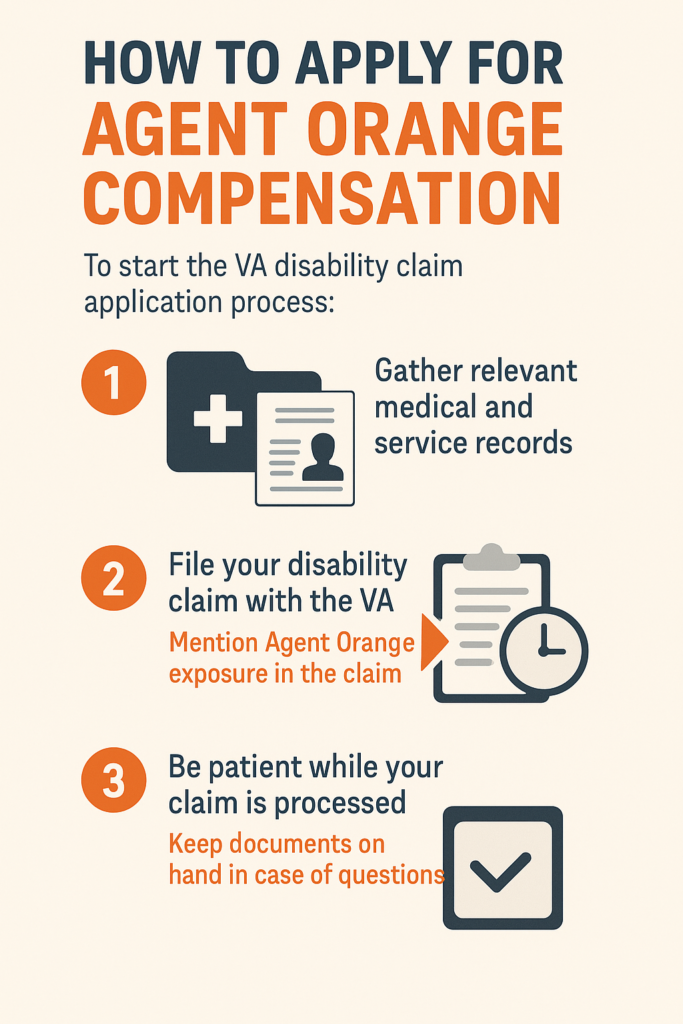
Gather Documentation by collecting all relevant medical records detailing your diagnosis and treatment, along with military service records proving qualifying service. Your DD-214 discharge papers are essential for establishing when and where you served. Medical records should clearly document your diagnosed condition and treatment history.
File Your Claim by submitting VA Form 21-526EZ (Application for Disability Compensation and Related Compensation Benefits) online through the VA website, by mail, or in person at a VA regional office. The online portal often provides faster processing. Include all supporting documentation with your initial submission to help avoid delays.
Undergo Examinations as the VA may request medical examinations, known as Compensation & Pension (C&P) exams, to evaluate your condition and its severity. These exams help the VA assign a disability rating.
Seek Assistance by considering working with a Veterans Service Organization (VSO) or an accredited claims agent to help navigate the application process and gather evidence. These organizations provide free support and have extensive experience with VA claims.
Factors Influencing Compensation Amounts and Ratings
VA Disability Rating is the primary factor. After reviewing a claim for Agent Orange-related conditions, the VA assigns a disability rating from 0% to 100%. This rating determines your VA disability compensation, which is paid as monthly payments. Higher ratings reflect more severe disabilities that have a greater impact on your daily life and ability to work.
The average compensation amount varies based on your VA disability rating and the number of dependents you have. Veterans with higher ratings and more dependents generally receive higher monthly payments.
Number of Dependents affects your compensation because payments increase for veterans with eligible spouses, children, and dependent parents. The VA recognizes that disabilities affect entire families and adjusts compensation accordingly.
Special Monthly Compensation (SMC) provides additional payments for specific severe disabilities or combinations of disabilities, such as loss of use of limbs or the need for aid and attendance.

Example Scenario
Robert, a Vietnam veteran who served in-country from 1968-1969, was diagnosed with Type 2 diabetes in his late 50s. Recognizing this as a presumptive condition, he gathered his medical records and DD-214. With the help of a VSO, he filed a VA disability claim, which was approved, providing him with a monthly compensation payment and access to VA healthcare for his diabetes, helping with financial needs.
Frequently Asked Questions
What is Agent Orange?
Agent Orange was a tactical herbicide used by the U.S. military during the Vietnam War for defoliation purposes. It contained dioxin, a highly toxic chemical linked to numerous health issues.
What diseases are linked to Agent Orange exposure?
The VA recognizes several diseases as “presumptive” to Agent Orange exposure, including various cancers (e.g., prostate cancer, non-Hodgkin’s lymphoma), Type 2 diabetes, Parkinson’s disease, ischemic heart disease, and peripheral neuropathy. Certain birth defects in children of veterans are also recognized for benefits.
How do I know if I was exposed to Agent Orange?
Exposure is primarily presumed for veterans who served in specific locations and during certain timeframes, such as in Vietnam between 1962-1975, the Korean Demilitarized Zone, or certain U.S. territorial waters. The VA website provides detailed eligibility criteria. Veterans may need to prove exposure by providing documentation of their service location and time.
Can family members of exposed veterans receive benefits?
Yes, eligible surviving spouses, dependent children, and parents of veterans who died as a result of an Agent Orange-related illness may be entitled to VA survivor benefits, such as Dependency and Indemnity Compensation (DIC) and healthcare. VA health care may also be available to eligible dependents.
What evidence do I need to file an Agent Orange claim?
You will need your military service records (DD-214) to prove qualifying service and medical records documenting your diagnosis of an Agent Orange-related condition. For presumptive conditions, this may be sufficient. When filing a VA claim for Agent Orange-related disability claims, providing thorough documentation is essential to establish service connection.
How long does it take to get Agent Orange compensation?
The claims process can vary in length, often taking several months to over a year, depending on the complexity of the claim, the completeness of evidence, and current VA processing times.
Where can I find help with my Agent Orange claim?
You can get free assistance from a Veterans Service Organization (VSO) like the American Legion or Veterans of Foreign Wars, accredited claims agents, or by contacting the VA directly through their website or local offices. The PACT Act has simplified the process for veterans to receive compensation for newly recognized presumptive conditions.
 AllVeteran.com Advisors
With expertise spanning local, state, and federal benefit programs, our team is dedicated to guiding individuals towards the perfect program tailored to their unique circumstances.