













A VA supplemental claim is a specific type of decision review that allows veterans to challenge a previous VA decision by submitting new and relevant evidence that wasn’t previously considered. Unlike other appeal options, supplemental claims specifically focus on introducing fresh evidence that can prompt the VA to reconsider your case. Here’s everything you need to know about supplemental claims and the success rates.
Why This Update
Supplemental claims are a key part in the disability benefits process, and we want to make sure the information you have to make your decision with is as up to date as possible.
Tamila’s Take
Receiving a VA denial letter can feel like the system doesn’t see you. It’s frustrating, even defeating. But what I’ve learned over the years is this: a denial isn’t the end of the road. It’s a signal to regroup, refocus, and come back stronger. That’s where the supplemental claim comes in.
The success rate for VA supplemental claims is higher than most people realize. In fact, it’s up to 70% when you submit strong, new, and relevant evidence. That’s not just a statistic. That’s thousands of veterans getting the benefits they were originally denied. Bringing in the right medical records, a solid nexus letter, or even a buddy statement can fill the missing piece to get you the benefits you deserve.
When is a Supplemental Claim Available
A supplemental claim is a way for disabled veterans to challenge an initial or original VA claim decision by submitting new evidence after their disability claim has been denied or needs to be revised.
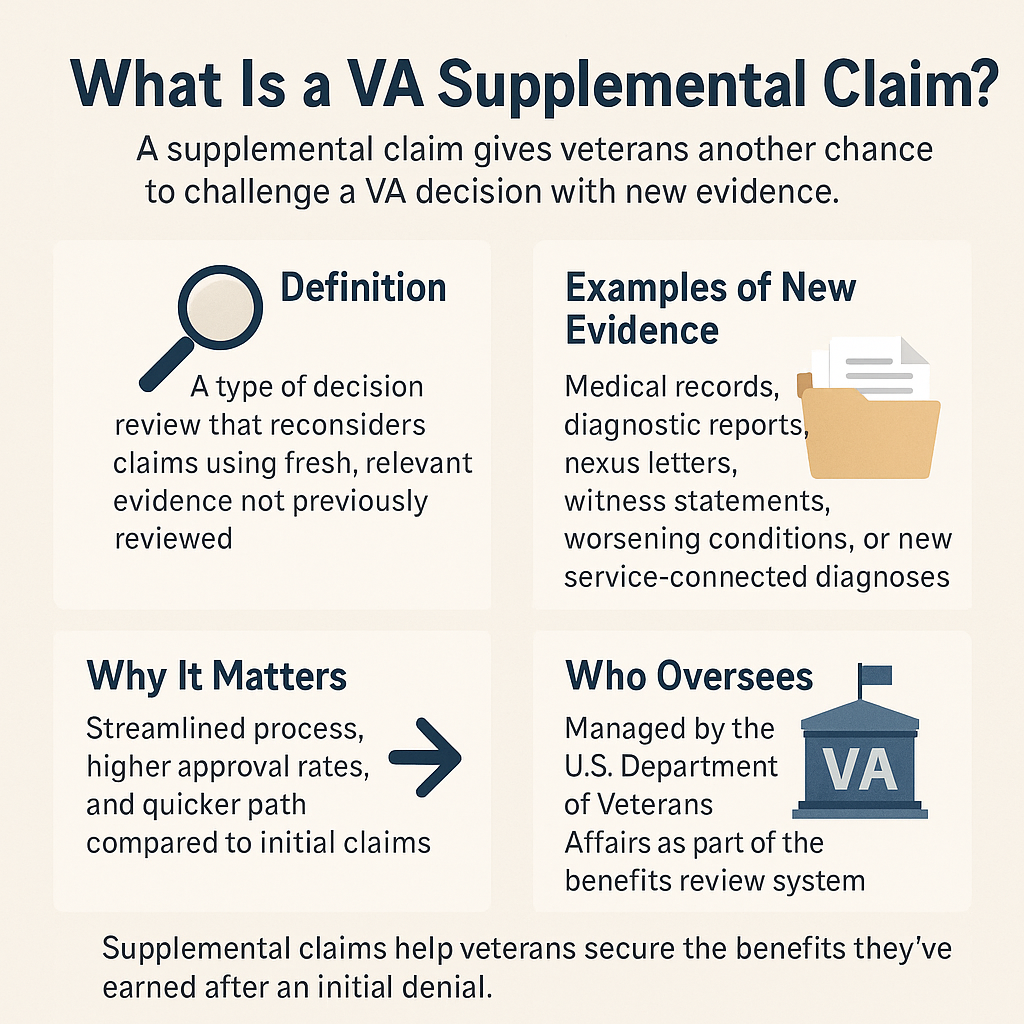
This appeal option is particularly valuable when you have:
- New medical records or diagnostic reports
- Expert medical opinions (nexus letters)
- Personal statements from witnesses
- Documentation of worsening conditions
- Evidence of previously undiagnosed service-connected conditions
- Note: The evidence submitted can include new documentation not previously considered in the original claim.
The key advantage of supplemental claims lies in their streamlined process and generally higher approval rates compared to initial claims, making them an attractive option for veterans seeking to overturn unfavorable decisions. The U.S. Department of Veterans Affairs oversees the disability claim process, and supplemental claims are a key tool for veterans to pursue VA benefits after an initial claim denial.
VA Supplemental Claim Success Rate: What the Numbers Tell Us
While the VA doesn’t publish official success rate statistics exclusively for VA supplemental claims, expert analyses and industry data provide valuable insights into their effectiveness. VA supplemental claims are a key part of the VA claims process for veterans seeking to overturn previous decisions and secure VA disability compensation. Successful supplemental claims can result in increased VA disability benefits for eligible veterans.
Current Success Rate Estimates
According to VA disability expert Brian Reese of VA Claims Insider, supplemental claims have an estimated success rate of approximately 50% when new and relevant evidence is properly submitted.
For Board of Veterans’ Appeals (BVA) appeals, the average success rate is around 38%, which provides important context for the likelihood of favorable outcomes compared to supplemental claims. Under the AMA appeals system, modernized appeals offer three structured options—Direct Review, Evidence Submission, and Hearing—each with different success rates depending on the type of appeal and the evidence provided.
The remand rate for BVA appeals is also a key metric, as a significant percentage of cases are sent back for further review or additional evidence before a final decision is made.
Comparative Success Rates
To understand how supplemental claims perform relative to other appeal options, consider these success rate comparisons:
- Supplemental Claims: 50-70% approval rate
- Higher-Level Reviews: ~50% success rate
Board Appeal (Board of Veterans’ Appeals):
- Direct Review: ~34% approval
- Evidence Submission: ~41% approval
- Formal Hearings: ~41% approval
Critical Factors That Influence VA Supplemental Claim Success Rates
1. New and Relevant Evidence Quality
This is the most crucial factor determining success. The VA requires evidence that is both “new” (not previously considered) and “relevant” (directly related to your claim). Simply resubmitting previously denied evidence will not improve your chances.
Types of High-Impact Evidence:
- Medical Records and Documentation
- Nexus Letters from Medical Professionals
- Lay Statements and Witness Testimony
2. Addressing Original Denial Reasons
Successful supplemental claims directly address the specific deficiencies cited in the initial decision as well as the original denial letter. Common denial reasons include:
- Lack of service connection evidence
- Insufficient medical documentation
- Missing nexus between service and current condition
- Inadequate proof of disability severity
Your new evidence must specifically counter these identified weaknesses to improve your supplemental claim success rate.
3. Timing of Submission
Filing your supplemental claim within one year of the original decision is crucial for preserving your effective date. This timing can result in significant retroactive benefits (back pay) if your claim is approved. Claims filed after one year typically receive an effective date from the new filing date, potentially costing thousands in lost benefits.
4. Professional Representation
Veterans working with a VA-accredited attorney or Veterans Service Officer (VSO) consistently achieve higher success rates.
The VA Supplemental Claim Process: Timeline and Steps
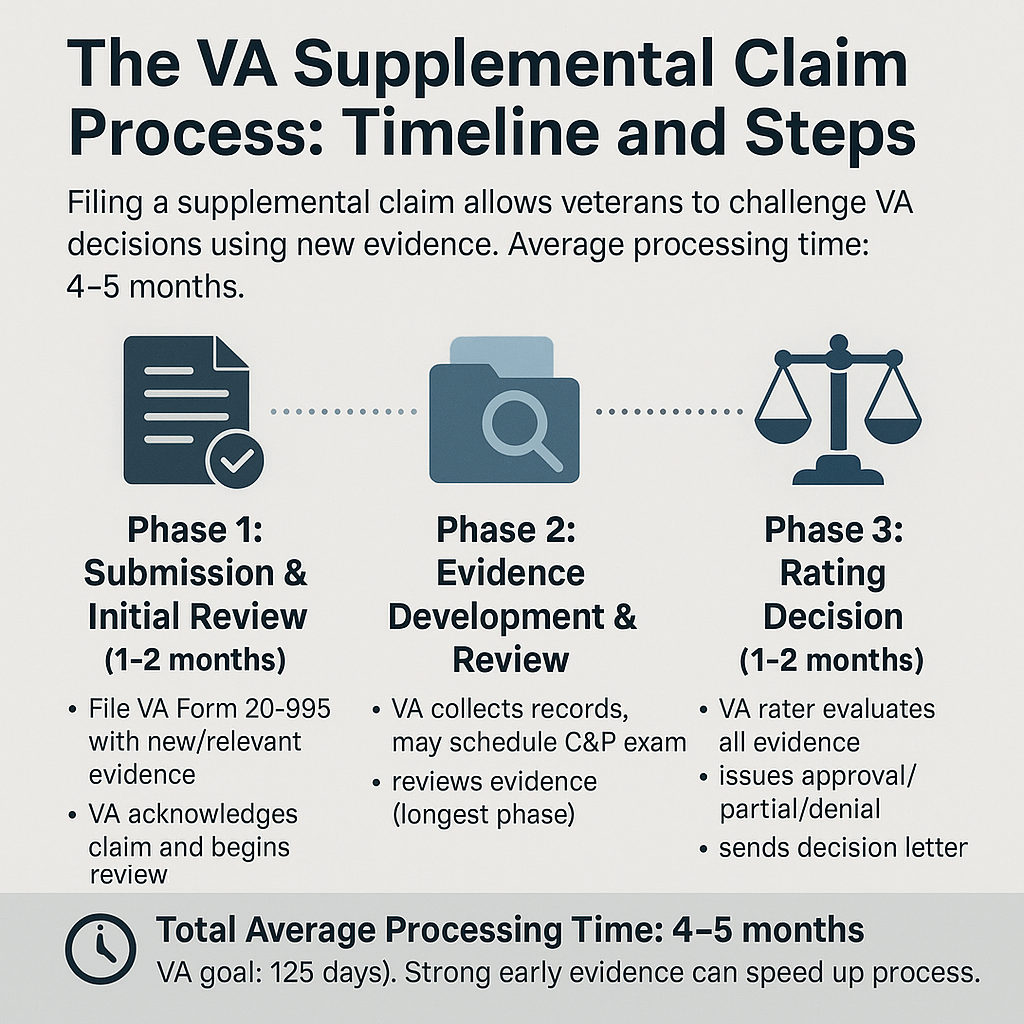
Phase 1: Submission and Initial Review (1-2 months)
- File VA Form 20-0995 with new and relevant evidence (Submitting strong medical evidence early can help process your claim quickly.)
- VA acknowledges receipt and begins initial case review (During this phase, the evidence allowed includes any new and relevant evidence not previously considered.)
- Additional evidence gathering if needed
Phase 2: Evidence Development and Review (2-4 months)
- Department of Veterans Affairs collects additional records as necessary
- Potential Compensation & Pension (C&P) exam scheduling
- Comprehensive evidence review and analysis
- Longest phase of the process
Phase 3: Rating Decision (1-2 months)
- VA rater evaluates all evidence
- Decision rendered: approval, partial approval, or denial
- Decision letter sent with explanation of outcome
Total Average Processing Time: 4-5 months (VA goal: 125 days for non-healthcare claims)
What Happens If Your Supplemental Claim Is Denied?
If your supplemental claim receives an unfavorable decision, you still have options under the Appeals Modernization Act.
File Another Supplemental Claim
- If you obtain additional new and relevant evidence
- No limit on the number of supplemental claims you can file
- Each must include genuinely new evidence
Request a Higher-Level Review
- For claims where you believe errors occurred in the review process
- No new evidence permitted
- Senior reviewer examines existing evidence for mistakes
Appeal to the Board of Veterans’ Appeals
- Formal review by a Veterans Law Judge
- Three docket options: Direct Review, Evidence Submission, or a formal hearing to present your case before the Board
- Typically longer processing times but formal legal review
The Impact of Recent Legislation on Success Rates
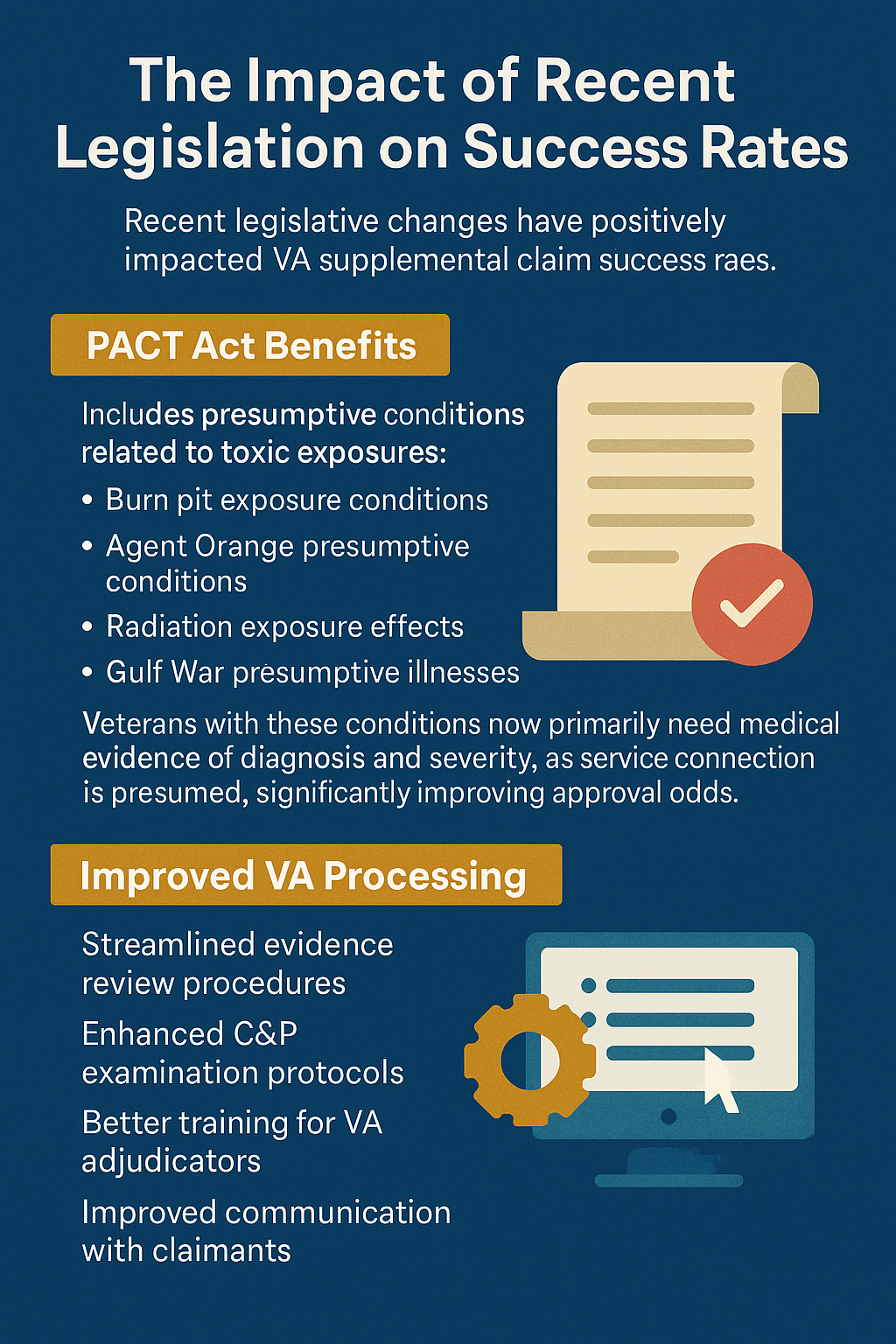
Recent legislative changes have positively impacted VA supplemental claim success rates:
PACT Act Benefits
The PACT Act has added numerous presumptive conditions related to toxic exposures, including:
- Burn pit exposure conditions
- Agent Orange presumptive conditions
- Radiation exposure effects
- Gulf War presumptive illnesses
Veterans with these conditions now primarily need medical evidence of diagnosis and severity, as service connection is presumed, significantly improving approval odds.
Improved VA Processing
- Streamlined evidence review procedures
- Enhanced C&P examination protocols
- Better training for VA adjudicators
- Improved communication with claimants
Example
Debbie, a Navy veteran, was denied service connection for her chronic back pain because her initial claim lacked a clear medical opinion linking it to her active duty. She then filed a supplemental claim, including a detailed nexus letter from her orthopedic specialist clearly stating her back condition was “at least as likely as not” due to her service-related duties, along with new MRI results showing worsened disc degeneration. This new and relevant evidence directly addressed the VA’s original denial reason, leading to her supplemental claim being approved.
Frequently Asked Questions
What is a VA supplemental claim?
A VA supplemental claim is an appeal option that allows veterans to challenge a previous VA decision by submitting new and relevant evidence that was not part of the initial review.
What is the typical success rate for VA supplemental claims?
While official VA statistics vary, expert analyses suggest that supplemental claims have an estimated success rate of 50-70% when compelling new and relevant evidence is properly submitted.
What kind of “new and relevant” evidence is needed for a supplemental claim?
New and relevant evidence can include recent medical records, new diagnostic test results, expert medical opinions (nexus letters), and detailed lay statements from witnesses or family members that were not previously considered by the VA.
How long does it take for the VA to process a supplemental claim?
The average processing time for a VA supplemental claim is typically 4-5 months, though it can vary. The VA’s goal is to complete non-healthcare related claims within 125 days.
What should I do if my VA supplemental claim is denied?
If your supplemental claim is denied, you have several options, including filing another supplemental claim with additional new evidence, requesting a Higher-Level Review, or appealing to the Board of Veterans’ Appeals.
How does the PACT Act impact VA supplemental claims?
The PACT Act has added numerous presumptive conditions for toxic exposures, simplifying the service connection requirement for many veterans. For these conditions, veterans primarily need to show a diagnosis and severity, which can significantly improve supplemental claim success rates.
Is professional representation necessary for a successful supplemental claim?
While not strictly necessary, veterans who work with a VA-accredited attorney or Veterans Service Officer (VSO) often achieve higher success rates due to their expertise in VA regulations, evidence gathering, and strategic claim presentation.
Your Path to Supplemental Claim Success
Don’t let a denied claim discourage you from pursuing the benefits you’ve earned. With proper preparation, quality evidence, and strategic approach, you can join the significant percentage of veterans who successfully overturn unfavorable VA decisions through the supplemental claim process.
 AllVeteran.com Advisors
With expertise spanning local, state, and federal benefit programs, our team is dedicated to guiding individuals towards the perfect program tailored to their unique circumstances.